

DOT Hazardous Materials Transportation Training Online
DOT HAZMAT Transportation: All-in-One Training (highway, air, rail, and vessel) provides comprehensive DOT-compliant instruction for employees who handle, package, ship, receive, load, unload, or transport hazardous materials (HAZMAT). This self-paced online course is designed to help HAZMAT employees satisfy applicable training requirements under 49 CFR 172.704 Subpart H, commonly associated with the HM-181 hazardous materials transportation regulations
Refund Policy: If for any reason you are unhappy or not satisfied with our courses or service, we will provide a full refund up to 30 days after purchase.
$195.00
Summary
The OSHACode® DOT Hazardous Materials Transportation Training Online course provides DOT-focused and is designed around 49 CFR Parts 171–180 and §172.704.
This self-paced online course teaches workers how to safely classify, package, mark, label, document, handle, and transport hazardous materials while maintaining federal transportation compliance. Training topics include shipping papers, DOT hazard classes, placards, labels, packaging requirements, emergency response information, and hazardous materials security awareness.
What Is DOT Hazardous Materials Training?
DOT Hazardous Materials Transportation Training is federally required training for employees whose job functions affect the safe transportation of hazardous materials. Under 49 CFR 172.704, these workers are classified as “HAZMAT employees” and must receive training covering general awareness, function-specific responsibilities, safety procedures, and security awareness.
DOT training helps workers understand how to properly:
- identify hazardous materials
- use the Hazardous Materials Table (HMT)
- classify hazardous substances
- package hazardous materials
- prepare shipping papers
- apply DOT labels and placards
- follow emergency response requirements
- comply with transportation security requirements
The goal of DOT HAZMAT training is to reduce the risk of spills, leaks, fires, explosions, environmental contamination, and transportation incidents involving hazardous materials.
Who Needs DOT HAZMAT Training?
DOT HAZMAT training is required for employees whose job functions directly affect the safe transportation of hazardous materials. This includes workers involved in shipping, packaging, labeling, marking, loading, unloading, handling, documenting, or transporting hazardous materials.
Workers commonly requiring DOT hazardous materials transportation training may include:
- shipping and receiving personnel
- warehouse workers
- package handlers
- drivers transporting hazardous materials
- environmental technicians
- logistics personnel
- hazardous waste personnel
- manufacturing employees
- emergency response personnel
- supervisors managing hazardous materials shipments
Training requirements apply across multiple industries including manufacturing, environmental services, construction, chemical operations, transportation, utilities, and hazardous waste management.
Function-Specific and Security Training
Employers are responsible for determining whether HAZMAT employees need additional function-specific or in-depth security training beyond the basic DOT hazardous materials training requirements. This determination should be based on each employee’s job duties, the hazardous materials handled, the transportation modes used, and whether the organization is required to maintain a DOT security plan under 49 CFR Part 172, Subpart I. Employers must ensure employees receive training appropriate to their assigned responsibilities and maintain documentation demonstrating compliance with the Hazardous Materials Regulations.

Regulatory Basis for DOT HAZMAT Training
DOT hazardous materials transportation training requirements are primarily governed by the U.S. Department of Transportation under 49 CFR Part 172 Subpart H. These regulations establish mandatory training requirements for HAZMAT employees involved in the transportation of hazardous materials. Employers are responsible for ensuring employees receive training appropriate to their assigned job functions and that training records are maintained properly.
DOT training requirements generally include:
- General awareness/familiarization training
- Function-specific training
- Safety training
- Security awareness training
- In-depth security training when applicable
Employees must typically complete training within 90 days of employment or assignment to a new HAZMAT function and receive recurrent training at least once every three years.
Why Workers Choose OSHACode
- DOT-focused hazardous materials transportation training
- Developed using real-world hazardous operations experience
- Practical DOT compliance instruction
- Interactive self-paced online delivery
- Mobile-friendly course access
- Immediate downloadable certificate
- Training designed for real-world HAZMAT operations

What You Will Learn
This DOT Hazardous Materials Transportation Training course provides practical instruction covering:
- Hazardous Materials Regulations (HMR)
- Hazard classification systems
- DOT hazard classes and divisions
- Proper shipping names
- Identification numbers (UN/NA)
- Packaging requirements
- Marking requirements
- Labeling requirements
- Placarding requirements
- Shipping papers
- Hazardous waste manifests
- Emergency response information
- Security awareness
- Loading and unloading procedures
- Carrier responsibilities
- Function-specific compliance requirements
The course is designed to help employees understand how to safely transport hazardous materials while maintaining compliance with federal DOT regulations.
DOT Hazard Classes
DOT regulations classify hazardous materials into nine hazard classes based on the type of risk presented during transportation. Workers involved in hazardous materials transportation should understand how these hazard classes affect packaging, labeling, placarding, segregation, and emergency response procedures.
DOT Hazard Classes include:
- Explosives
- Gases
- Flammable Liquids
- Flammable Solids
- Oxidizers and Organic Peroxides
- Toxic and Infectious Substances
- Radioactive Materials
- Corrosives
- Miscellaneous Hazardous Materials
Understanding hazard classes is critical for selecting proper packaging, shipping descriptions, labels, placards, and emergency response procedures.
Frequently Asked Questions
How often is DOT HAZMAT training required?
DOT generally requires recurrent HAZMAT training every three years under 49 CFR 172.704. Additional training may also be required whenever job functions change.
Can DOT HAZMAT training be completed online?
Yes. DOT hazardous materials transportation training may be completed online provided the training meets applicable regulatory requirements and includes testing to verify understanding.
What is a HAZMAT employee?
Under DOT regulations, a HAZMAT employee is any person whose job functions directly affect the safe transportation of hazardous materials. This includes employees involved in packaging, labeling, loading, unloading, documenting, or transporting hazardous materials.
What happens if employees do not receive DOT training?
Employees who do not complete required DOT HAZMAT training may not legally perform regulated hazardous materials job functions. Employers may face regulatory penalties, fines, and liability exposure if untrained employees handle hazardous materials.
What regulations govern DOT hazardous materials transportation training?
DOT hazardous materials transportation training requirements are primarily governed under 49 CFR Part 172 Subpart H and apply to employees involved in hazardous materials transportation operations.
Accreditation
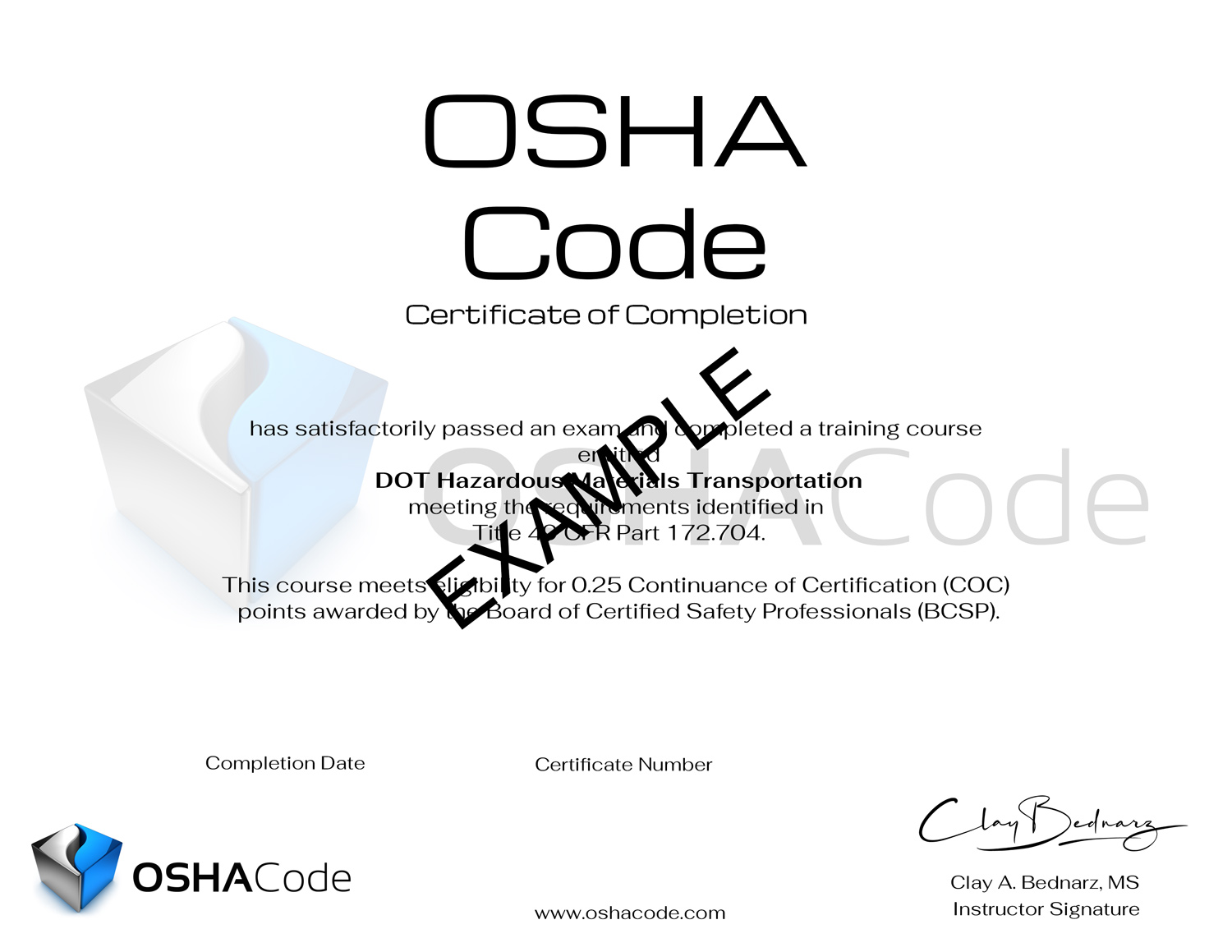
This course meets the eligibility for Continuance of Certification (COC) points awarded by the Board of Certified Safety Professionals (BCSP).
Also, for the following organizations, our courses may be eligible for technical contact hours or re-certification points:
• Board for Global EHS Credentialing (Formerly The American Board of Industrial Hygiene)
• American Council for Accredited Certification (ACAC)
DOT Training vs HAZWOPER Training
While DOT training focuses on the transportation of hazardous materials, HAZWOPER training addresses hazardous waste operations and emergency response. DOT training is required for shipping and logistics roles, while HAZWOPER applies to site cleanup, remediation, and emergency response environments.
Understanding the difference ensures that workers receive the appropriate training based on their job duties and regulatory requirements.
Course Features and Benefits
This DOT training course is designed for flexibility and real-world application. The program is fully online, allowing learners to complete training at their own pace while maintaining engagement through structured modules and assessments.
The course includes professional narration, interactive content, and knowledge checks that reinforce critical concepts. Upon successful completion, learners receive a certificate documenting compliance with DOT training requirements.
Course Outline
Course Introduction
-
Welcome and course objectives
-
Importance of DOT hazmat transportation training
-
Overview of 49 CFR Hazardous Materials Regulations (HMR)
-
Who must be trained (shippers, carriers, handlers, managers, emergency response staff)
-
Training requirements under 49 CFR §172.704 (General awareness, Function-specific, Safety, Security awareness, In-depth security training if required)
Module 1: Understanding Hazardous Materials Regulations
-
Purpose of DOT’s Hazardous Materials Regulations (HMR)
-
Key agencies involved (DOT, PHMSA, FAA, FMCSA, Coast Guard, FRA)
-
Definitions: hazardous materials, dangerous goods, hazmat employee
-
Training frequency and recordkeeping requirements
-
Penalties for non-compliance
Module 2: Hazardous Materials Classification
-
Nine hazard classes and associated divisions
-
Understanding packing groups (I, II, III)
-
Identifying hazardous substances, marine pollutants, elevated temperature materials
-
Special cases (limited quantities, excepted quantities)
-
Examples of commonly shipped hazardous materials
Module 3: Hazard Communication Requirements
-
Shipping papers and required information (Basic Description sequence: UN/NA ID, proper shipping name, hazard class, packing group)
-
Emergency response information (ERG references)
-
Marking requirements (general and specific)
-
Labeling requirements (hazard labels vs. handling labels)
-
Placarding requirements (design, display, exceptions, bulk vs. non-bulk)
-
Relationship between DOT hazmat communication and OSHA HazCom
Module 4: Packaging and Containment
-
General packaging requirements (performance standards under 49 CFR Part 173)
-
Authorized packaging (UN specification vs. non-specification)
-
Bulk vs. non-bulk packaging requirements
-
Closure instructions and manufacturer’s responsibilities
-
Special provisions for certain classes (explosives, radioactive, infectious substances)
-
Reuse, reconditioning, and retesting of packagings
Module 5: Transportation Modes and Modal Requirements
-
Highway transportation (FMCSA rules)
-
Rail transportation (FRA requirements)
-
Air transportation (ICAO/IATA alignment with DOT rules)
-
Vessel transportation (IMDG Code and U.S. Coast Guard requirements)
-
Intermodal considerations and international shipments
Module 6: Safety and Security Requirements
-
Employee safety practices when handling hazmat
-
Personal protective equipment (PPE) considerations
-
Safe handling, loading, unloading, and segregation of hazardous materials
-
Security awareness training under 49 CFR §172.704(a)(4)
-
In-depth security plan requirements (for certain high-risk materials)
-
Real-world incidents and lessons learned
Module 7: Emergency Response and Incident Reporting
-
Recognizing hazmat emergencies during transport
-
Using the DOT Emergency Response Guidebook (ERG)
-
Spill response procedures and notification requirements
-
Reporting releases and incidents to DOT (49 CFR §171.15 & §171.16)
-
Coordination with local emergency responders
-
Case studies of transportation accidents
Module 8: Function-Specific Training
-
Shipper responsibilities: classification, packaging, marking, labeling, shipping papers
-
Carrier responsibilities: accepting shipments, vehicle placarding, handling and stowage
-
Driver responsibilities: inspections, segregation, documentation in cab
-
Warehouse/handler responsibilities: loading, unloading, storage-in-transit
-
Customized content for industry-specific roles (e.g., waste transporters, fuel delivery, lab shipments)
Final Exam
-
Course review and key takeaways
Certification
After successfully passing a final exam, you can immediately download your official certificate. A copy is stored in our site database should you need additional copies. View Certificate Example


Related Training
Additional OSHACode® courses commonly associated with hazardous materials operations include: