
Summary
HAZWOPER — Hazardous Waste Operations and Emergency Response — is OSHA’s federal safety standard under 29 CFR 1910.120. It applies to workers involved in hazardous waste site cleanup, facility operations, and emergency response. Training requirements range from 24 to 40 hours depending on job role, with an 8-hour annual refresher required to maintain compliance.
Key Takeaways
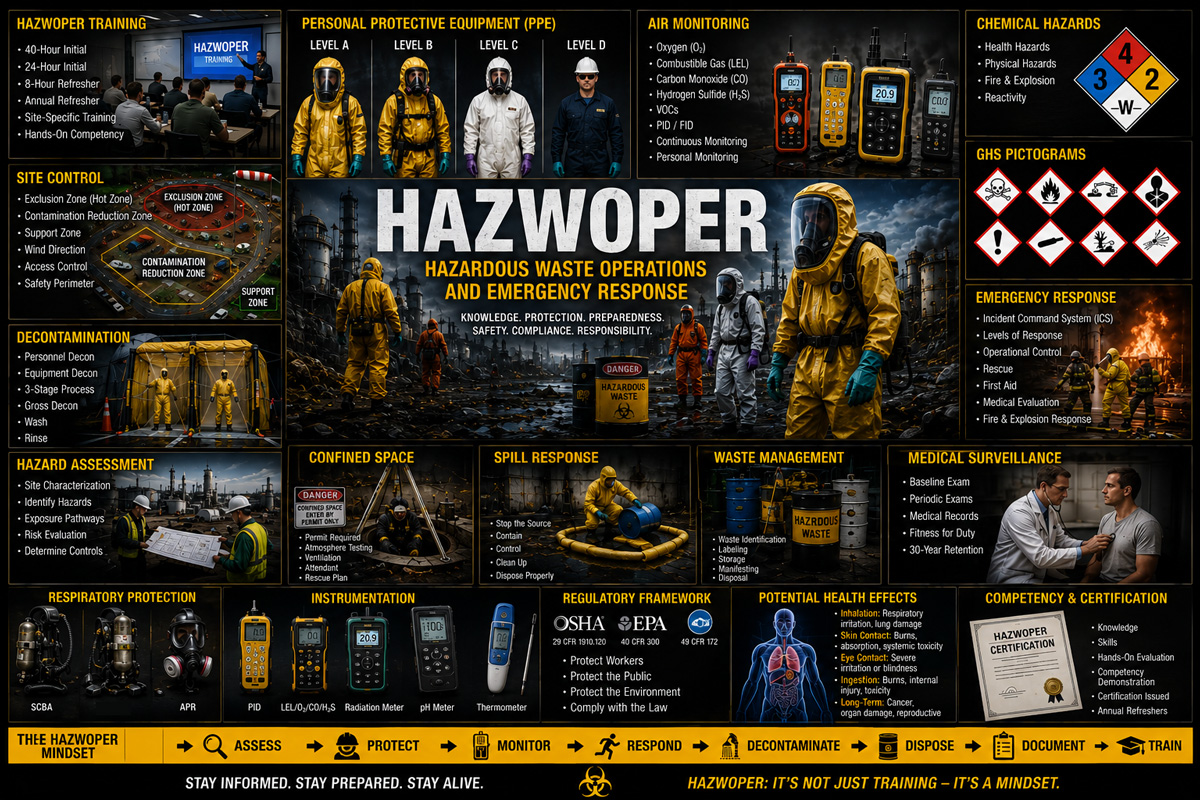
- HAZWOPER stands for Hazardous Waste Operations and Emergency Response under OSHA 29 CFR 1910.120.
- The standard protects workers involved in hazardous waste cleanup, emergency response, and hazardous substance operations.
- HAZWOPER commonly applies to cleanup sites, RCRA corrective actions, TSDF operations, emergency response, and certain voluntary cleanup activities.
- Training requirements vary by job duties and may include 40 Hour HAZWOPER, 24 Hour HAZWOPER, and annual refresher training.
- Employers must provide appropriate training, PPE, site control procedures, and site-specific safety instruction.
Complete HAZWOPER at a Glance
| HAZWOPER Topic | Requirement |
|---|---|
| OSHA Standard | 29 CFR 1910.120 |
| Construction Equivalent | 29 CFR 1926.65 |
| 40-Hour Training | General Site Workers |
| 24-Hour Training | Occasional Site Workers |
| Annual Refresher | 8 Hours |
| Field Experience | 3 Days (40 Hour) / 1 Day (24 Hour) |
| Primary PPE Levels | A, B, C and D |
| Employer Requirement | Site-Specific Training |
What HAZWOPER Covers

What HAZWOPER Does Not Cover
| Covered | Not Covered |
|---|---|
| Superfund cleanup | Routine manufacturing |
| Hazardous waste remediation | Normal construction on clean sites |
| TSDF operations | Routine laboratory work (unless covered activities exist) |
| Emergency response | Incidental spills handled safely by employees |
| Hazardous substance releases | Ordinary maintenance |
When Did HAZWOPER Start?

What Does HAZWOPER Mean?
HAZWOPER stands for Hazardous Waste Operations and Emergency Response. It is the federal worker safety standard issued by the Occupational Safety and Health Administration (OSHA) under 29 CFR 1910.120, finalized in 1989 and effective in 1990. HAZWOPER establishes mandatory training, protective equipment, medical surveillance, and site safety requirements for workers who may be exposed to hazardous substances during cleanup operations, facility work, and emergency response incidents. If you work near hazardous waste — or respond to chemical emergencies — HAZWOPER almost certainly applies to you.
If you are searching for the meaning of HAZWOPER, the short answer is this: it is OSHA training and safety requirements for hazardous waste operations and emergency response work.
Why Was HAZWOPER Created?
HAZWOPER was developed after growing national concern over dangerous hazardous waste sites, chemical spills, toxic contamination, and worker injuries. The regulation was designed to ensure that workers entering hazardous environments receive proper training, personal protective equipment, medical surveillance, and site safety protections.
Today, HAZWOPER remains a core safety standard for workers who may encounter:
- Chemical releases
- Contaminated soil or groundwater
- Hazardous waste containers
- Toxic vapors or gases
- Unknown substances
- Emergency spill situations
The Five Categories Covered by HAZWOPER
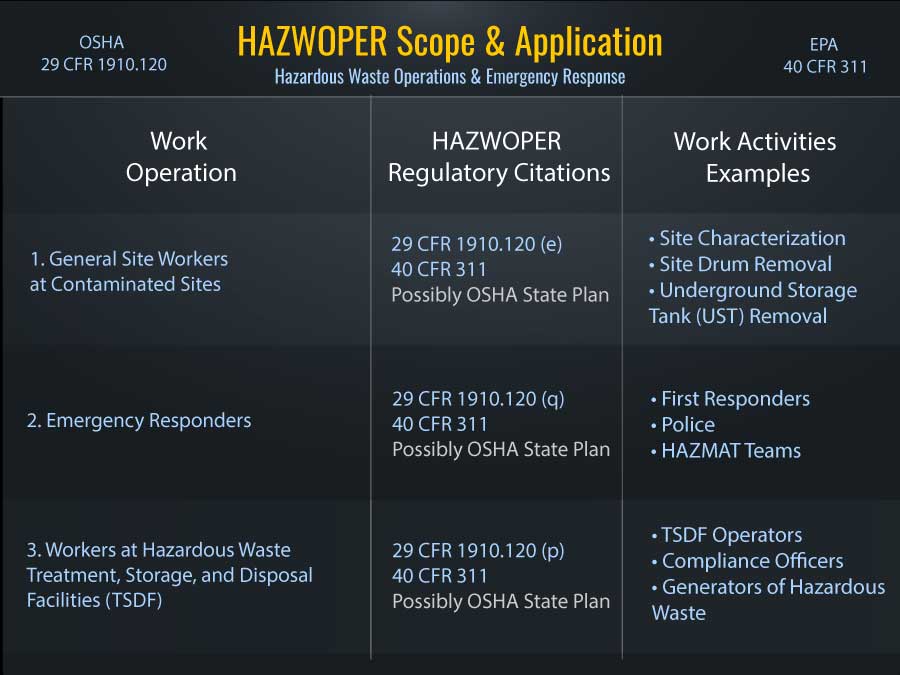
The scope of HAZWOPER defines which operations and job activities fall under the protection of 29 CFR 1910.120. HAZWOPER applies to five major categories of work involving hazardous substances. Understanding which category applies to your operation is the first step toward determining the correct training level and employer obligations.
1. Uncontrolled Hazardous Waste Site Cleanup
This is the most common application of HAZWOPER and it is found at 29 CFR 1910.120(e). It covers cleanup operations at abandoned, inactive, or uncontrolled hazardous waste sites where hazardous substances have been deposited, stored, disposed of, or placed — or where they have otherwise come to be located.
These sites are characterized by unknown or poorly documented contamination, unpredictable exposure risks, and the absence of active regulatory controls that would otherwise protect workers.
Common examples include:
- Former industrial or manufacturing properties with soil or groundwater contamination
- Abandoned landfills containing unknown or mixed waste streams
- Chemical disposal areas from prior industrial activity
- Brownfield redevelopment sites undergoing environmental investigation or remediation
- Superfund sites under Environmental Protection Agency (EPA) oversight or state environmental agency authority
- Underground storage tank removal and soil remediation projects
Who is typically affected: Environmental contractors, remediation technicians, site laborers, equipment operators, and their direct supervisors. Any worker with a reasonable possibility of exposure to hazardous substances at these sites falls under HAZWOPER.
Key compliance note: The “uncontrolled” designation does not mean the site lacks a cleanup plan — it means the contamination itself is not under active regulatory containment. Even well-managed Superfund sites with detailed work plans are covered.
2. Corrective Action at Hazardous Waste Facilities
Active hazardous waste facilities operating under RCRA (Resource Conservation and Recovery Act) permits may be required to investigate and remediate releases of hazardous waste or contamination. When workers are conducting this corrective action work — rather than routine facility operations — HAZWOPER applies.
Common examples include:
- Investigation of soil or groundwater releases at permitted Treatment, Storage, and Disposal Facilities (TSDFs)
- Cleanup of past disposal areas within an active facility’s boundary
- Remediation work triggered by RCRA corrective action orders
Who is typically affected: Environmental engineers, remediation crews, and facility workers assigned to investigation or cleanup tasks that go beyond normal permitted operations.
Key compliance note: This category is often misunderstood. Workers at an active RCRA facility performing routine permitted operations may not need HAZWOPER training. The requirement is triggered when they move into corrective action — investigating or cleaning up a release. Employers should evaluate each job function individually.
3. Treatment, Storage, and Disposal Facilities (TSDFs)
Employees working at facilities that treat, store, or dispose of hazardous waste under RCRA may require HAZWOPER training depending on their specific duties and exposure potential. This applies to the ongoing operations of the facility itself, not just corrective action activities.
Common facility types include:
- Commercial hazardous waste treatment and disposal facilities
- Industrial facilities with on-site hazardous waste storage units
- Incinerators handling hazardous waste streams
- Landfills with hazardous waste disposal cells
- Facilities managing hazardous waste under RCRA interim status or final permits
Who is typically affected: Facility operators, waste handlers, lab technicians, loading and unloading crews, and maintenance workers with potential exposure to hazardous waste streams.
Key compliance note: Not every employee at a TSDF automatically needs HAZWOPER training. OSHA requires it for workers who are exposed or potentially exposed to hazardous substances, health hazards, or safety hazards. Administrative staff and workers in areas with no reasonable exposure potential may not be covered — but employers must document that determination.
4. Emergency Response to Hazardous Substance Releases
Workers who respond to unplanned releases of hazardous substances — whether at industrial facilities, transportation incidents, or public emergencies — fall under the emergency response provisions of HAZWOPER at 29 CFR 1910.120(q).
This section covers a wide range of responders, from industrial plant emergency teams to public sector hazardous materials (HAZMAT) units.
Common examples include:
- Industrial facility emergency response brigades handling chemical releases
- HAZMAT teams responding to transportation accidents involving hazardous cargo
- Fire departments with HAZMAT response responsibilities
- Specialized spill response contractors
- Utility and pipeline emergency response crews
- Public works personnel responding to chemical releases in municipal systems
Who is typically affected: The regulation establishes five distinct responder levels under this category, each with different training requirements:
| Responder Level | Primary Role | Typical Minimum Training | Response Limitation |
|---|---|---|---|
| First Responder Awareness | Recognizes a hazardous-substance release and notifies appropriate personnel. | Sufficient awareness training. | Does not take action to stop or contain the release. |
| First Responder Operations | Takes defensive actions to protect people, property, or the environment. | At least 8 hours or sufficient demonstrated competency. | Defensive response only; does not plug, patch, or stop the release source. |
| Hazardous Materials Technician | Responds aggressively to stop or control the release. | At least 24 hours of training appropriate to technician duties. | Requires specialized PPE, monitoring, decontamination, and incident procedures. |
| Hazardous Materials Specialist | Provides advanced technical support for specific hazardous substances or processes. | At least 24 hours plus specialized substance- or process-specific training. | Supports technician-level response with deeper technical expertise. |
| On-Scene Incident Commander | Directs the emergency response and coordinates resources. | At least 24 hours plus incident-command training. | Responsible for command, safety, communications, and overall response coordination. |
Key compliance note: Emergency response training under 29 CFR 1910.120(q) is separate from the 40-hour and 24-hour cleanup training. Responders must meet the requirements for their specific level. Many organizations maintain both cleanup-trained workers and separately trained emergency responders.
5. Voluntary Cleanup Operations
Certain voluntary site cleanup or brownfield redevelopment projects — those undertaken without a government mandate — may still trigger HAZWOPER requirements if workers are exposed or potentially exposed to hazardous substances during the work.
Common examples include:
- Voluntary brownfield cleanups pursued for redevelopment purposes
- Property owners proactively remediating contamination prior to a real estate transaction
- Environmental due diligence activities that escalate into active remediation
- State voluntary cleanup program participants
Who is typically affected: Environmental consultants, remediation contractors, and site workers involved in active soil or groundwater remediation, even when no regulatory order has been issued.
Key compliance note: The voluntary nature of the cleanup does not exempt the employer from HAZWOPER. If workers are exposed or potentially exposed to hazardous substances, the standard applies regardless of whether the cleanup is court-ordered, permit-required, or entirely voluntary.
Training Topics
The OSHA HAZWOPER regulations contain 17 different sections on topics such as hazard recognition and protection, medical monitoring, air monitoring, site control, decontamination, and emergency response. These provide safeguards for individual workers but also supports environmental protection and regulatory compliance.
HAZWOPER Training Levels
HAZWOPER training is not one-size-fits-all. OSHA established distinct training levels under 29 CFR 1910.120 based on the type of work performed, the degree of exposure potential, and the worker’s role on site. Employers are responsible for evaluating each job function and assigning the correct level before workers enter covered operations.
There are three primary training levels and they are for contaminated sites, emergency response, and RCRA TSDF personnel.
Contaminated Sites
40-Hour HAZWOPER Training
Required under: 29 CFR 1910.120(e)(3)(i)
The 40-hour course is the most common and most recognized HAZWOPER certification. It is required for general site workers — those who are regularly present at uncontrolled hazardous waste sites and have a reasonable possibility of exposure to hazardous substances at or above permissible exposure limits.
Who needs it:
- Remediation technicians and laborers working directly in contaminated areas
- Equipment operators at hazardous waste cleanup sites
- Hazardous waste handlers with regular hands-on duties
- Supervisors who directly oversee general site workers
What it covers: The 40-hour course addresses the full scope of HAZWOPER requirements, including:
- Hazard recognition and toxicology
- Air monitoring and sampling
- Personal protective equipment selection and use
- Levels of PPE (A, B, C, and D)
- Decontamination procedures
- Site characterization and control
- Health and safety plan development
- Emergency response planning
- Medical surveillance requirements
- Confined space awareness
- Drum and container handling
- Regulatory overview of 29 CFR 1910.120
Field experience requirement: In addition to the 40 hours of instruction, OSHA requires a minimum of 3 days of actual field experience under the supervision of a trained, experienced supervisor. This hands-on component cannot be completed online and must occur in an actual or simulated field environment.
Annual refresher: Workers must complete an 8-hour annual refresher every 12 months to maintain compliance. Missing the refresher deadline may require repeating the full 40-hour course.
| Detail | Requirement |
| Instructional hours | 40 hours |
| Field experience | 3 days supervised |
| Annual refresher | 8 hours |
| CFR citation | 29 CFR 1910.120(e)(3)(i) |
| Renewal frequency | Every 12 months |
24-Hour HAZWOPER Training
Required under: 29 CFR 1910.120(e)(3)(ii)
The 24-hour course applies to occasional site workers — those who visit covered hazardous waste sites infrequently and whose duties do not involve working in areas where exposure above permissible exposure limits is expected.
This level is often misapplied. Employers sometimes assign 24-hour training to workers who, based on their actual duties, should be receiving 40-hour training. OSHA evaluates coverage based on actual exposure potential, not job title.
Who needs it:
- Environmental consultants conducting periodic site visits for assessment purposes
- Geologists or engineers performing sampling with limited hands-on contact
- Health and safety officers who visit sites occasionally but do not perform cleanup work
- Workers with limited task assignments well away from active contamination zones
What it covers: The 24-hour course covers the same core subject areas as the 40-hour course but at a reduced depth appropriate for workers with lower exposure potential. It is not a shortcut version of the 40-hour — it is a genuinely different scope of training designed for a different role.
Field experience requirement: OSHA requires a minimum of 1 day of actual field experience under qualified supervision, in addition to the 24 hours of instruction.
Annual refresher: The same 8-hour annual refresher requirement applies. Workers who allow their refresher to lapse may need to repeat the full 24-hour initial training.
| Detail | Requirement |
| Instructional hours | 24 hours |
| Field experience | 1 day supervised |
| Annual refresher | 8 hours |
| CFR citation | 29 CFR 1910.120(e)(3)(ii) |
| Renewal frequency | Every 12 months |
8-Hour HAZWOPER Annual Refresher
Required under: 29 CFR 1910.120(e)(8)
The 8-hour annual refresher is required for all workers who have completed either the 40-hour or 24-hour initial training. It must be completed within 12 months of the initial training completion date — and then every 12 months thereafter without interruption.
The refresher is not optional and is not a formality. OSHA designed it to ensure workers stay current with updated safety practices, regulatory changes, new hazard recognition techniques, and lessons learned from incidents in the field.
What it covers:
- Review of core HAZWOPER topics from initial training
- Updates to OSHA regulations and guidance
- New or revised PPE requirements and technologies
- Incident reviews and case studies
- Site-specific hazard awareness updates
- Emergency response protocol reviews
Can it be taken online? Yes. The 8-hour refresher can be completed entirely online, unlike the initial training which requires a hands-on field component. This makes it the most flexible of the three training levels to maintain.
What happens if it lapses? If a worker misses the 12-month window, they fall out of compliance. Many employers and site safety officers require workers to repeat the full initial training — 40-hour or 24-hour — before allowing them back on a covered site. Some employers accept a late refresher with documentation, but this is a site-specific decision, not an OSHA allowance.
| Detail | Requirement |
| Instructional hours | 8 hours |
| Field experience | None required |
| Applies to | All 40-hr and 24-hr trained workers |
| CFR citation | 29 CFR 1910.120(e)(8) |
| Renewal frequency | Every 12 months |
Supervisor Training
Required under: 29 CFR 1910.120(e)(4)
Supervisors and managers directly responsible for workers engaged in hazardous waste operations must receive the same level of training as the workers they supervise — plus an additional 8 hours of specialized management and supervision training.
This means a supervisor overseeing 40-hour trained workers needs 40 hours of general training plus 8 hours of supervisor-specific content, for a total of 48 hours of initial training.
Supervisor training topics include:
- Personnel management at hazardous waste sites
- Implementing site safety and health plans
- Hazard recognition and control from a supervisory perspective
- Emergency response coordination
- Worker monitoring and exposure assessment oversight
- Regulatory compliance responsibilities
Emergency Response Training
Required under: 29 CFR 1910.120(q)
Workers who respond to hazardous substance releases — rather than performing planned cleanup operations — fall under a separate emergency response training track. This track is organized by responder level, each with its own minimum training requirement.
This is distinct from the 40-hour and 24-hour cleanup training. A worker can be trained under both tracks if their duties include both planned site work and emergency response.
| Responder Level | Minimum Training | Key Responsibility |
|---|---|---|
| First Responder Awareness | Awareness-level training | Recognize and report releases only. |
| First Responder Operations | 8 hours | Perform defensive containment actions. |
| Hazardous Materials Technician | 24 hours | Actively stop or control the release. |
| Hazardous Materials Specialist | 24 or more hours of specialized training | Provide advanced technical and command support. |
| On-Scene Incident Commander | 24 hours plus incident command system training | Direct the overall emergency response. |
RCRA TSDF Training
Required under: 29 CFR 1910.120(p)
Workers employed at facilities that treat, store, or dispose of hazardous waste under RCRA fall under a distinct section of the HAZWOPER standard — 29 CFR 1910.120(p). This section is separate from the uncontrolled hazardous waste site provisions covered under 29 CFR 1910.120(e), and it carries its own specific training requirements designed for the controlled but high-risk environment of a permitted TSDF.
Unlike cleanup workers operating at uncontrolled or abandoned sites, TSDF employees work within active, permitted facilities where hazardous waste is routinely handled as part of normal operations. The hazards are no less serious — workers may be exposed to toxic, corrosive, flammable, or reactive materials on a daily basis — but the regulatory framework recognizes that these environments operate under established controls and documented waste streams.
Who Is Covered
HAZWOPER 29 CFR 1910.120(p) applies to employees at TSDF facilities who are exposed or potentially exposed to hazardous waste or health hazards during the course of their work. This includes:
- Facility operators who handle or manage hazardous waste containers, tanks, surface impoundments, or waste piles
- Workers involved in loading, unloading, or transferring hazardous waste
- Maintenance personnel who service equipment in areas where hazardous substances are present
- Laboratory technicians performing waste characterization or analysis
- Emergency response personnel at the facility level
- Supervisors and managers who oversee any of the above
Not every employee at a TSDF facility falls under this section. Administrative staff, security personnel, and workers with no reasonable probability of exposure are generally not required to receive HAZWOPER TSDF training. However, employers bear the responsibility of making that determination through a documented hazard assessment — and OSHA has historically interpreted exposure potential broadly.
Training Requirements
The TSDF training requirements under 29 CFR 1910.120(p) differ from the 40-hour and 24-hour site worker requirements in both structure and focus. Rather than prescribing a fixed number of training hours, the regulation requires that training be designed to inform workers about the specific hazards present at that facility, the procedures and controls in place to protect them, and the emergency response procedures applicable to their role.
Initial Training All covered employees must receive initial HAZWOPER TSDF training before they are permitted to work in areas where they may be exposed to hazardous waste. Training must cover the hazards specific to the facility, the properties and risks of the waste streams handled, safe work practices and engineering controls, the use of personal protective equipment, and the facility’s emergency response plan.
Annual Refresher Covered employees must complete an annual refresher to maintain their training currency. Unlike the 40-hour and 24-hour tracks, the TSDF refresher does not carry a fixed hourly minimum under 29 CFR 1910.120(p) — but training must be sufficient to ensure workers remain competent in the hazards and procedures relevant to their role. Most employers use an 8-hour format to align with the refresher standard applied across other HAZWOPER tracks.
Supervisor Training Supervisors at TSDF facilities who directly oversee workers exposed to hazardous waste must receive the same training as the employees they supervise, plus additional training to ensure they can manage safe work operations, implement the facility’s health and safety plan, and respond appropriately to emergencies.
How TSDF Training Differs from 40-Hour HAZWOPER
This is one of the most commonly misunderstood distinctions in HAZWOPER compliance. The two tracks cover different regulatory sections and different work environments.
A worker trained under the 40-hour HAZWOPER contaminated site standard is not automatically qualified to work at a TSDF under 29 CFR 1910.120(p), and vice versa. Employers operating TSDFs must evaluate each employee’s role and ensure their training aligns with the correct regulatory section
The Employer’s Responsibility
OSHA places the compliance burden squarely on the employer. Under 29 CFR 1910.120(p), employers operating TSDF facilities must:
- Develop and implement a written safety and health program specific to the facility
- Conduct and document a hazard assessment for each job classification
- Provide initial and annual refresher training to all covered employees before exposure
- Maintain training records for each employee
- Ensure that emergency response procedures are in place and that all employees know their role within them
- Provide appropriate personal protective equipment at no cost to the employee
Training certificates from a third-party course provider do not fulfill the TSDF-specific training requirement on their own. Facility-specific hazard information, site-specific procedures, and emergency response protocols must be incorporated into the training program. Employers who rely solely on a generic online course without facility-specific content risk non-compliance even if employees hold current certificates.
Key Compliance Note
If a TSDF facility undertakes corrective action — investigating or cleaning up a release of hazardous waste — that work triggers the corrective action provisions under 29 CFR 1910.120(c), which may require workers to meet the training requirements of the uncontrolled site sections as well. Employers conducting both routine TSDF operations and corrective action work must evaluate which regulatory provisions apply to each activity and ensure workers are trained accordingly.
| Feature | 40-Hour HAZWOPER §1910.120(e) |
RCRA TSDF §1910.120(p) |
|---|---|---|
| Work Environment | Uncontrolled hazardous waste sites. | Permitted treatment, storage, and disposal facilities. |
| Fixed Training Hours | Yes — 40 hours for general site workers with routine or substantial potential exposure. | No — training must be based on the employee’s duties, hazards, and role. |
| Field Experience | Three days of supervised field experience. | Not specifically prescribed by §1910.120(p). |
| Annual Refresher | 8 hours annually. | Sufficient training to maintain competency, generally provided annually. |
| Corrective Action Work | Covered when the work meets the hazardous waste site cleanup criteria under §1910.120(e). | A separate provision may apply depending on the facility operation and corrective-action activity. |
Important: The applicable HAZWOPER provision depends on the nature of the operation, employee duties, anticipated exposure, and site conditions. Employers should evaluate each role and provide training appropriate to the actual work being performed.
Does HAZWOPER Apply to Your Operation?
If you are uncertain whether HAZWOPER covers your work, the practical test is straightforward: Are workers exposed or potentially exposed to hazardous substances during the operation? If the answer is yes — or even possibly yes — employers should assume coverage applies and conduct a formal hazard assessment before concluding otherwise.
OSHA has consistently interpreted HAZWOPER broadly. Underestimating coverage creates regulatory liability and, more importantly, leaves workers unprotected in high-risk environments.
Who Needs HAZWOPER Training?
| Job | Typical Course |
|---|---|
| Environmental Consultant | 40 Hour |
| Remediation Contractor | 40 Hour |
| Hazardous Waste Technician | 40 Hour |
| TSDF Worker | 24 Hour TSDF |
| Emergency Responder | HAZWOPER Emergency Response |
| Utility Worker | Depends on exposure |
| Excavation Contractor | Depends on contamination |
| Industrial Maintenance | Depends on duties |
Common HAZWOPER Misconceptions
- HAZWOPER is not simply a certification.
- HAZWOPER is not the same as DOT HAZMAT.
- OSHA 10 is not HAZWOPER.
- OSHA 30 is not HAZWOPER.
- Online training alone does not satisfy all HAZWOPER requirements.
- Every hazardous waste generator does not automatically require HAZWOPER.
Related OSHA Standards
| OSHA Standard | Topic |
|---|---|
| 1910.120 | HAZWOPER |
| 1910.1200 | Hazard Communication |
| 1910.134 | Respiratory Protection |
| 1910.146 | Confined Space |
| 1910.147 | Lockout/Tagout |
| 1910.132 | PPE |
How to Choose the Right Training Level
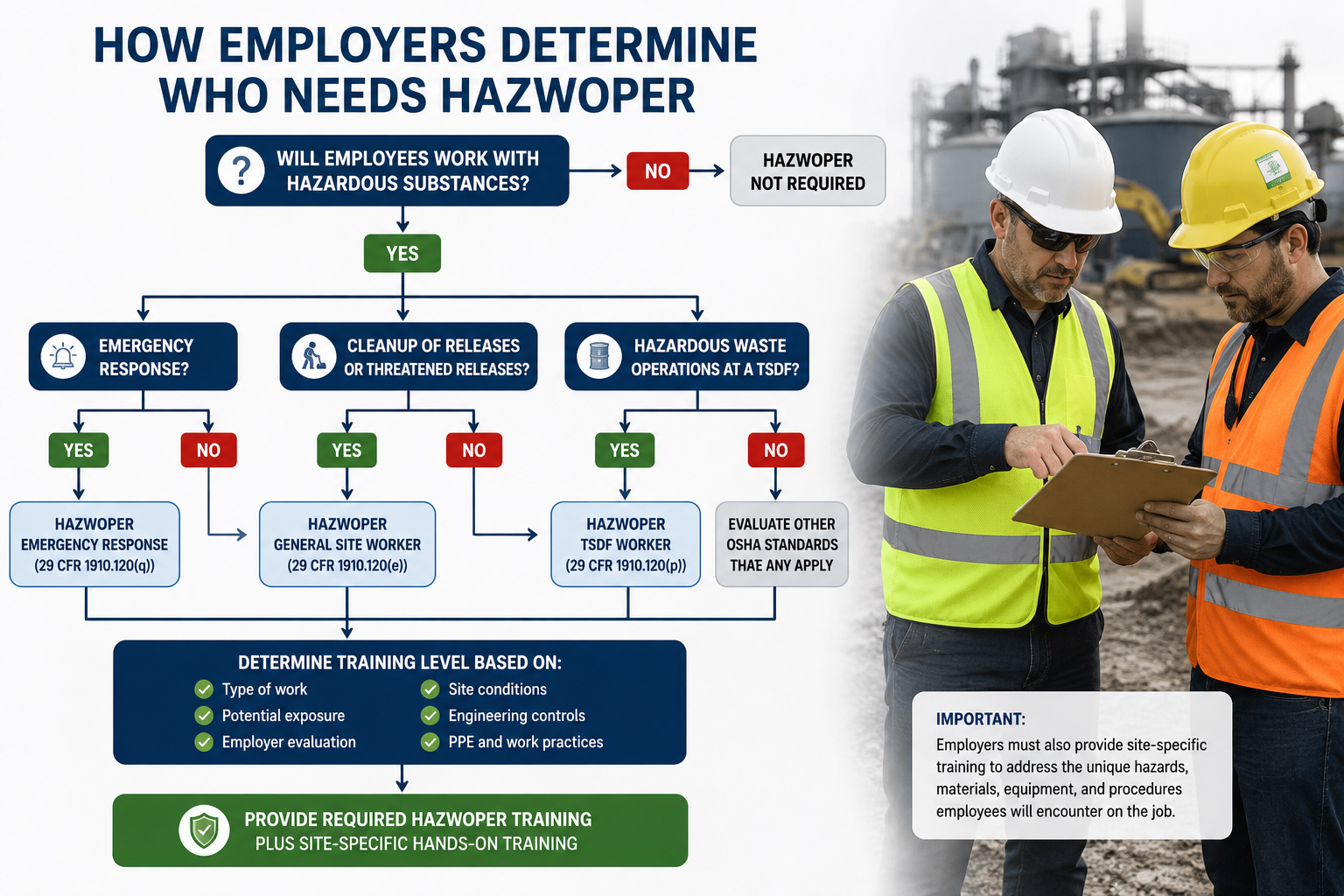
Employers — not workers — are responsible for determining which training level applies. The decision should be based on a written hazard assessment that considers:
- The nature and concentration of hazardous substances present
- The worker’s specific job duties and physical location on site
- The frequency and duration of potential exposure
- Whether the work involves active cleanup or only observation and assessment
When in doubt, OSHA’s general guidance is to assign the higher training level. The cost difference between 24-hour and 40-hour training is far smaller than the liability exposure of under-training a worker who is subsequently injured.
What Employers Are Required To Do
Depending on the operation, employers may need to provide:
- Required HAZWOPER training
- Site-specific safety briefings
- Personal protective equipment
- Medical surveillance
- Air monitoring
- Decontamination procedures
- Emergency response planning
- Supervised field experience where applicable
Training certificates alone do not replace employer responsibilities for site-specific safety compliance.
Training Level Quick Reference
| Training Level | CFR Citation | Hours | Field Experience | Annual Refresher | Best For |
|---|---|---|---|---|---|
| 40-Hour HAZWOPER | 29 CFR 1910.120(e)(3)(i) | 40 hours instruction | 3 days supervised | 8 hours annually | Regular site workers at uncontrolled hazardous waste sites with significant exposure potential. |
| 24-Hour HAZWOPER | 29 CFR 1910.120(e)(3)(ii) | 24 hours instruction | 1 day supervised | 8 hours annually | Occasional site visitors or workers with limited exposure potential at uncontrolled hazardous waste sites. |
| RCRA TSDF | 29 CFR 1910.120(p) | Hazard and role based — no fixed minimum | Not specified | Sufficient to maintain competency — commonly 8 hours annually | Employees at permitted treatment, storage, and disposal facilities handling hazardous waste as part of routine operations. |
| Supervisor Training | 29 CFR 1910.120(e)(4) | Same level as supervised employees plus 8 additional hours | Same field experience required for the supervised worker category | 8 hours annually | Direct supervisors of workers at uncontrolled hazardous waste sites. |
| Emergency Response | 29 CFR 1910.120(q) | 8 to 24+ hours depending on responder level | Varies by assigned response level and duties | Annually, based on assigned response level | Workers responding to unplanned hazardous substance releases. |
| 8-Hour Annual Refresher | 29 CFR 1910.120(e)(8) | 8 hours | None required | N/A — this is the refresher | All 40-hour and 24-hour trained workers maintaining annual compliance. |
State-Specific HAZWOPER Training Requirements
HAZWOPER is a federal OSHA standard under 29 CFR 1910.120, which means its training requirements apply nationwide. However, workers in state-plan states — the 22 states and territories that operate their own OSHA-approved occupational safety programs — may be subject to additional or more stringent requirements than the federal baseline. State plan agencies must adopt standards that are at least as effective as federal OSHA, but they are permitted to exceed federal requirements in scope, specificity, or enforcement.
For example, California’s Division of Occupational Safety and Health (Cal/OSHA) maintains its own hazardous waste operations regulations under Title 8 CCR Section 5192, which parallels 29 CFR 1910.120 but includes state-specific enforcement priorities and agency oversight. Workers and employers operating in state-plan states should verify compliance with both the federal standard and any applicable state-level requirements. Regardless of state, the core HAZWOPER training levels — 40-hour, 24-hour, and the annual 8-hour refresher — remain the compliance foundation for covered operations.
Is OSHA 40 the Same As OSHA 30?
Many people search for OSHA 40, but in most cases they mean 40-Hour HAZWOPER training. HAZWOPER is different from OSHA Outreach programs such as OSHA 10 or OSHA 30.
| Training Type | Purpose |
| 40-Hour HAZWOPER | Hazardous waste operations training |
| 24-Hour HAZWOPER | Limited hazardous waste operations duties |
| OSHA 10 – construction or general industry | Basic worker awareness |
| OSHA 30 – construction or general industry | Broader supervisory safety topics |
Final Thoughts
HAZWOPER means more than just a training course. It is a complete worker protection system designed to reduce injuries and illnesses during hazardous waste operations and emergency response work. Understanding the scope and application of HAZWOPER helps employers assign the correct training and helps workers stay safer in high-risk environments.
FAQs
What does HAZWOPER stand for?
HAZWOPER stands for Hazardous Waste Operations and Emergency Response.
Is HAZWOPER required by OSHA?
Yes, for covered operations under 29 CFR 1910.120.
Who needs HAZWOPER certification?
Workers involved in hazardous waste cleanup, certain hazardous waste facilities, or emergency response operations may need training.
How long is HAZWOPER certification good for?
Initial HAZWOPER certification does not expire on a fixed schedule, but workers must complete an 8-hour annual refresher every 12 months to maintain compliance under 29 CFR 1910.120(e)(8). If the refresher lapses, the worker may be required to repeat the full initial training before returning to covered operations.
Is HAZWOPER the same as HAZMAT?
No. HAZWOPER and HAZMAT are related but distinct. HAZWOPER is the OSHA regulatory standard governing worker safety during hazardous waste operations and emergency response. HAZMAT refers broadly to hazardous materials and the teams or personnel who handle them. A HAZMAT team operates under HAZWOPER’s emergency response provisions, but not all HAZWOPER-covered workers are HAZMAT responders.
What happens if my HAZWOPER certification expires?
If a worker’s annual 8-hour refresher is not completed on time, they are considered out of compliance with 29 CFR 1910.120. Depending on the employer’s interpretation and the site’s requirements, this can mean the worker must either complete the refresher immediately or repeat the full 40-hour or 24-hour initial training before being permitted back on a covered site.
Can HAZWOPER training be taken online?
Yes, for the instructional portion. OSHA allows the classroom component of HAZWOPER training to be completed online. However, OSHA also requires hands-on field experience — three days for 40-hour trainees and one day for 24-hour trainees — which must be completed under qualified supervision in an actual or simulated field setting. Online training alone does not satisfy the full HAZWOPER requirement.
Does HAZWOPER apply to construction workers?
It can. Construction workers who perform remediation, excavation, or demolition at sites with known or suspected hazardous contamination may fall under HAZWOPER. The determining factor is whether the work involves hazardous substances at or above permissible exposure limits, or at uncontrolled hazardous waste sites. Standard construction activity on clean sites is not covered by HAZWOPER.
What is the difference between 40-hour and 24-hour HAZWOPER?
The 40-hour course is required for general site workers who are regularly exposed to hazardous substances or work at uncontrolled hazardous waste sites with significant exposure potential. The 24-hour course applies to occasional site workers — those who visit covered sites infrequently and are unlikely to be exposed above permissible exposure limits. Employers are responsible for determining which level applies based on job duties and expected exposure.
What operations are NOT covered by HAZWOPER?
HAZWOPER does not apply to routine hazardous waste operations at facilities operating under RCRA permits where workers are not exposed above action levels or permissible exposure limits, and proper engineering controls are in place. It also does not cover incidental spills that can be cleaned up immediately by the employees who caused them, using available equipment, without evacuation. When in doubt, employers should conduct a formal hazard assessment before concluding HAZWOPER does not apply.
Who is responsible for ensuring HAZWOPER compliance — the employer or the worker?
The employer bears primary responsibility under 29 CFR 1910.120. Employers must assess whether operations are covered, assign appropriate training levels, provide personal protective equipment, conduct medical surveillance, develop a site safety and health plan, and ensure all required training is current before workers enter covered areas. Workers are responsible for completing assigned training and following site safety procedures, but the regulatory obligation rests with the employer.
Frequently Searched HAZWOPER Terms
HAZWOPER
HAZWOPER meaning
HAZWOPER definition
HAZWOPER certification
HAZWOPER training
40 Hour HAZWOPER
24 Hour HAZWOPER
8 Hour Refresher
HAZWOPER PPE
HAZWOPER Standard
1910.120
Emergency Response
Hazardous Waste Operations
Site Safety and Health Plan
Medical Surveillance
Need HAZWOPER Training?
Get certified online with courses built on 30+ years of real-world EHS field experience.
✓ 40-Hour HAZWOPER
✓ 24-Hour HAZWOPER
✓ 8-Hour Annual Refresher
100% online · Self-paced · Instant certificate
Sources
Emergency Response and Preparedness
OSHA HAZWOPER Hands-on Training Requirement
Medical Surveillance Requirements
U.S. Occupational Safety and Health Administration
https://www.osha.gov/laws-regs/standardinterpretations/1992-08-27-1
U.S. Environmental Protection Agency
https://www.epa.gov/laws-regulations/summary-resource-conservation-and-recovery-act
Related Articles
Building a HAZWOPER Safety Culture
About the Author
This article was written by Clay A. Bednarz, MS, RPIH, founder of National Environmental Trainers® and OSHACode®. Bednarz pioneered the first commercial online HAZWOPER training programs in 1998 and has supported major hazardous waste operations, environmental remediation projects, and emergency response training initiatives nationwide.