Competent Person Excavation, Trenching and Shoring Training Online
The OSHACode® Competent Person Excavation, Trenching and Shoring Training Online course provides OSHA-focused excavation safety training covering trenching operations, soil classification, protective systems, and competent person responsibilities under 29 CFR 1926 Subpart P.
This self-paced online course teaches workers how to identify excavation hazards, conduct trench inspections, evaluate soil conditions, implement sloping and shoring systems, recognize cave-in risks, and maintain OSHA excavation safety compliance. Training topics include trench protective systems, spoil pile placement, hazardous atmospheres, underground utilities, access and egress requirements, and daily excavation inspections.
Refund Policy: If for any reason you are unhappy or not satisfied with our courses or service, we will provide a full refund up to 30 days after purchase.
Group discounts: discounts for 3 or more people. Discounts applied at the time of purchase.
$90.00
What Is Competent Person Excavation Training?
Our training teaches workers how to identify excavation hazards, classify soil conditions, inspect trenching operations, and implement protective systems designed to prevent cave-ins and other excavation-related incidents. OSHA requires excavation sites to be inspected daily by a competent person capable of identifying existing and predictable hazards and authorized to take prompt corrective action.
Under OSHA regulations, a “competent person” is someone who:
- can identify excavation hazards
- understands soil classification methods
- recognizes unsafe conditions
- evaluates trench protective systems
- has authority to stop work and correct hazards immediately
Excavation competent persons play a critical role in protecting workers from trench collapses, hazardous atmospheres, underground utility strikes, water accumulation, falling loads, and protective system failures.
OSHA Regulatory Basis for Excavation and Trenching Safety
Excavation and trenching safety requirements are governed primarily by OSHA 29 CFR 1926 Subpart P – Excavations. These regulations establish minimum safety requirements for excavation operations, trenching activities, soil classification, sloping, benching, shoring, shielding systems, inspections, and protective systems used on construction sites.
OSHA requires daily inspections of excavations, adjacent areas, and protective systems by a competent person before work begins and throughout the shift as conditions change. Additional inspections are required following rainstorms, vibrations, surcharge loading, or other hazard-increasing events.
OSHA excavation regulations also require:
- protective systems for trenches 5 feet deep or greater unless stable rock is present
- safe access and egress for trenches 4 feet deep or greater
- atmospheric testing where hazardous atmospheres may exist
- utility locating before excavation begins
- proper spoil pile placement
- employee protection from water accumulation and falling loads
The OSHA excavation standard places significant responsibility on the competent person to recognize hazards and ensure excavation operations remain safe and compliant.
Who Needs Competent Person Excavation Training?
This training is commonly required for workers responsible for supervising excavation activities or evaluating trench safety conditions. Employees who may benefit from this training include:
- construction supervisors
- foremen
- utility contractors
- excavation crews
- trenching personnel
- site safety officers
- project managers
- underground utility workers
- pipeline crews
- municipal workers
- environmental remediation personnel
Workers involved in trenching and excavation operations should understand how to recognize cave-in hazards, classify soils, evaluate protective systems, inspect excavation sites, and comply with OSHA excavation safety requirements.
OSHA Definition of a Competent Person
Under OSHA 29 CFR 1926.650, a competent person is defined as:
“One who is capable of identifying existing and predictable hazards in the surroundings or working conditions which are unsanitary, hazardous, or dangerous to employees, and who has authorization to take prompt corrective measures to eliminate them.”
For excavation operations, the competent person is responsible for inspecting trenches, evaluating soil conditions, monitoring protective systems, identifying hazardous conditions, and ensuring employees are protected from cave-ins and excavation-related hazards.
Accreditation
This course meets the eligibility for Continuance of Certification (COC) points awarded by the Board of Certified Safety Professionals (BCSP).
Also, for the following organizations, our courses may be eligible for technical contact hours or re-certification points:
• Board for Global EHS Credentialing (Formerly The American Board of Industrial Hygiene)
• American Council for Accredited Certification (ACAC)
Course Description
Become the safety expert your excavation crew depends on with our Competent Person – Excavation, Trenching & Shoring Training, a comprehensive course designed to meet OSHA’s requirements under 29 CFR 1926 Subpart P. This in-depth program teaches workers, supervisors, and field leaders how to recognize excavation hazards, classify soil, select proper protective systems, and conduct the daily inspections required on every trenching operation. If your role involves overseeing trenches, working around excavation sites, or ensuring compliance on construction projects, this course provides the essential knowledge and authority needed to serve as your jobsite’s designated Competent Person.
Through step-by-step instruction, real-world scenarios, and visual learning tools, participants learn how to prevent cave-ins, identify unsafe conditions, evaluate trench stability, assess water intrusion, and address atmospheric hazards such as oxygen deficiency and toxic gases. The course also explains OSHA’s requirements for access and egress, spoil pile placement, underground utility locating, and emergency procedures. By the end of the training, you will understand how to confidently apply stop-work authority, document conditions, and implement corrective actions to keep your team safe and compliant.
Ideal for construction supervisors, foremen, safety professionals, and excavation crews, this Competent Person training provides a strong foundation for reducing jobsite risks and preventing costly violations. Whether you’re expanding your safety responsibilities or formalizing your qualifications, this OSHA-aligned course equips you with the skills and knowledge to protect workers, maintain regulatory compliance, and ensure every trenching operation is performed safely and efficiently.
Course Outline
Module 1 — Introduction to Excavation Safety
1.1 Course Purpose and Objectives
-
Define the role of a Competent Person under OSHA Subpart P
-
Understand regulatory requirements and employer responsibilities
1.2 Definitions & Key Concepts
-
Excavation, trench, shoring, shielding, sloping
-
Cave-in
-
Protective system
-
Access/egress
-
Hazard exposure
1.3 Legal Framework
-
OSHA 29 CFR 1926.650–652
-
OSHA General Duty Clause relevance
-
State-plan variations
Module 2 — Competent Person Authority & Responsibilities
2.1 OSHA Definition of a Competent Person
-
Ability to identify existing and predictable hazards
-
Authority to take prompt corrective measures
2.2 Duties in the Field
-
Daily inspections
-
Continuous hazard monitoring
-
Documentation
-
Stop-work authority
2.3 When a Site Requires More Than One Competent Person
-
Multi-employer worksites
-
Large-scale trenching operations
Module 3 — Soil Classification & Analysis
3.1 OSHA Soil Types (A, B, C)
-
Characteristics
-
Impact on trench stability
3.2 Visual & Manual Soil Tests
-
Plasticity
-
Fissures
-
Water content
-
Layering
3.3 Manual Field Testing Methods
-
Pocket penetrometer
-
Shear vane tester
-
Thumb test
-
Dry strength test
3.4 Documenting Soil Classification
-
Required documentation
-
Site-specific records
-
Variability across the site
Module 4 — Excavation Hazards & Risk Assessment
4.1 Common Excavation Hazards
-
Cave-ins
-
Water accumulation
-
Adjacent structure instability
-
Vibrations (equipment, traffic)
-
Hazardous atmospheres (oxygen deficiency, toxic gases)
-
Underground utilities
4.2 Jobsite Hazard Assessment Process
-
Pre-excavation surveys
-
Daily inspections
-
Environmental conditions
-
Equipment hazards
4.3 Case Studies: Fatal and Near-Miss Incidents
-
OSHA fatality summaries
-
Lessons learned
Module 5 — Protective Systems
5.1 Overview of Protective System Requirements
-
Required when trench is 5 ft or deeper
-
Required at <5 ft if a cave-in hazard exists
5.2 Sloping & Benching Systems
-
Type A, B, C soil angle requirements
-
Configurations and limitations
5.3 Shoring Systems
-
Hydraulic shores
-
Timber shoring
-
Aluminum hydraulic shoring
-
Installation and removal procedures
5.4 Shielding Systems (Trench Boxes)
-
Use, placement, and depth limitations
-
Manufacturer’s tabulated data
-
Transition areas (in/out of the box)
5.5 Designing Protective Systems
-
Using tabulated data
-
Using pre-engineered systems
-
Custom designs by a registered professional engineer
Module 6 — Access, Egress & Traffic Control
6.1 Ladders and Ramps
-
Ladder spacing every 25 ft of lateral travel
-
Ladder extension above trench edge
6.2 Walkways & Crossovers
-
Guardrail requirements
-
Structural integrity
6.3 Protection from Mobile Equipment
-
Barricades
-
Spotters
-
Warning systems
Module 7 — Atmospheric Hazards & Monitoring
7.1 Hazardous Atmospheres in Excavations
-
Oxygen deficiency
-
Hydrogen sulfide
-
Methane
-
VOCs
7.2 Atmospheric Monitoring Equipment
-
Calibration
-
Bump testing
-
Continuous vs. periodic monitoring
7.3 Ventilation & Engineering Controls
-
Fans / blowers
-
Purging
-
Hot work precautions
Module 8 — Water Accumulation & Emergency Situations
8.1 Water Control Procedures
-
Pumps
-
Diversions
-
Well points
-
Special considerations for Type C soil
8.2 Emergency Rescue Planning
-
Competent Person’s role during emergencies
-
Engulfment rescue hazards
-
Controlled access points
8.3 Severe Weather Considerations
-
Rain
-
Freezing
-
Flooding potential
Module 9 — Utility Locating & Underground Installations
9.1 811 Requirements
9.2 Locating and Exposing Utilities
-
Hand-digging
-
Vacuum excavation
9.3 Support Systems for Adjacent Structures
-
Foundations
-
Roadways
-
Poles
-
Pipelines
Module 10 — Inspection Requirements
10.1 Daily Inspections
-
Start-of-shift
-
After rain
-
After vibration events
-
After hazard notifications
10.2 Inspection Documentation
-
Forms
-
Logs
-
Photography
-
Corrective actions
10.3 Frequency and Triggers
-
Continuous during exposure
-
Post-incident inspections
Module 11 — Safe Work Practices
11.1 Spoil Pile Requirements
-
2 ft minimum setback
-
Soil weight considerations
11.2 Equipment Operation Near Excavations
-
Undercutting
-
Bench collapse hazards
11.3 Worker Positioning and Communication
-
No working under loads
-
Communication protocols
Final Exam
Certificate
After successfully passing a final exam, you can immediately download your official certificate. A copy is stored in our site database should you need additional copies. View Certificate Example
Soil Classification and Protective Systems
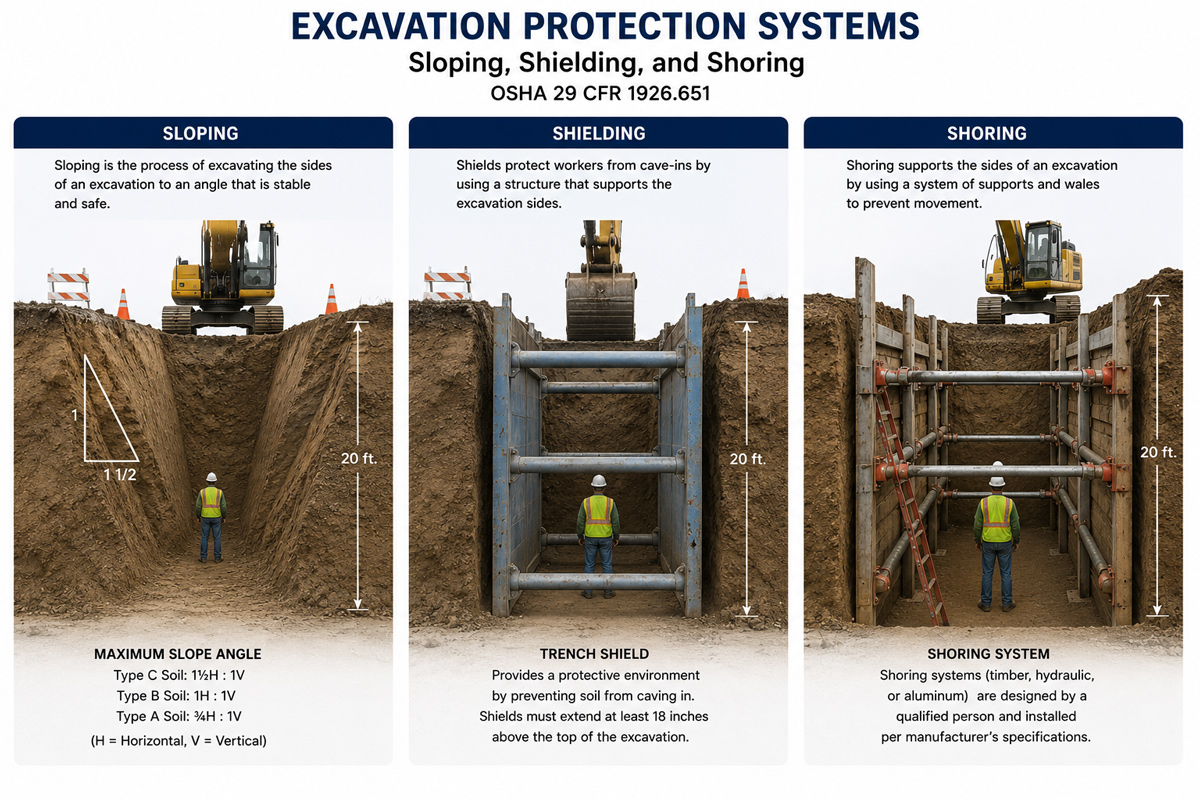
Proper soil classification is one of the most important responsibilities of the excavation competent person because soil conditions directly affect trench stability and protective system selection. OSHA classifies soils into four categories:
- Stable Rock
- Type A Soil
- Type B Soil
- Type C Soil
Soil classification must be based on at least one visual analysis and one manual analysis before selecting sloping, benching, shoring, or shielding systems.
Protective systems commonly discussed in excavation training include:
- sloping systems
- benching systems
- hydraulic shoring
- timber shoring
- trench boxes
- shielding systems
The competent person must understand how soil conditions, surcharge loads, water accumulation, adjacent structures, and vibration hazards can affect excavation stability.
Common Excavation and Trenching Hazards
Excavation and trenching operations expose workers to numerous potentially fatal hazards including:
- trench cave-ins
- falling loads
- hazardous atmospheres
- engulfment hazards
- underground utility strikes
- water accumulation
- equipment hazards
- falling materials
- vibration hazards
- inadequate access and egress
Cave-ins remain one of the leading causes of fatalities during excavation operations because soil can collapse suddenly and exert thousands of pounds of force on trapped workers. OSHA excavation safety requirements are intended to reduce the risk of these incidents through proper planning, inspections, soil evaluation, and protective systems.
Common Causes of Trench Cave-Ins
Common causes of trench cave-ins typically involve:
- improper soil classification
- water accumulation
- vibration
- surcharge loads
- inadequate protective systems
- weather conditions
- nearby traffic/equipment
What You Will Learn
This training course covers:
- OSHA 29 CFR 1926 Subpart P requirements
- Competent person responsibilities
- Soil classification procedures
- Visual and manual soil testing
- Sloping and benching requirements
- Hydraulic shoring systems
- Trench boxes and shielding systems
- Daily excavation inspections
- Protective system requirements
- Utility locating procedures
- Hazardous atmospheres in excavations
- Water accumulation hazards
- Access and egress requirements
- Spoil pile placement
- Emergency response considerations
The course is designed to help workers understand excavation hazards and implement OSHA-compliant excavation safety procedures.
Why Workers Choose OSHACode
- OSHA-focused excavation safety training
- Practical trenching and shoring instruction
- Real-world hazard recognition emphasis
- Self-paced online flexibility
- Interactive safety-focused modules
- Mobile-friendly course access
- Immediate downloadable certificate

FAQs
What is a competent person in excavation safety?
A competent person is an individual capable of identifying excavation hazards and authorized to take immediate corrective action to eliminate unsafe conditions. OSHA requires competent person inspections during trenching and excavation operations.
Does OSHA require a competent person for trenching operations?
Yes. OSHA requires excavations, adjacent areas, and protective systems to be inspected daily by a competent person before employees enter excavation areas and as conditions change throughout the shift.
What depth trench requires protective systems?
OSHA generally requires protective systems for trenches 5 feet deep or greater unless the excavation is made entirely in stable rock.
What are the main types of excavation protective systems?
Common excavation protective systems include:
- sloping
- benching
- shoring
- shielding systems
- trench boxes
The appropriate system depends on soil classification, trench depth, surrounding conditions, and site-specific hazards.
Does this course cover soil classification?
Yes. This course covers OSHA soil classification requirements including Stable Rock, Type A, Type B, and Type C soils along with visual and manual soil testing procedures.
Daily Excavation Inspection Requirements
OSHA requires excavations, trenches, adjacent areas, and protective systems to be inspected daily by a competent person before workers enter the excavation and throughout the shift as conditions change. These inspection requirements are outlined under 29 CFR 1926.651 and are intended to help identify hazards that could lead to cave-ins, hazardous atmospheres, water accumulation, falling loads, or other dangerous excavation conditions.
Daily excavation inspections should evaluate soil stability, trench protective systems, spoil pile placement, access and egress, underground utility exposure, water intrusion, hazardous atmospheres, vibration sources, and nearby equipment operations that could affect excavation stability. Additional inspections are required after rainstorms, freeze-thaw cycles, vibrations, surcharge loading, or any event that may increase the risk of excavation failure.
The competent person must have the authority to stop work and implement corrective actions whenever hazardous conditions are identified. Excavation work should not continue until unsafe conditions are corrected and workers can safely enter the trench or excavation area. Proper daily inspections are one of the most important elements of OSHA excavation safety compliance and help reduce the risk of trench collapses and serious worker injuries.