
Summary
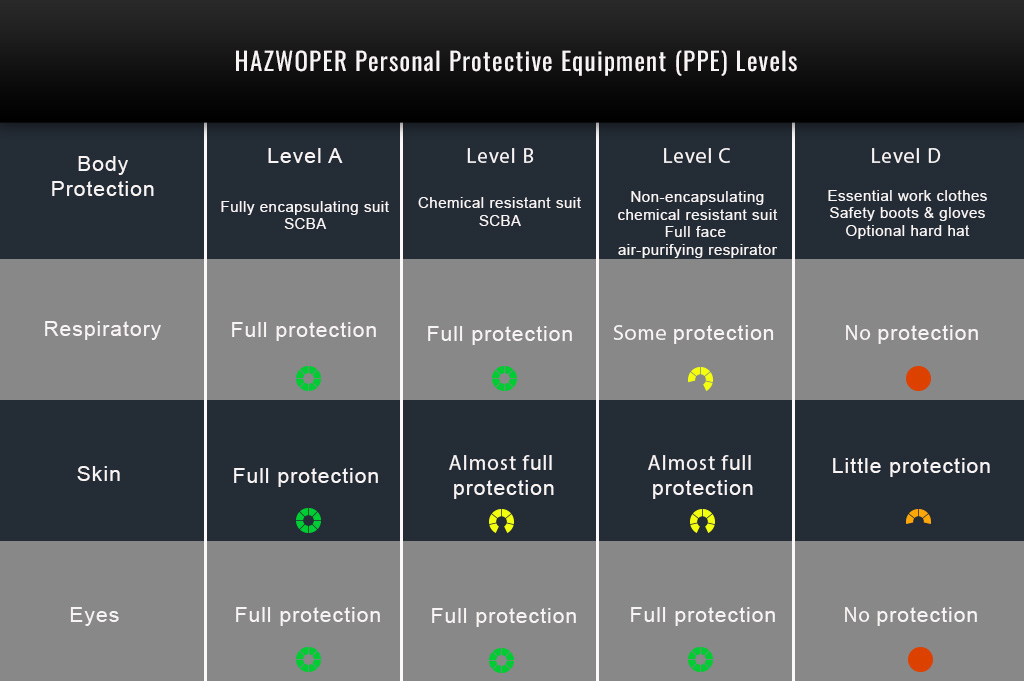
OSHA’s HAZWOPER PPE levels define the minimum protective clothing and respiratory equipment workers must wear when performing hazardous waste operations and emergency response activities. HAZWOPER requires employers to assign one of four PPE levels to workers based on the hazards present at the site. Level A provides maximum protection against vapors, gases, and skin contact using a fully encapsulating gas-tight suit and SCBA. Level B provides maximum respiratory protection with a non-encapsulating splash suit. Level C uses an air-purifying respirator where airborne hazards are known and controlled. Level D is standard work clothing for non-hazardous or fully characterized environments. The site’s HASP determines which level applies — and selecting the wrong level is one of the most common HAZWOPER compliance failures.
Key Takeaways
- HAZWOPER PPE levels are designed to protect workers from hazardous substances encountered during hazardous waste operations and emergency response activities.
- OSHA recognizes four PPE levels: Level A, Level B, Level C, and Level D.
- Level A PPE provides the highest level of respiratory and skin protection through a fully encapsulating chemical-resistant suit and SCBA.
- Level B PPE provides the highest level of respiratory protection but less skin protection than Level A.
- Level C PPE uses an air-purifying respirator (APR) and is appropriate only when contaminants are known and oxygen levels are adequate.
- Level D PPE consists of standard work clothing and offers minimal protection against chemical hazards.
- Proper PPE selection is based on site characterization, hazard assessments, air monitoring results, and anticipated exposure risks.
- Air monitoring plays a critical role in determining appropriate PPE levels and identifying when upgrades or downgrades are necessary.
- PPE levels may be upgraded when hazards increase or downgraded when monitoring confirms lower risk conditions.
- An SCBA is typically required for Level A and Level B operations involving unknown or highly hazardous atmospheres.
- Air-purifying respirators should never be used in oxygen-deficient atmospheres or when contaminant concentrations are unknown.
- Excessive PPE can create additional hazards such as heat stress, reduced mobility, fatigue, and communication challenges.
- Employers must train workers on PPE selection, use, limitations, inspection, maintenance, donning, doffing, and emergency procedures.
- HAZWOPER PPE requirements are governed primarily by OSHA 29 CFR 1910.120 and must be incorporated into the site’s HASP.
- Selecting the correct PPE level helps protect workers while allowing tasks to be performed safely and efficiently in hazardous environments.
HAZWOPER PPE Levels at a Glance
| PPE Level | Respiratory Protection | Skin Protection | Typical Use |
|---|---|---|---|
| Level A | Pressure-demand SCBA or supplied-air respirator with escape SCBA | Maximum protection using a fully encapsulating chemical-resistant suit with chemical-resistant gloves and boots. |
|
| Level B | Pressure-demand SCBA or supplied-air respirator with escape SCBA | High protection using chemical-resistant splash clothing with gloves and boots. |
|
| Level C | Air-Purifying Respirator (APR) or Powered Air-Purifying Respirator (PAPR) | Moderate protection using chemical-resistant clothing, gloves, and boots. |
|
| Level D | No respiratory protection required | Basic work clothing with standard safety equipment such as safety glasses, gloves, hard hat, and safety footwear as needed. |
|
This comparison provides a quick overview of OSHA’s four HAZWOPER PPE levels. The appropriate level of protection is determined through a site-specific hazard assessment, air monitoring results, chemical properties, and the tasks employees will perform. As conditions change, PPE levels may be upgraded or downgraded to ensure adequate worker protection.
What Are HAZWOPER PPE Levels?
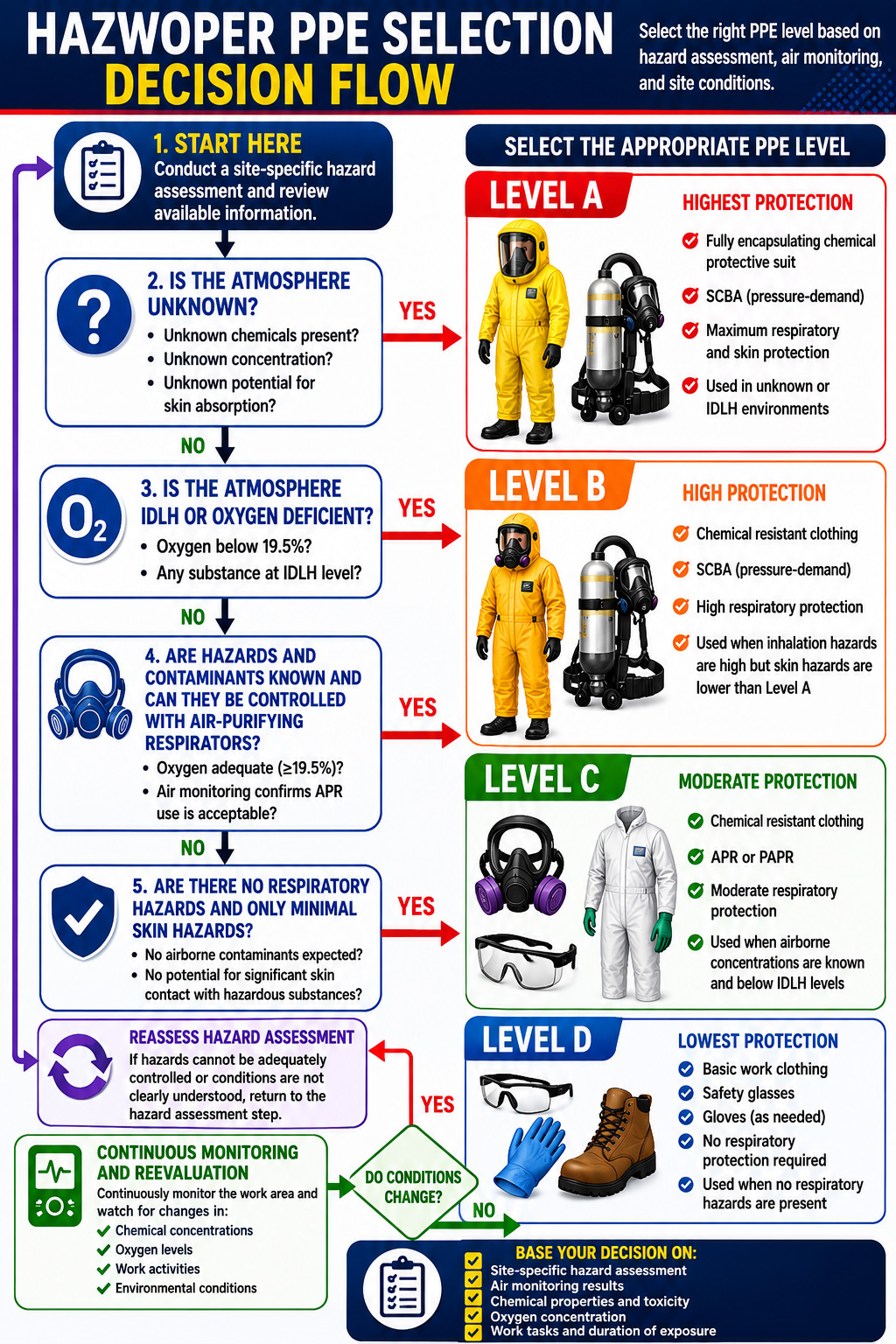
Figure 1. HAZWOPER PPE Selection Decision Flow. OSHA requires employers to select the appropriate level of personal protective equipment based on a site-specific hazard assessment, air monitoring results, oxygen concentration, chemical properties, and anticipated worker exposure. PPE levels may be upgraded or downgraded as site conditions change.
How OSHA Selects PPE Levels
OSHA Determines PPE Levels Based On:
- Site characterization
- Hazard assessment
- Air monitoring
- Chemical toxicity
- Oxygen concentration
- IDLH conditions
- Skin absorption hazards
- Task being performed
- Weather conditions
- Duration of exposure
Levels of Protection
The Occupational Safety and Health Administration (OSHA), Hazardous Waste Operations and Emergency Response (HAZWOPER) standard has four levels of personal protective equipment (PPE) for employee protection. The levels are Level A, Level B, Level C and Level D. It is critical that employers familiarize themselves with these PPE levels, as it protects their employees from certain hazards they will encounter on various work sites. Typically, the Health and Safety Plan (HASP) will determine the PPE required based on site hazards. Employees are exposed to hazards in 3 basic ways, biological, chemical, and/or physical.
• Biological hazards include microorganisms such as bacteria, viruses, yeasts, molds and parasites.
• Chemical hazards include any form of chemicals that are potentially toxic or irritating to the body.
• Physical hazards include objects that are hard or sharp such as glass, metal, plastic, etc.
HAZWOPER Level A PPE
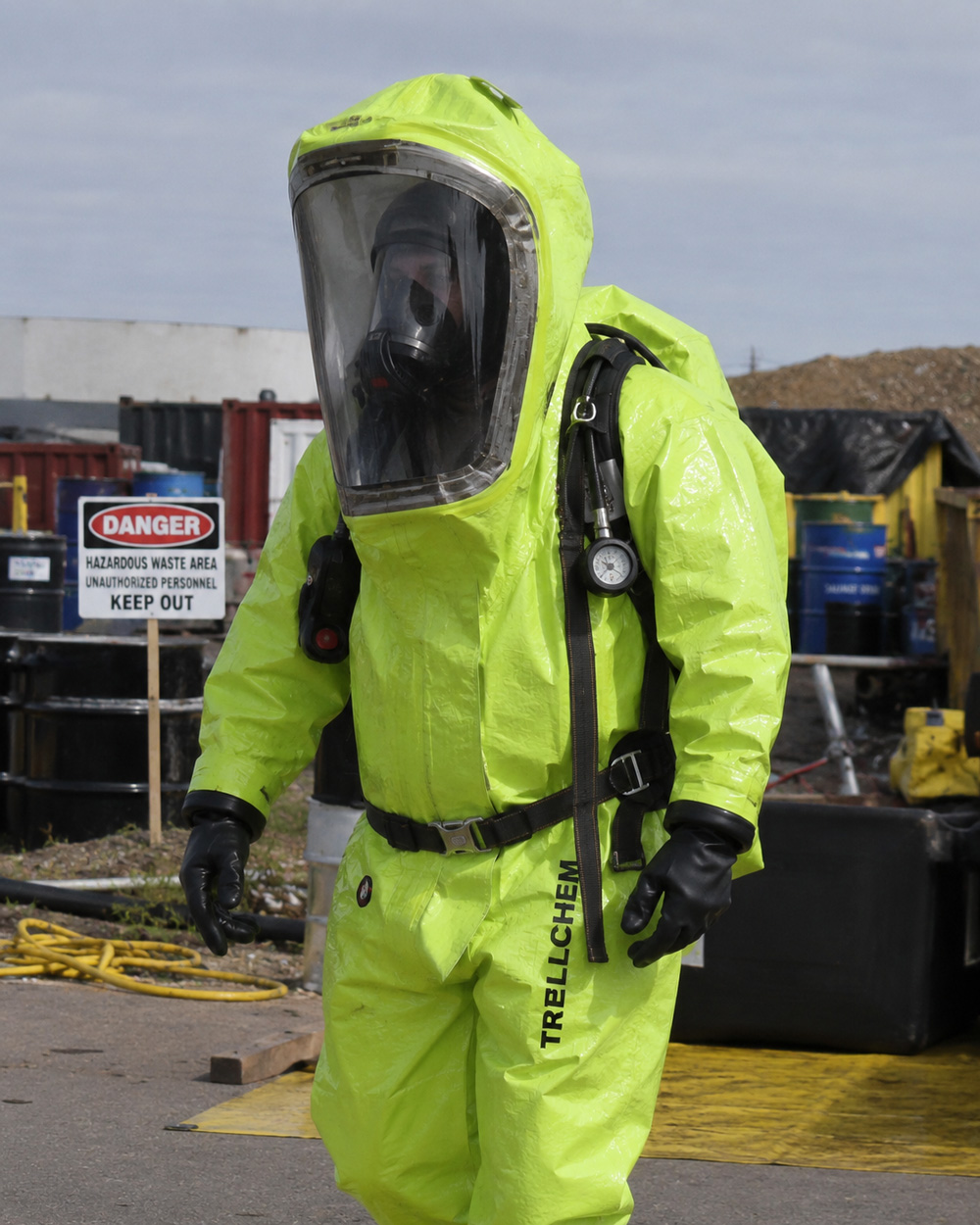
Level A PPE must be worn when the greatest level of skin, respiratory, and eye protection is required. A fully encapsulating suit is donned for this level. This type of protective ensemble is required for dealing with hazardous substances that are at or above their respective threshold quantities. A good example of a highly hazardous chemical is chlorine. A list of highly hazardous chemicals can be found on the U.S. OSHA webpage. Also, OSHA utilizes a series of tables that display the name of a particular hazardous substance(s) and its permissible exposure limit(s). The hazardous substance(s) can be found in the OSHA Z Tables.
Suit Components
This level is typically used during emergency response of chemical releases and for initial entry into contaminated sites that have not been fully characterized. A typical Level A suit is a fully encapsulating, gas-tight garment constructed of specialized chemical-resistant materials such as Teflon®, butyl rubber, or Viton®. The suit completely encloses the wearer—including the self-contained breathing apparatus (SCBA)—to prevent any contact with hazardous vapors, gases, mists, or particulates. The SCBA supplies clean, breathable air from a compressed air cylinder carried on the user’s back. Level A PPE also includes chemical-resistant gloves (inner and outer layers), chemical-resistant boots (often worn under or attached to the suit), two-way radio communication, and voice diaphragms or microphones for communication in noisy or high-risk environments. Some ensembles may include cooling vests or air-circulating systems to manage heat stress during extended operations.
Typical Uses of Level A PPE
Typical uses of Level A PPE occur in situations where workers handle unknown chemical releases, highly toxic gases or vapors, chemical spill emergencies or other hazardous materials (HAZMAT) involving substances like hydrogen cyanide, phosgene, or concentrated acids. It is commonly used by HAZMAT response teams, EPA emergency responders, industrial cleanup contractors, and military or fire department HAZMAT units during entry into chemical release zones, confined spaces with vapor hazards, or environments with confirmed Immediately Dangerous to Life or Health (IDLH) atmospheres. For example, Level A protection may be required during the initial entry into an uncontrolled hazardous waste site to identify contaminants, during the containment of an unknown chemical spill, or while managing incidents involving volatile organic compounds or pesticide manufacturing residues.
Because Level A PPE is both heavy and restrictive, it is used only when lesser levels of protection (Levels B, C, or D) are insufficient. Once air monitoring confirms that airborne contaminants do not pose a vapor hazard or direct contact threat to the skin, responders may downgrade to Level B or C PPE.
Summary
In summary, Level A PPE represents the maximum defense barrier available to HAZWOPER and HAZMAT professionals, ensuring that responders can safely operate in the most dangerous and unpredictable chemical environments.
HAZWOPER Level B PPE
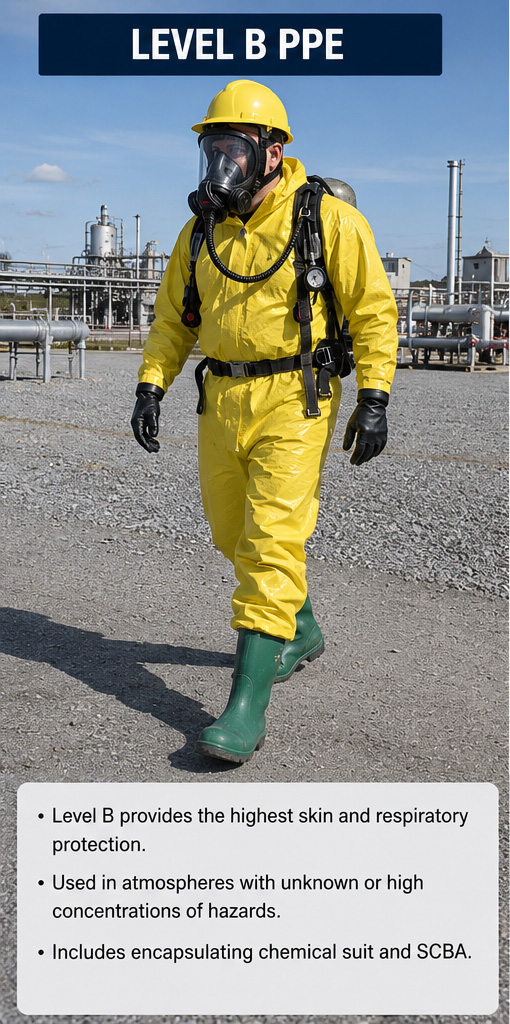
Level B PPE is designed to provide maximum respiratory protection and a high—but not total—level of skin protection, making it the second-highest level of defense used in HAZWOPER and HAZMAT operations. It is required when the atmospheric hazards are primarily inhalation risks—such as toxic vapors, gases, or oxygen deficiency—but when skin absorption or direct contact hazards are not expected to cause serious injury or illness. In practical terms, Level B PPE is used when air contaminants are known or suspected to be dangerous, yet do not pose a significant dermal hazard, or when the chemical type has been identified but concentrations are not fully characterized.
Suit Components
A Level B ensemble includes an SCBA or a Supplied-Air Respirator (SAR) with an escape SCBA bottle. The SCBA provides the highest level of respiratory protection, supplying breathable air from a pressurized tank carried by the user. The protective suit is non-encapsulating but splash-protective, meaning it covers the entire body—including arms, legs, and torso—but does not completely seal around the breathing apparatus. This allows greater mobility and comfort than Level A suits while still offering a durable chemical barrier against liquid splashes and particulates. The suit is commonly made of multi-layer barrier fabrics such as Tychem® TK, Saranex®, or PVC-coated materials, each engineered to resist penetration and degradation by acids, caustics, solvents, and other industrial chemicals.
Additional components of Level B PPE include chemical-resistant gloves (inner and outer layers), steel-toe, steel-shank chemical-resistant boots, a hard hat, and often a full-face mask integrated with the SCBA regulator to protect the eyes and respiratory system. Workers also utilize two-way radios or integrated communication systems, reflective striping for visibility, and in some cases, chemical-resistant tape to seal glove and boot interfaces. Depending on environmental conditions, cooling garments or air-distribution vests may be worn underneath to help manage heat stress during extended operations. Also, heads up displays (HUD) is available for some models that shows on the face mask lens the amount of air in the SCBA tank.
Typical Uses of Level B PPE
Typical uses of Level B PPE include situations where airborne contaminants pose a respiratory hazard but do not readily penetrate intact skin or clothing. Examples include initial site entry and characterization during hazardous waste cleanup, drum handling and sampling where vapors may be present, chemical spill containment and overpack operations, leak detection, and decontamination of Level A entrants or equipment. Emergency response teams may don Level B protection when entering areas containing toxic gas releases—such as chlorine, ammonia, or hydrogen sulfide—or when mitigating industrial chemical leaks, pesticide incidents, or petroleum-based product spills. It is also common for the Environmental Protection Agency (EPA) and OSHA site investigators, environmental contractors, and fire department HAZMAT units to use Level B protection during assessments when monitoring results indicate that contaminants are airborne but not corrosive or absorbed through skin contact.
In the HAZWOPER hierarchy, Level B represents a transition from the extreme isolation of Level A to more flexible, task-oriented protection. It allows responders to work efficiently in environments with significant respiratory hazards while maintaining a reasonable degree of comfort and dexterity. However, if monitoring later confirms that the air is no longer IDLH or that vapor levels are below permissible limits, PPE can be downgraded to Level C, which relies on air-purifying respirators instead of supplied-air systems. Conversely, if site conditions deteriorate or new information suggests a potential for skin absorption or chemical permeation, workers must upgrade to Level A protection immediately.
Summary
In summary, Level B PPE provides comprehensive respiratory defense and robust splash protection, serving as the standard configuration for many HAZWOPER field operations. It strikes a critical balance between safety, maneuverability, and endurance—making it indispensable during initial emergency response, environmental cleanup, and hazardous material assessment when air quality is uncertain and respiratory hazards are the primary concern.
HAZWOPER Level C PPE
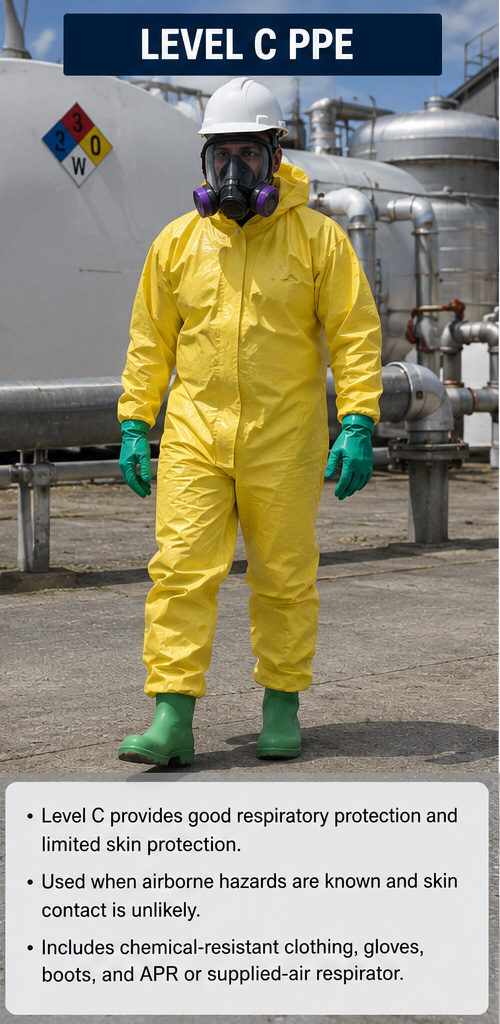
Level C PPE is used in HAZWOPER and HAZMAT operations when airborne contaminants are known, measured, and controllable—and when air quality is sufficient for safe use of air-purifying respirators (APRs). It provides the same level of skin protection as Level B but offers a lower level of respiratory protection, since it relies on filtration rather than a supplied-air system. Level C PPE is selected only after air monitoring confirms that oxygen levels are adequate (at least 19.5%), that no substances exceed the respirator’s protection limits, and that contact or splash hazards are minimal. This makes Level C the standard for routine site operations and cleanup once the work environment has been characterized and stabilized.
Suit Components
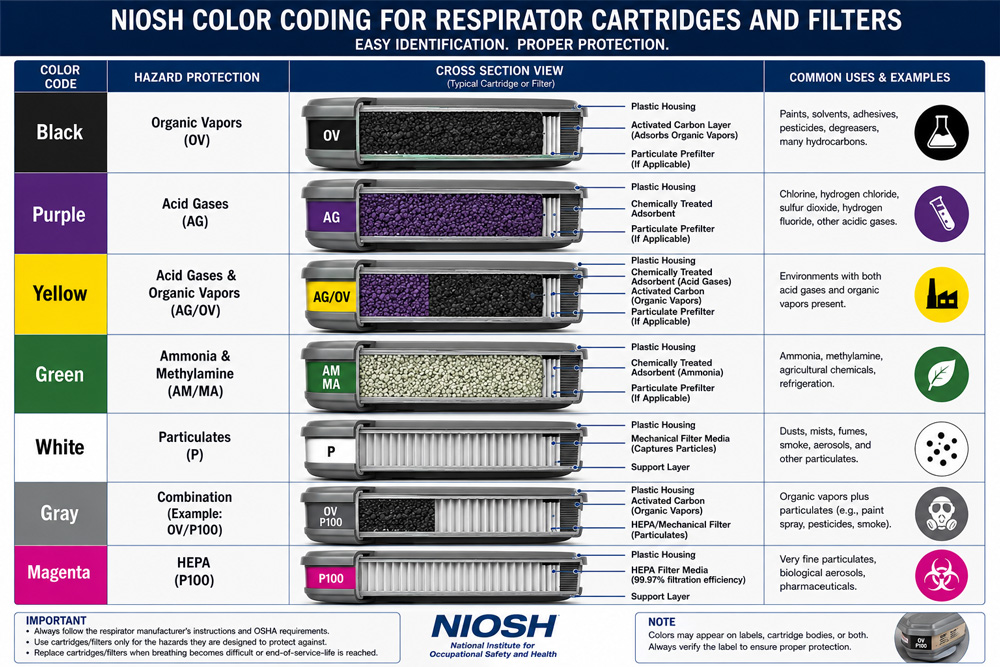
A typical Level C ensemble includes a chemical-resistant splash suit, such as one made from Tyvek®, Tychem® SL, or Saranex®-coated materials. These suits protect against solid particulates, dusts, and light liquid splashes but are not gas-tight. The suit is combined with either a full-face or half-mask APR, or in some cases, a powered air-purifying respirator (PAPR). The respirator uses cartridges or filters specifically matched to the identified hazards—for example, organic vapor cartridges for solvents, acid gas cartridges for corrosives, or HEPA filters for particulates and biological contaminants. A full-face APR provides additional eye protection, while a half-mask model must be supplemented with chemical splash goggles or a face shield.
Additional PPE components include inner and outer chemical-resistant gloves, steel-toe, steel-shank boots with chemical-resistant overboots, hard hat, two-way radio communication, and chemical-resistant tape to seal glove and boot interfaces. Depending on the job’s complexity and duration, workers may also wear cooling vests, reflective outerwear, or hearing protection. Although lighter and less restrictive than Level A or B ensembles, Level C PPE still requires careful selection, fit testing, and regular inspection to ensure full protection against the identified chemical hazards.
Typical Uses
Typical uses of Level C PPE include environmental site characterization, soil and groundwater sampling, drum labeling and repackaging, decontamination line operations, and post-emergency cleanup where contaminants have been reduced to manageable levels. Workers performing routine maintenance at hazardous waste sites, monitoring vapor emissions around containment areas, or handling decontaminated equipment frequently use Level C protection. It is also common during waste segregation, containerizing, and inspection tasks once air monitoring verifies that concentrations are below IDLH levels and that respiratory hazards can be controlled by filter-based respirators. For example, an environmental contractor performing soil sampling at a RCRA corrective action site with low levels of benzene vapors or an industrial hygienist conducting air monitoring for Volatile Organic Compounds (VOCs) at a spill recovery site would typically wear Level C PPE.
In the HAZWOPER PPE hierarchy, Level C represents a controlled, post-characterization work phase—where hazards are known, predictable, and below the thresholds requiring supplied-air protection. It allows for greater mobility, communication, and endurance compared to Levels A and B, making it ideal for extended fieldwork and data collection. However, its use depends entirely on accurate, ongoing air monitoring. If conditions worsen—such as an unexpected rise in vapor concentrations, discovery of new contaminants, or changes in temperature that increase volatility—workers must immediately upgrade to Level B or Level A protection to ensure safety.
Summary
In summary, Level C PPE is the go-to protective configuration for routine, non-emergency operations at hazardous waste sites, industrial cleanup projects, and environmental monitoring activities. It provides solid splash and respiratory protection in environments where hazards are well understood and manageable, ensuring worker safety while maximizing comfort and efficiency. This level is the backbone of most HAZWOPER field activities, representing the point at which science, safety, and practicality converge to allow sustained, compliant, and effective environmental response work.
HAZWOPER Level D PPE
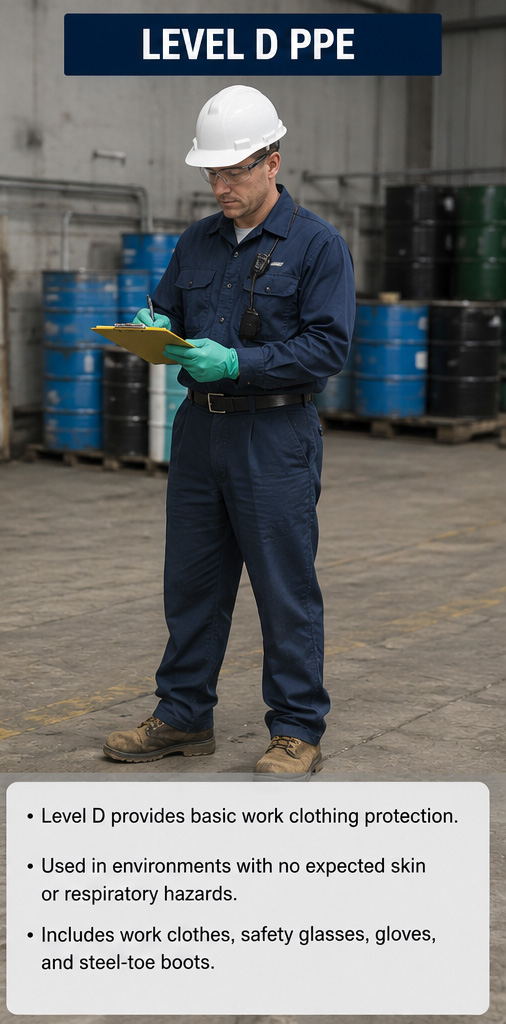
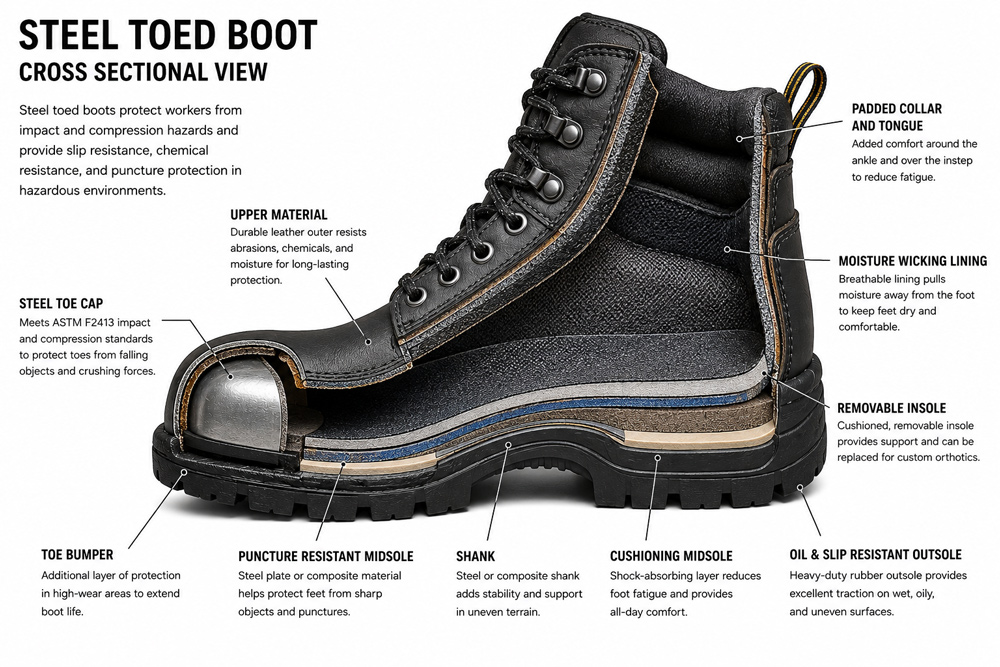
Level D PPE is the lowest level of protection recognized under the HAZWOPER and HAZMAT PPE hierarchy, designed for use in non-hazardous, fully characterized, and controlled environments. It provides only minimal protection—suitable for situations where there is no known atmospheric hazard, no potential for skin absorption or contact with toxic substances, and no risk of oxygen deficiency. Level D PPE is essentially work clothing enhanced with standard industrial safety gear, used when the work area is completely free of respiratory and chemical exposure risks. Because it lacks both respiratory and significant skin protection, Level D may only be used after site monitoring and hazard assessments confirm that conditions pose no threat to worker health under 29 CFR 1910.120(e) and related OSHA standards.
Components
A Level D ensemble typically consists of standard work coveralls or uniforms, steel-toe and shank safety boots, hard hat, safety glasses or chemical splash goggles, and work gloves suited to the specific task (e.g., leather for mechanical work, cotton for comfort, or cut-resistant gloves for handling tools). Optional items such as hearing protection, high-visibility safety vests, or face shields may be used depending on the physical environment. The clothing is designed for comfort, durability, and freedom of movement rather than chemical resistance. In some cases, lightweight disposable coveralls (e.g., Tyvek®) may be worn to protect against dust, dirt, or minor splashes from non-toxic materials, but this does not elevate the PPE to Level C or B. Importantly, no respiratory protection is included—meaning this level is appropriate only when air monitoring confirms that airborne contaminant levels are well below OSHA’s permissible exposure limits (PELs) and that there are no IDLH conditions present.
Typical uses of Level D PPE occur in support zones or clean areas of hazardous waste sites, where personnel are removed from direct contamination sources. This includes equipment operators, truck drivers, engineers, site supervisors, and administrative staff performing oversight or documentation tasks. It is also worn during initial site reconnaissance after confirmation that the area is free of airborne or contact hazards, or during final site restoration and post-remediation verification when contamination has been eliminated. For example, a heavy equipment operator excavating clean backfill material, a technician inspecting monitoring wells in a non-contaminated zone, or a safety officer observing from the command post would all be appropriately dressed in Level D PPE. It may also be used during waste drum transport, equipment maintenance, or decontamination pad setup in zones confirmed safe by continuous air monitoring.
In the HAZWOPER protection hierarchy, Level D represents the final step of PPE reduction—the point at which environmental hazards have been controlled, and work can proceed much like any other industrial operation. Its focus is on basic occupational safety rather than chemical defense. Workers are protected from physical, thermal, and ergonomic hazards, but not from airborne or chemical threats. However, it is critical that site conditions remain stable and verified. If new information indicates a potential airborne contaminant, liquid splash, or unknown substance, personnel must immediately upgrade to Level C, B, or A, depending on the risk.
Summary
In summary, Level D PPE is appropriate for low-risk, fully characterized worksites where respiratory protection and chemical resistance are unnecessary. It provides essential protection against physical injury, impact, and minor nuisance contamination, allowing workers to perform tasks safely and comfortably once hazards have been mitigated. Although it offers the least chemical protection, Level D plays an important role in maintaining safety continuity on HAZWOPER sites by ensuring that even in non-hazardous zones, workers are still shielded from common occupational risks such as slips, impacts, noise, and debris. It symbolizes the endpoint of the decontamination and hazard control process—the stage where safe, compliant, and routine operations can resume with confidence.
Common PPE Selection Mistakes
- Using APRs in oxygen-deficient atmospheres
- Wearing Level C before contaminants are identified
- Choosing PPE based on cost
- Ignoring heat stress
- Failing to inspect suits
- Mixing incompatible chemical gloves
- Not upgrading PPE after air monitoring changes
Who Approves HAZWOPER PPE?
The approval and certification process for Level A, B, C, and D HAZMAT suits is governed by a combination of federal agencies, national standards organizations, and third-party testing laboratories, each responsible for ensuring that the equipment provides the correct level of protection for the specific hazards encountered. There is no single government agency that “approves” every type of suit; instead, different components—such as the suit materials, respiratory systems, and accessories—are tested and certified under specific standards that together define compliance for each protection level.
Level A suits, the highest form of protection used in HAZWOPER and HAZMAT operations, are fully encapsulating, vapor-tight ensembles designed for use in environments with unknown or IDLH conditions. These suits are certified to NFPA 1991: Standard on Vapor-Protective Ensembles for Hazardous Materials Emergencies and CBRN Terrorism Incidents, a standard developed by the National Fire Protection Association (NFPA). NFPA 1991 outlines strict requirements for vapor-tight integrity, chemical permeation resistance, material durability, and overall ensemble performance. Suit manufacturers submit their products to independent third-party testing organizations such as UL Solutions (Underwriters Laboratories) and SEI (Safety Equipment Institute) for certification to NFPA 1991. Meanwhile, the respiratory component—SCBA—is approved by the National Institute for Occupational Safety and Health (NIOSH) under 42 CFR Part 84, which governs respirator performance and safety. Although OSHA does not “approve” specific suits, it enforces their proper selection and use under 29 CFR 1910.120 HAZWOPER, requiring employers to use NFPA-and NIOSH-compliant PPE for workers entering hazardous environments.
Level B suits, which provide maximum respiratory protection but less skin protection than Level A, are certified to NFPA 1992: Standard on Liquid Splash-Protective Ensembles and Clothing for Hazardous Materials Emergencies. NFPA 1992 establishes performance criteria for splash resistance, material strength, closure integrity, and chemical penetration resistance. These suits are also tested and certified by UL or SEI, ensuring they meet NFPA’s standards for protecting against liquid splashes and chemical contact. Like Level A, Level B ensembles rely on a NIOSH-approved SCBA or supplied-air respirator for full respiratory protection. OSHA mandates the use of NFPA 1992-certified suits in situations where there is a risk of liquid chemical exposure but no risk of vapor infiltration.
Level C suits, used when contaminants are known and air concentrations are below IDLH limits, do not have a single governing NFPA standard equivalent to Level A or B but often follow NFPA 1993: Standard on Support Function and Contamination Control Garments or Advancing Standards Transforming Markets (ASTM) ASTM F1001 standards for chemical permeation testing. These suits are selected based on manufacturer chemical compatibility data, ASTM testing results, and field hazard assessments. The respirator used with Level C PPE—typically an APR or PAPR—must be NIOSH-certified under 42 CFR Part 84 to ensure it provides the proper protection against the specific airborne contaminants present. While Level C suits are not “approved” by NIOSH or OSHA, they must meet these performance benchmarks, and OSHA enforces that employers select suits verified through recognized testing standards and chemical compatibility guidelines.
Level D protection represents standard industrial work clothing and is not designed for chemical exposure. These garments are not certified to NFPA standards because they do not provide chemical resistance or respiratory protection. Instead, Level D PPE must comply with OSHA’s general PPE standards under 29 CFR 1910.132–138 and appropriate American National Standards Institute (ANSI) ANSI/ASTM industrial safety standards. For example, ANSI Z89.1 governs hard hats, ANSI Z87.1 covers eye protection, and ASTM F2413 sets requirements for safety footwear. Level D clothing—such as cotton or flame-resistant coveralls, safety shoes, hard hats, and safety glasses—is considered acceptable only in environments verified to be free from chemical, biological, or respiratory hazards.
In short, NFPA sets the performance standards (NFPA 1991 for Level A, NFPA 1992 for Level B, NFPA 1993 for Level C), NIOSH certifies all respiratory protection, and third-party laboratories like UL and SEI conduct the actual testing and certification to verify compliance. OSHA enforces the use of properly certified PPE in the workplace through its HAZWOPER regulations (29 CFR 1910.120) and general PPE requirements. Level D suits are governed only by OSHA and ANSI safety standards, as they are used in non-hazardous environments. Together, these organizations create a layered system of accountability: NFPA defines how the suits must perform, NIOSH certifies the respirators, UL/SEI verify the product’s compliance, and OSHA ensures that employers use the correct ensemble for each hazard level.
Final Thoughts
HAZWOPER PPE levels are critical for ensuring safety in environments where hazardous materials are present. There are four distinct levels of PPE, ranging from Level D, which provides the least protection and is suitable for minimal risk environments, to Level A, offering the highest level of protection for the most hazardous situations. Each level is determined by the potential exposure to chemical hazards and requires appropriate training and equipment to ensure worker safety. Understanding these levels is essential for compliance with regulations and for the effective management of hazardous materials.
How Much Does HAZWOPER Training Cost?
Online HAZWOPER training costs vary by course level and provider. As a general range, the 40-hour course typically runs between $150 and $300, the 24-hour course between $100 and $200, and the 8-hour annual refresher between $50 and $100. Classroom-based training from local providers or training centers is generally more expensive, often ranging from $500 to $1,500 or more for the 40-hour course depending on location and class size. Group and bulk pricing is available from most online providers for employers training multiple workers. The site-specific hands-on training for PPE and other equipment is supplied by the employer. The hands-on field experience component required by OSHA — three days for 40-hour trainees, one day for 24-hour trainees — is separate from the online course and is typically arranged by the employer. OSHACode’s online HAZWOPER courses are priced competitively and include instant certificate access upon completion.
FAQs
What are the four HAZWOPER PPE levels?
HAZWOPER identifies four levels of personal protective equipment: Level A, Level B, Level C, and Level D. Each level provides a different degree of respiratory and skin protection based on the hazards present at a worksite.
What is Level A PPE?
Level A PPE provides the highest level of respiratory, skin, eye, and mucous membrane protection. It typically consists of a fully encapsulating chemical-resistant suit worn with a self-contained breathing apparatus (SCBA). Level A protection is used when workers face unknown hazards or highly toxic substances capable of causing severe skin absorption hazards.
When is Level A PPE required?
Level A PPE is required when the highest level of skin and respiratory protection is necessary. Examples include hazardous waste site investigations involving unknown chemicals, highly toxic substances, or situations where significant skin absorption hazards exist.
What is Level B PPE?
Level B PPE provides the highest level of respiratory protection but a lower level of skin protection than Level A. It generally includes an SCBA or supplied-air respirator worn with chemical-resistant clothing, gloves, and boots.
When should Level B PPE be used?
Level B PPE is used when respiratory hazards are high, but skin exposure hazards are less severe than those requiring Level A protection. It is commonly used during hazardous materials response operations and site characterization activities.
What is Level C PPE?
Level C PPE includes a full-face or half-mask air-purifying respirator (APR) combined with chemical-resistant clothing, gloves, and boots. It is used when airborne contaminants are known, measured, and within the capabilities of the selected respirator.
When is Level C PPE appropriate?
Level C PPE may be used when contaminants have been identified, oxygen levels are adequate, and air-purifying respirators can effectively protect workers from the anticipated hazards.
What is Level D PPE?
Level D PPE is the lowest level of protection and generally consists of standard work clothing, safety boots, safety glasses, hard hats, and gloves as needed. It does not provide respiratory protection against hazardous atmospheres.
When can workers wear Level D PPE?
Level D PPE may be appropriate when no respiratory hazards, chemical splashes, or significant skin hazards are present and the work environment has been adequately characterized.
What type of respirator is used with Level A PPE?
Level A PPE typically requires a positive-pressure self-contained breathing apparatus (SCBA) or a positive-pressure supplied-air respirator with an escape SCBA.
Does Level B PPE require an SCBA?
Yes. Level B PPE generally requires an SCBA or supplied-air respirator because it is intended for environments where respiratory hazards are significant or unknown.
Can an air-purifying respirator be used with Level C PPE?
Yes. Level C PPE is specifically designed for situations where air-purifying respirators are appropriate because contaminants are known and oxygen concentrations are sufficient.
How do employers determine the correct PPE level?
Employers determine the appropriate PPE level through hazard assessments, site characterization, air monitoring data, chemical exposure evaluations, and the requirements outlined in the site’s Health and Safety Plan (HASP).
Can PPE levels change during a HAZWOPER operation?
Yes. PPE levels may be upgraded or downgraded as conditions change and additional information becomes available through air monitoring, sampling, and hazard assessments.
What is PPE upgrading and downgrading?
Upgrading occurs when hazards are greater than initially anticipated and additional protection is required. Downgrading occurs when monitoring and site characterization demonstrate that a lower level of protection can safely be used.
Does OSHA require PPE training for HAZWOPER workers?
Yes. OSHA requires workers to receive training on PPE selection, use, limitations, inspection, maintenance, donning, doffing, and emergency procedures before using protective equipment in hazardous environments.
What are the limitations of Level C PPE?
Level C PPE should not be used in oxygen-deficient atmospheres, environments with unknown contaminants, or situations where airborne concentrations exceed the capabilities of the selected air-purifying respirator.
Is Level A PPE always safer than Level B PPE?
Not necessarily. The safest PPE level is the one that provides adequate protection for the identified hazards while allowing workers to perform their tasks safely. Excessive PPE can increase heat stress, fatigue, and operational risks.
What role does air monitoring play in PPE selection?
Air monitoring helps identify contaminants, determine exposure levels, verify oxygen concentrations, and support decisions regarding PPE selection, upgrading, or downgrading during hazardous waste operations.
What OSHA standard governs HAZWOPER PPE requirements?
HAZWOPER PPE requirements are primarily found in OSHA 29 CFR 1910.120, which requires employers to evaluate hazards and provide appropriate personal protective equipment for hazardous waste operations and emergency response activities.
HAZWOPER Training Online
Understanding HAZWOPER PPE levels is essential, but selecting and using protective equipment safely requires comprehensive training. OSHACode’s online HAZWOPER courses teach workers how to recognize hazards, select appropriate PPE, understand respirator limitations, interpret air monitoring data, and comply with OSHA requirements. Employers then provide the required site-specific hands-on training using the actual protective equipment employees will wear on the job.
Sources
Emergency Response and Preparedness
OSHA HAZWOPER Hands-on Training Requirement
Medical Surveillance Requirements
U.S. Occupational Safety and Health Administration
https://www.osha.gov/laws-regs/standardinterpretations/1992-08-27-1
U.S. Environmental Protection Agency
https://www.epa.gov/laws-regulations/summary-resource-conservation-and-recovery-act
Related Articles
Building a HAZWOPER Safety Culture
Hands-on Training Discussions with U.S. OSHA
About the Author
This article was written by Clay A. Bednarz, MS, RPIH, founder of National Environmental Trainers® and OSHACode®. Bednarz pioneered the first commercial online HAZWOPER training programs in 1998 and has supported major hazardous waste operations, environmental remediation projects, and emergency response training initiatives nationwide.