
Summary
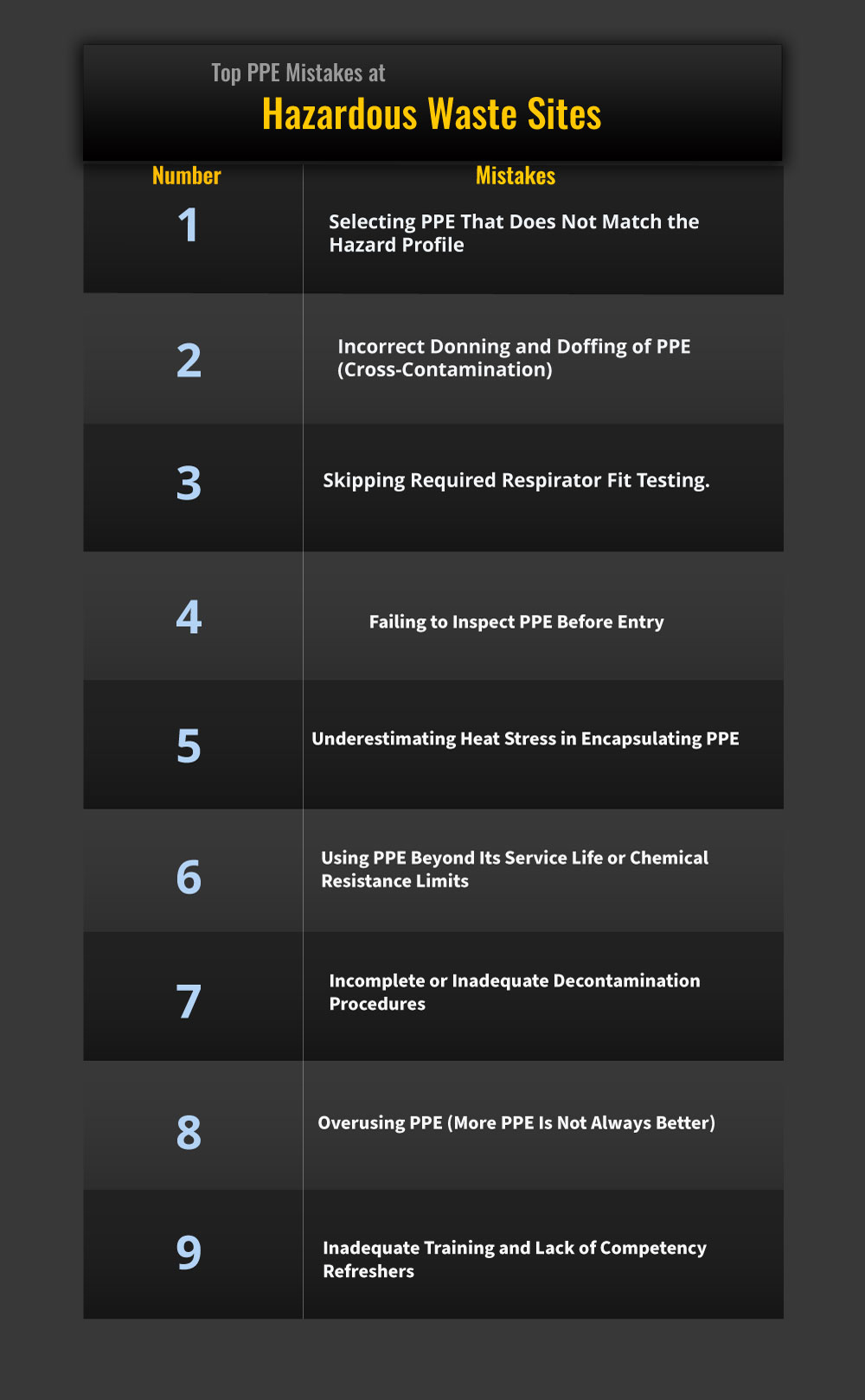
Personal Protective Equipment (PPE) is the final barrier protecting workers from toxic chemicals, airborne contaminants, and physical hazards present during hazardous waste operations. Under the Hazardous Waste Operations and Emergency Response (HAZWOPER) standard, by the Occupational Safety and Health Administration (OSHA) 29 CFR 1910.120, employers must not only provide appropriate PPE but also ensure that workers are trained, competent, and medically capable of using it. Despite these requirements, PPE-related failures continue to be one of the leading causes of exposure incidents, contamination events, and medical emergencies at hazardous waste sites. Below is an in-depth look at the top PPE mistakes at Hazardous Waste Sites, why they happen, and what every site must do to prevent them.
1. Selecting PPE That Does Not Match the Hazard Profile
One of the most dangerous—and common—errors is choosing PPE based on assumption rather than a scientifically supported hazard assessment. Workers may default to Level C or Level D protection even when monitoring results, chemical properties, or site conditions demand Level A or Level B respiratory and dermal protection. Using chemically incompatible gloves, splash suits for vapor-producing chemicals, or air-purifying respirators in oxygen-deficient atmospheres puts workers at immediate risk.
Root Cause: Incomplete hazard characterization, inadequate pre-entry briefings, or lack of understanding of chemical breakthrough times.
Prevention: Conduct atmospheric monitoring, review Safety Data Sheets (SDS), evaluate Immediately Dangerous to Life and Health (IDLH) concentrations, and follow established PPE selection matrices as required by OSHA and the site’s Health and Safety Plan (HASP).
2. Incorrect Donning and Doffing of PPE (Cross-Contamination)
Improper donning and doffing procedures are responsible for many contamination events—often more than primary exposures. Workers may rush the suiting process, skip integrity checks, fail to conduct respirator seal tests, or remove PPE in the wrong sequence. Even a minor breach during doffing can transfer contaminants from the suit exterior to a worker’s skin or respiratory zone.
Root Cause: Rushed operations, inadequate oversight, and failure to use the buddy system.
Prevention: Mandatory buddy-assist donning/doffing, standardized checklists, and periodic hands-on drills that mirror real site conditions.
3. Skipping Required Respirator Fit Testing
Respirators only work when properly fitted. Workers frequently bypass fit testing, rely on outdated fit tests, or use respirators incompatible with facial hair, weight fluctuations, or facial changes. This drastically reduces the Assigned Protection Factor (APF) and can render the respirator essentially useless.
Regulatory Requirement: OSHA’s Respiratory Protection Standard, 29 CFR 1910.134, mandates annual fit testing for each respirator model used.
Prevention: Annual fit tests, routine seal-check reminders, and policies restricting facial hair in areas that interfere with the face seal.
4. Failing to Inspect PPE Before Entry
Damaged zippers, worn boot soles, cracked face shields, degraded respirator cartridges, and small tears in gloves are often overlooked—especially during busy operations. Even minor damage can compromise worker safety, especially when dealing with corrosive or highly permeable chemicals.
Root Cause: Complacency and overreliance on visual checks alone.
Prevention: Structured pre-entry inspections, routine maintenance logs, and immediate removal of compromised PPE from service.
5. Underestimating Heat Stress in Encapsulating PPE
Level A and Level B PPE significantly restrict ventilation, trap heat, and impede natural cooling. Workers frequently underestimate internal temperatures, resulting in heat exhaustion, heat stroke, dehydration, and cognitive impairment—often within minutes.
Root Cause: Poor work/rest cycle planning and lack of physiological monitoring.
Prevention: Adopt OSHA required heat monitoring protocols, establish mandatory work/rest cycles, integrate cooling vests, and track worker vitals during high-exertion tasks.
6. Using PPE Beyond Its Service Life or Chemical Resistance Limits
Chemical-resistant gloves, boots, splash suits, and respirator cartridges all have defined service lives. Workers sometimes reuse chemical suits past their recommended lifespan or ignore breakthrough time data. Cartridges may be used until visibly dirty instead of replaced based on time-in-service or contaminant concentration.
Root Cause: Lack of inventory control or misunderstanding chemical permeation.
Prevention: Develop a PPE expiration schedule, track cartridge change-out times, and replace PPE based on chemical compatibility charts—not just appearance.
7. Incomplete or Inadequate Decontamination Procedures
Decontamination lines (decon) are often rushed or improperly set up, leading to cross-contamination between HAZWOPER hot, warm, and cold zones. Workers may remove PPE in the wrong order, fail to wash down surfaces, or walk through the exclusion zone boundary without proper decon.
Root Cause: Poor zone control, inadequate supervision, or incomplete HASP implementation.
Prevention: Establish clearly marked HAZWOPER hot/warm/cold zones, ensure a structured decon line with trained attendants, and reinforce proper PPE removal sequences.
8. Overusing PPE (More PPE Is Not Always Better)
A frequent misconception is that higher levels of PPE automatically mean greater protection. In reality, unnecessary use of Level A or Level B suits increases fatigue, reduces mobility, limits dexterity, restricts visibility, and raises the risk of slips, trips, falls, and procedural errors.
Root Cause: Overcompensation due to fear or misunderstanding of hazard levels.
Prevention: Follow the hierarchy of PPE selection and always use the minimum level necessary to safely control the hazard.
9. Inadequate Training and Lack of Competency Refreshers
Many PPE failures occur because workers have not practiced enough, do not understand suit limitations, or have not received updated training that reflects current hazards. HAZWOPER operations require hands-on drills—not just classroom instruction—to maintain competency.
Regulatory Requirement: OSHA mandates annual 8-hour HAZWOPER refresher training and ongoing competency verification.
Prevention: Integrate scenario-based drills, full PPE exercises, toolbox talks, and quarterly refresher sessions.
Conclusion: PPE Mistakes Are Preventable with Proper Training and Oversight
PPE failures are rarely caused by equipment alone—they result from insufficient training, poor planning, or weak adherence to established HAZWOPER protocols. By strengthening hazard assessments, improving training, enforcing proper donning and doffing sequences, and ensuring regular PPE inspection and maintenance, employers can significantly reduce risk and keep workers safe. Following the requirements of OSHA 29 CFR 1910.120, employers and workers can build a safety culture where proper PPE use becomes second nature on every hazardous waste site.
Become HAZWOPER Certified Today!
Ready to begin your own HAZWOPER training? Start your certification today with our courses. We are industry professionals with decades of field experience who know the job firsthand!
Sources
Emergency Response and Preparedness
OSHA HAZWOPER Hands-on Training Requirement
Medical Surveillance Requirements
U.S. Occupational Safety and Health Administration
https://www.osha.gov/laws-regs/standardinterpretations/1992-08-27-1
U.S. Environmental Protection Agency
https://www.epa.gov/laws-regulations/summary-resource-conservation-and-recovery-act
Related Articles
Building a HAZWOPER Safety Culture
Hands-on Training Discussions with U.S. OSHA