
Summary
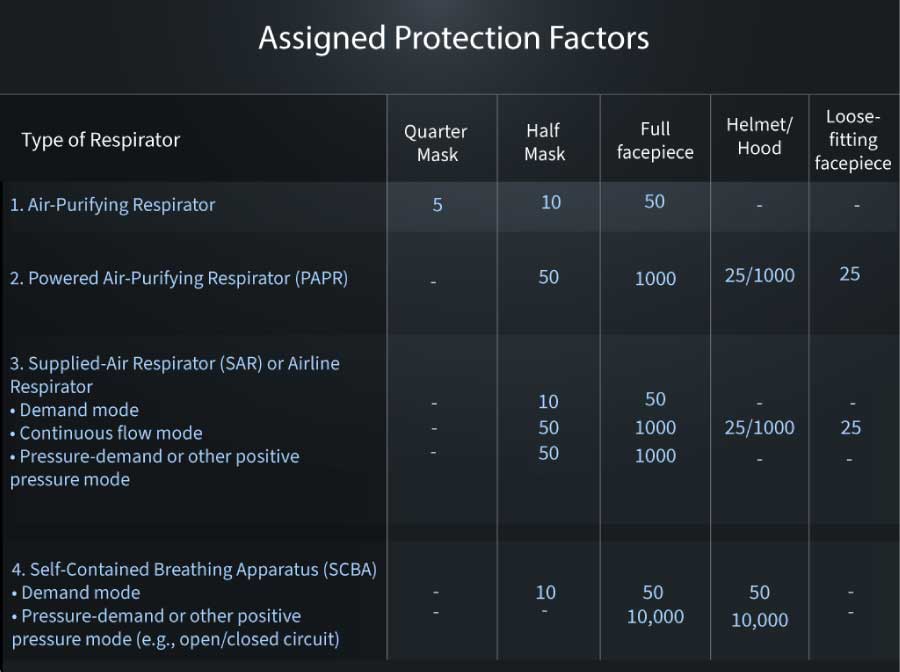
In HAZWOPER (Hazardous Waste Operations and Emergency Response), workers are frequently exposed to hazardous substances, including toxic gases, vapors, dust, and biological agents. Respiratory protection is critical in these environments, and Assigned Protection Factors (APFs) help determine the effectiveness of different respirator types in reducing exposure to airborne contaminants.
APFs are set by the Occupational Safety and Health Administration (OSHA) (29 CFR 1910.134) and represent the level of protection provided by a respirator when properly fitted and used according to manufacturer guidelines. The APF indicates the multiplicative reduction of airborne contaminant concentration inside the respirator compared to the external environment.
For example, an APF of 10 means the respirator reduces airborne contaminant levels inside the mask to 1/10th of the concentration outside.
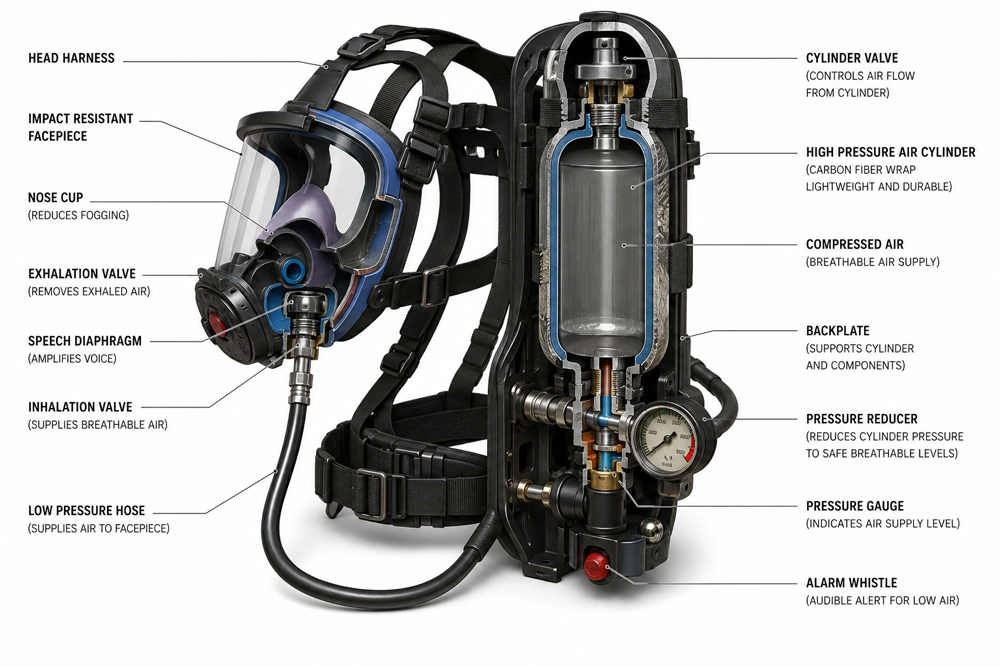
Self Contained Breathing Apparatus (SCBA)
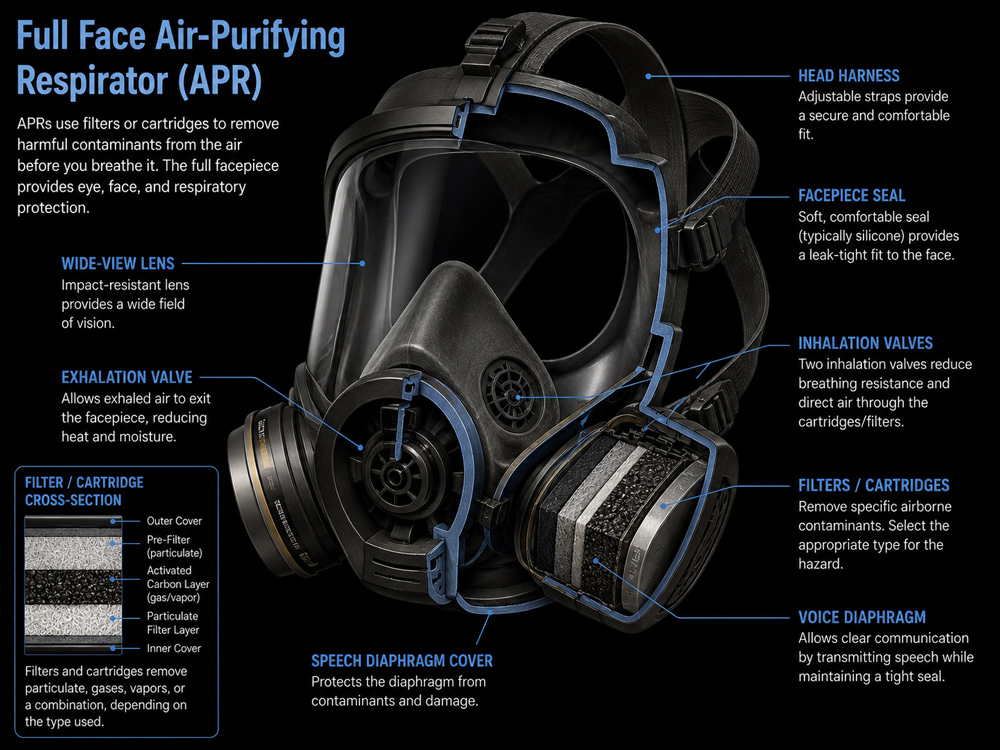
Full Face Air Purifying Respirator
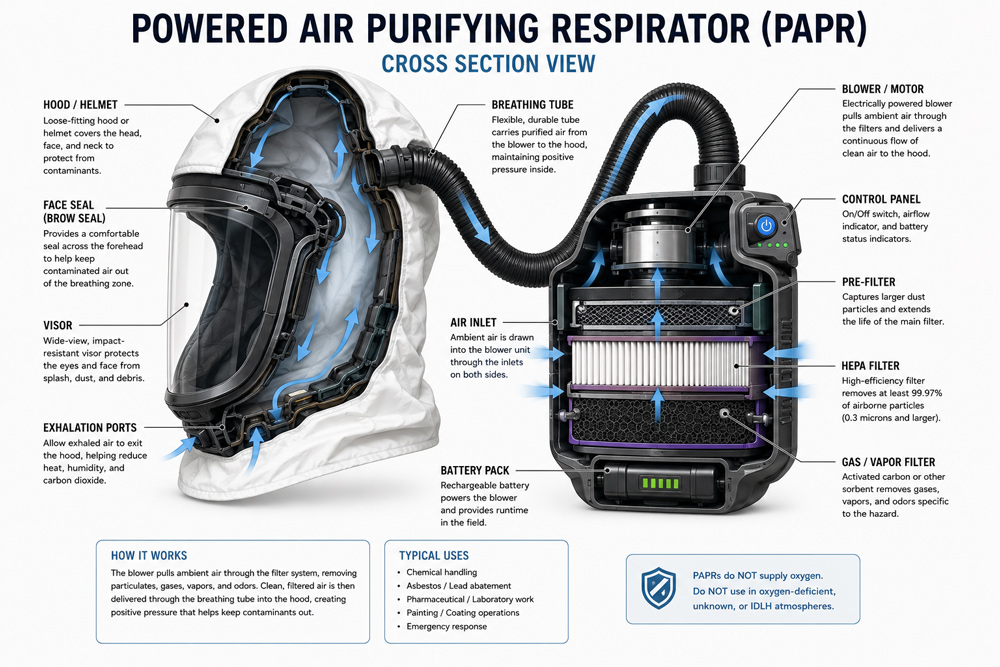
Powered Air Purifying Respirator (PAPR)
Common OSHA Assigned Protection Factors
| Respirator Class | Facepiece or Configuration | OSHA APF | Typical HAZWOPER Use | Key Limitation |
|---|---|---|---|---|
| Filtering Facepiece Respirator | Tight-fitting disposable respirator, such as an N95 | 10 | Certain dust, mist, or particulate tasks when the filter is appropriate for the hazard. | Does not protect against gases or vapors and cannot be used in oxygen-deficient, unknown, or IDLH atmospheres. |
| Half-Mask APR | Tight-fitting elastomeric half-mask with cartridges or filters | 10 | Known, below-IDLH particulate, gas, or vapor exposures when the correct cartridge or filter is selected. | Does not protect the eyes and cannot be used in oxygen-deficient, unknown, or IDLH atmospheres. |
| Full-Face APR | Tight-fitting full-facepiece with cartridges or filters | 50 | Level C work involving known airborne contaminants at below-IDLH concentrations. | Depends on surrounding air and cannot be used in oxygen-deficient, unknown, or IDLH atmospheres. |
| Loose-Fitting PAPR | Loose-fitting hood or helmet with powered blower and approved filters | 25 | Particulate work where a loose-fitting configuration is appropriate and a tight face seal cannot be achieved. | Cannot be used in oxygen-deficient, unknown, or IDLH atmospheres. |
| Full-Face PAPR | Tight-fitting full-facepiece with powered blower and approved filters | 1,000 | Higher-level protection for known, non-IDLH contaminants when the approved PAPR configuration is suitable. | Still depends on ambient air and cannot be used in oxygen-deficient, unknown, or IDLH atmospheres. |
| Full-Face SAR | Pressure-demand supplied-air respirator | 1,000 | Extended work requiring supplied breathing air in known hazardous atmospheres. | For IDLH use, it must include an auxiliary self-contained air supply for escape. |
| Full-Face SCBA | Pressure-demand self-contained breathing apparatus | 10,000 | Level A or Level B entry into unknown, oxygen-deficient, or IDLH atmospheres. | Limited air duration and requires specialized inspection, maintenance, training, and emergency procedures. |
Important: APFs apply only to OSHA-recognized respirator classes when the respirator is NIOSH-approved, correctly selected for the hazard, properly fitted when required, inspected, maintained, and used under an effective respiratory-protection program.
Respiratory Protection Levels and APFs
1. Air-Purifying Respirators (APRs)
APRs remove contaminants from the air but do not supply oxygen, making them unsuitable for oxygen-deficient or IDLH (Immediately Dangerous to Life or Health) conditions.
| Respirator Type | Description | APF |
|---|---|---|
| Half-Facepiece Elastomeric APR | Covers nose and mouth, uses replaceable cartridges/filters | 10 |
| Full-Facepiece Elastomeric APR | Covers entire face, higher protection due to better seal | 50 |
🔹 Use case: Protection from dust, fumes, and certain gases/vapors at moderate concentrations. Not suitable for IDLH atmospheres.
🔹 Limitations: Cannot be used if oxygen levels are below 19.5%, and cartridge/filter breakthrough can occur if not changed timely.
2. Powered Air-Purifying Respirators (PAPRs)
PAPRs use a battery-powered blower to draw air through filters/cartridges, providing positive pressure inside the mask, making breathing easier.
| Respirator Type | Description | APF |
|---|---|---|
| Loose-Fitting PAPR (hood/helmet style) | Worn over the head, does not require a tight face seal | 25 |
| Tight-Fitting Full-Facepiece PAPR | More secure seal, higher level of protection | 1,000 |
🔹 Use case: Provides better comfort and protection than non-powered APRs, suitable for higher levels of contamination.
🔹 Limitations: Cannot be used in oxygen-deficient environments and may not protect against all contaminants.
3. Supplied-Air Respirators (SARs)
SARs deliver clean air from an external compressed air source. They are preferred for extended use in hazardous atmospheres.
| Respirator Type | Description | APF |
|---|---|---|
| Continuous-Flow Loose-Fitting Hood/Helmet | Air is continuously supplied; less tight seal | 25 |
| Continuous-Flow Tight-Fitting Full-Facepiece | Higher protection due to tight seal | 1,000 |
| Pressure-Demand or Positive-Pressure Full-Facepiece SAR | Provides the highest level of SAR protection | 1,000 |
🔹 Use case: Long-duration tasks in toxic atmospheres where APRs are insufficient but SCBA is not necessary.
🔹 Limitations: Dependent on air supply hose; restricted mobility.
4. Self-Contained Breathing Apparatus (SCBA)
SCBAs provide independent air supply, making them suitable for IDLH and oxygen-deficient conditions.
| Respirator Type | Description | APF |
|---|---|---|
| Full-Facepiece SCBA in Demand Mode | Only supplies air when user inhales (less protective) | 50 |
| Full-Facepiece SCBA in Pressure-Demand Mode | Constant positive pressure, best protection for IDLH | 10,000 |
🔹 Use case: Highest level of respiratory protection for IDLH atmospheres, emergency response, and hazardous material handling.
🔹 Limitations: Heavy and limited air supply (typically 30–60 minutes of air), requiring strict monitoring.
How APFs Are Used in HAZWOPER Respirator Selection
-
Determine Contaminant Concentration:
- Air monitoring is required to measure airborne chemical, biological, and particulate hazards.
-
Compare to Permissible Exposure Limits (PELs):
- OSHA sets PELs (e.g., 50 ppm benzene limit). The respirator must reduce exposure below this threshold.
-
Choose the Right Respirator Based on APF:
- Example: If airborne lead concentration is 5,000 µg/m³, and OSHA’s PEL is 50 µg/m³, you need a respirator with APF ≥ 100 to bring exposure to safe levels.
-
Account for IDLH and Oxygen-Deficient Environments:
- SCBA (APF 10,000) or SAR with escape SCBA is mandatory for IDLH conditions.
-
Fit Testing and Seal Checks:
- Tight-fitting respirators require annual fit testing (qualitative or quantitative).
- Workers must perform a seal check each use to ensure no leaks.
How APF Helps Determine Respirator Selection
| Selection Step | What the Employer Evaluates | Why It Matters | Example |
|---|---|---|---|
| 1. Identify the Hazard | Chemical identity, physical form, toxicity, warning properties, and potential exposure routes. | The respirator must be approved and appropriate for the actual contaminant. | A particulate filter may be appropriate for lead dust but will not protect against solvent vapors. |
| 2. Measure or Estimate Exposure | Air-monitoring results, task data, exposure assessments, and anticipated peak concentrations. | APF is used to determine whether the respirator can reduce exposure below the applicable limit. | If exposure is 20 times the limit, a respirator with an APF of at least 20 is needed. |
| 3. Check Oxygen and IDLH Conditions | Oxygen concentration, atmosphere predictability, and whether the hazard is immediately dangerous to life or health. | APR and PAPR selection is prohibited for oxygen-deficient, unknown, or IDLH atmospheres. | An unknown confined-space atmosphere requires an appropriate pressure-demand SCBA or SAR with escape SCBA. |
| 4. Select an APF That Meets the Need | The required protection level compared with the OSHA APF for the respirator class. | The selected respirator must provide an APF equal to or greater than the required protection factor. | A full-face APR with an APF of 50 may be selected for a known, non-IDLH exposure requiring an APF greater than 10 but no more than 50. |
| 5. Confirm Program Requirements | Medical evaluation, fit testing, training, cartridge change schedules, inspection, cleaning, storage, and program evaluation. | A respirator can only provide its expected APF when it is used correctly within a compliant program. | A worker with facial hair in the sealing area may not achieve the protection expected from a tight-fitting full-face APR. |
OSHA Respirator Requirements and Training
- OSHA 29 CFR 1910.134 and 1910.120 (HAZWOPER standard) require:
- Medical evaluations to ensure workers can wear respirators.
- Fit testing for all tight-fitting respirators.
- Training on respirator use, limitations, and maintenance.
- Cartridge change schedules based on breakthrough times.
- Emergency procedures for respirator failures.
Final Thoughts
- APFs guide respirator selection to ensure workers are adequately protected.
- SCBAs and SARs are required for IDLH conditions, while APRs/PAPRs are suitable for lower-hazard environments.
- Proper fit testing, training, and maintenance are crucial to ensuring the effectiveness of respiratory protection in HAZWOPER operations.
Make Respirator Selection a Site-Specific Safety Decision
Assigned Protection Factors provide an important starting point for respirator selection, but an APF number alone does not make a respirator safe for a particular task. Employers must evaluate air-monitoring results, exposure limits, contaminant identity, oxygen concentration, cartridge limitations, task conditions, and the possibility that site conditions could change.
OSHACode® HAZWOPER training helps workers and supervisors understand APFs, respirator limitations, PPE selection, air monitoring, IDLH hazards, decontamination, and emergency procedures. Employers can then reinforce that knowledge with site-specific training using the actual respirators, PPE, monitoring instruments, and work practices required for the job.
Give your workforce the knowledge to understand respirator protection factors—and the judgment to recognize when a higher level of protection is required.
Frequently Asked Questions
What is an Assigned Protection Factor?
An Assigned Protection Factor is a number that represents the expected level of protection a class of respirators can provide in the workplace when it is properly selected and used within an effective respiratory-protection program. For example, an APF of 10 means the respirator is expected to reduce the concentration inside the facepiece to one-tenth of the outside concentration under the conditions assumed by OSHA’s program requirements.
How is APF used to select a respirator?
Employers compare the airborne contaminant concentration to the applicable occupational exposure limit to determine the protection factor needed. The selected respirator must have an APF equal to or greater than that required protection level, while also being approved and appropriate for the contaminant, concentration, oxygen level, and work conditions.
Is APF the same as a fit factor?
No. APF is the expected protection assigned by OSHA to a respirator class. A fit factor is a numerical result from quantitative fit testing that measures the seal of a particular tight-fitting facepiece on an individual worker. A passing fit test is one important part of achieving the protection associated with an APF.
What is the APF of a half-mask respirator?
A half-mask air-purifying respirator, including many elastomeric half-mask respirators and filtering facepiece respirators, has an OSHA APF of 10 when properly selected and used in a compliant program.
What is the APF of a full-face APR?
A full-face air-purifying respirator generally has an OSHA APF of 50. It can provide more protection than a half-mask APR and also protects the eyes, but it still depends on the surrounding atmosphere and cannot be used in oxygen-deficient, unknown, or IDLH conditions.
What is the APF of an SCBA?
A pressure-demand, full-facepiece self-contained breathing apparatus has an OSHA APF of 10,000. It is used when the atmosphere may be IDLH, oxygen-deficient, or unknown, provided the SCBA is selected and used under the employer’s respiratory-protection program.
Does a higher APF always mean a respirator is appropriate?
No. APF is only one part of respirator selection. The employer must also evaluate the contaminant, concentration, oxygen level, whether the atmosphere is IDLH or unknown, the respirator’s NIOSH approval, cartridge or filter capability, service life, chemical warning properties, and task conditions.
Can an APR be used in an IDLH atmosphere?
No. Air-purifying respirators do not supply oxygen and should not be used in unknown, oxygen-deficient, or IDLH atmospheres. OSHA requires appropriate atmosphere-supplying respirators for IDLH conditions.
Does APF eliminate the need for fit testing?
No. Workers who wear tight-fitting respirators must be fit tested before initial use, whenever a different facepiece is used, and at least annually. APF assumes that the respirator fits correctly and is used as part of an effective program.
Can facial hair affect APF protection?
Yes. Facial hair that interferes with the sealing surface of a tight-fitting respirator can prevent an adequate seal. If the respirator cannot seal correctly, the worker may not receive the protection assumed by its APF.
Are APFs the same for every PAPR?
No. PAPR APFs depend on the specific respirator configuration, including whether it uses a loose-fitting hood or helmet, a tight-fitting facepiece, and the manufacturer’s approved configuration. Employers should consult OSHA’s APF table, the respirator’s NIOSH approval, and manufacturer instructions before selection.
What else is required besides selecting a respirator with the right APF?
A compliant respiratory-protection program includes hazard evaluation, written procedures, medical evaluations, fit testing for tight-fitting respirators, employee training, cleaning and maintenance, inspection, storage, cartridge change schedules where applicable, and periodic program evaluation. APF only works as intended when these program elements are in place.
Sources
Emergency Response and Preparedness
OSHA HAZWOPER Hands-on Training Requirement
Medical Surveillance Requirements
U.S. Occupational Safety and Health Administration
https://www.osha.gov/laws-regs/standardinterpretations/1992-08-27-1
U.S. Environmental Protection Agency
https://www.epa.gov/laws-regulations/summary-resource-conservation-and-recovery-act
Related Articles
Building a HAZWOPER Safety Culture
Hands-on Training Discussions with U.S. OSHA