
Summary
In HAZWOPER (Hazardous Waste Operations and Emergency Response), selecting the appropriate respirator depends on the hazard level and potential exposure to toxic chemicals, gases, vapors, or particulates. Respiratory protection varies based on the assigned Level of Personal Protection Equipment (PPE) (A, B, or C), which is determined by the type and concentration of airborne contaminants and the presence of Immediately Dangerous to Life or Health (IDLH) conditions.
Overview of HAZWOPER PPE Levels and Respirator Selection
| PPE Level | Protection Needed | Respirator Type Used | Example Use Cases |
|---|---|---|---|
| Level A | Highest protection for IDLH environments and unknown hazards. | Full-face SCBA (Self-Contained Breathing Apparatus) or Supplied-Air Respirator (SAR) with escape SCBA. | Chemical spills, toxic-gas releases, and oxygen-deficient atmospheres. |
| Level B | High respiratory protection with less skin protection than Level A. | Full-face SCBA or SAR with escape SCBA. | High concentrations of toxic gases or vapors and decontamination zones. |
| Level C | Known airborne contaminants at below-IDLH levels with no oxygen deficiency. | Full-face or half-face Air-Purifying Respirator (APR) or Powered Air-Purifying Respirator (PAPR). | Cleanup of non-IDLH chemical spills, lead or asbestos removal, and pesticide application. |
Key Takeaways
- Level A & B requires a Self Contained Breathing Apparatus (SCBA) or Supplied Air Respirator (SAR) with an escape option for high-toxicity and oxygen-deficient environments.
- Level C allows the use of Air Purifing Respirators (APRs) and Powered Air Purifying Respirators (PAPRs) but is only effective for non – IDLH and oxygen-rich conditions.
- Respirator selection depends on contaminant type, concentration, and workplace exposure conditions.
- National Institute for Occupational Safety and Health (NIOSH) – approved filters (color-coded system) must match the specific hazards to provide effective protection.
- Fit testing is required for all tight-fitting respirators to ensure a proper seal and maximum protection.
Supplied Air Respirator (SAR)

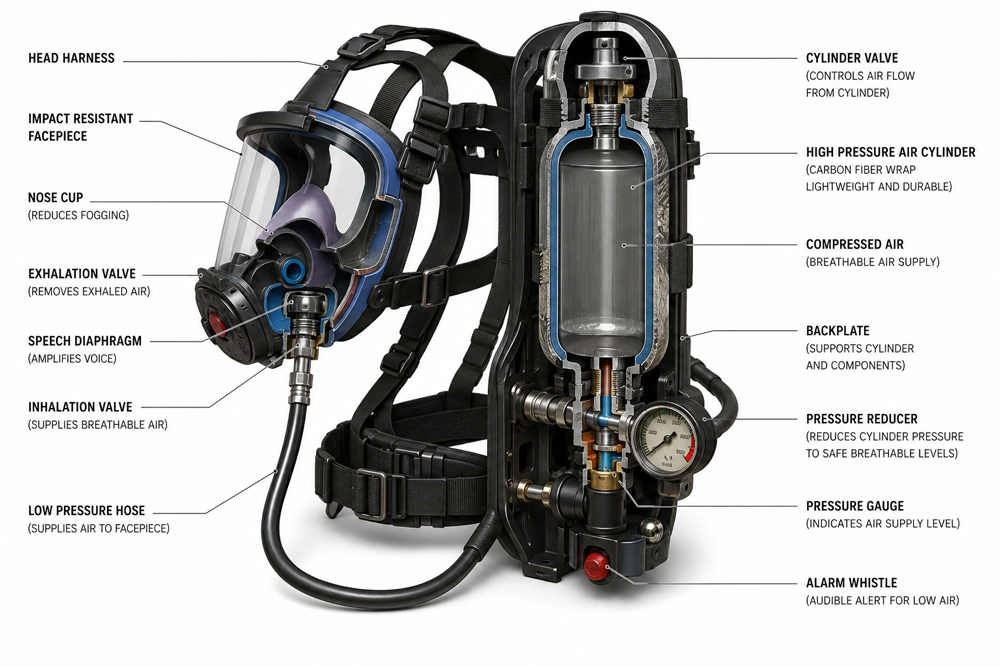
Self Contained Breathing Apparatus (SCBA)
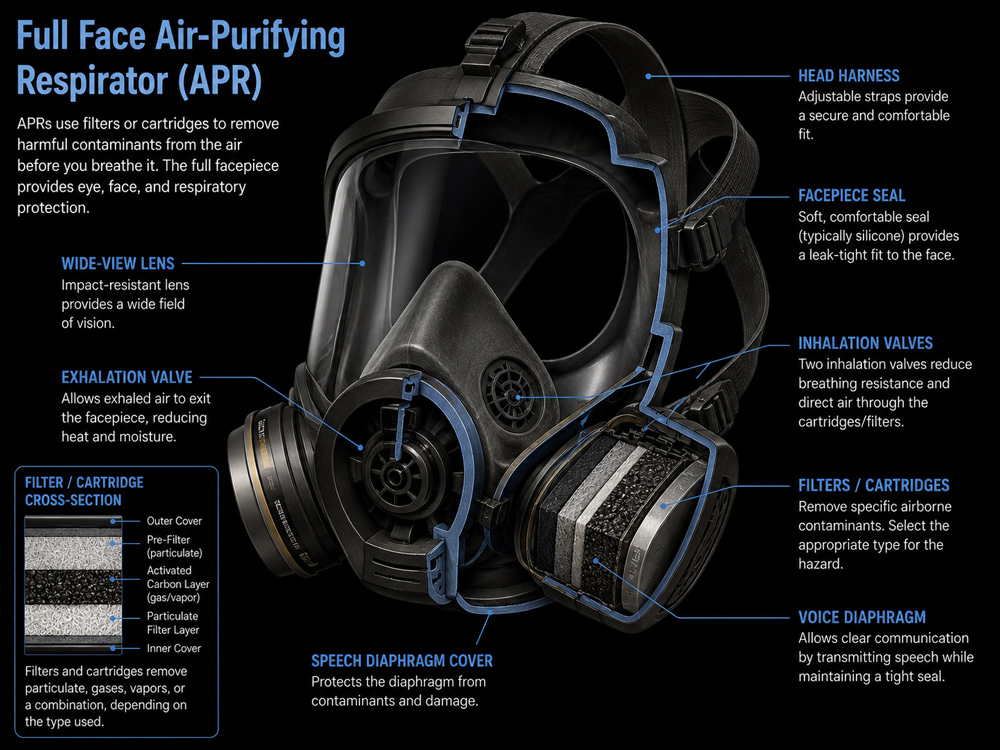
Air Purifying Respirator (APR)
Respirator Comparison by HAZWOPER Level
Level A: Maximum Protection
✅ When Used:
- Unknown airborne hazards or IDLH conditions (e.g., high toxicity gases, severe chemical spills).
- Oxygen-deficient environments (<19.5%).
- Maximum skin and respiratory protection required.
✅ Respirator Type:
| Respirator Type | Description | Protection Level |
|---|---|---|
| Full-Face SCBA (Self-Contained Breathing Apparatus) | Provides independent air supply (30-60 minutes of air) | Highest protection (APF 10,000) |
| Supplied-Air Respirator (SAR) with Escape SCBA | Air supply from a remote source, with a backup escape SCBA | Very high protection (APF 1,000) |
✅ Pros:
- Protection in IDLH and oxygen-deficient conditions.
- Provides clean air independent of the environment.
- Essential for unknown chemical exposure scenarios.
❌ Cons:
- Heavy and bulky; limited mobility.
- SCBA air supply is limited (requires monitoring).
- Requires extensive training and fit testing.
💡 Example Use Cases:
- Response to chemical spills with unknown hazards.
- Confined space entry where toxic gases may be present.
- Industrial accident response with high gas concentrations.
Level B: High Respiratory Protection, Moderate Skin Protection
✅ When Used:
- High airborne toxicity risk, but no risk of skin absorption.
- Oxygen-deficient environments (similar to Level A).
- Contaminant concentration is known and below IDLH limits.
✅ Respirator Type:
| Respirator Type | Description | Protection Level |
|---|---|---|
| Full-Face SCBA | Provides self-contained air supply | APF 10,000 |
| SAR with Escape SCBA | Remote air supply with backup escape air | APF 1,000 |
✅ Pros:
- Same respiratory protection as Level A but allows for less restrictive skin protection.
- Effective for highly toxic atmospheres with known contaminants.
❌ Cons:
- Still requires SCBA or SAR with backup air, limiting mobility.
- Not suitable for skin-absorbing hazardous materials.
💡 Example Use Cases:
- Chemical spill cleanup teams working outside the hot zone.
- Decontamination teams in hazardous zones.
- Waste site investigations with known airborne hazards.
Level C: Moderate Protection, Known Air Contaminants
✅ When Used:
- Airborne contaminants are known and below IDLH levels.
- Oxygen levels are safe (>19.5%).
- Minimal skin absorption risk.
✅ Respirator Type:
| Respirator Type | Description | Protection Level |
|---|---|---|
| Full-Face Air-Purifying Respirator (APR) | Uses filters/cartridges to remove contaminants | APF 50 |
| Half-Face Air-Purifying Respirator (APR) | Covers nose and mouth; lower protection | APF 10 |
| Powered Air-Purifying Respirator (PAPR) | Battery-powered blower assists breathing | APF 25-1,000 |
✅ Pros:
- Lightweight and more comfortable than SCBA.
- Longer use time since it doesn’t rely on a fixed air supply.
- Suitable for lower-risk hazardous environments.
❌ Cons:
- Not for IDLH or oxygen-deficient environments.
- Cartridges must be changed frequently to maintain effectiveness.
- Requires fit testing and proper selection of filters (NIOSH) color-coded system).
💡 Example Use Cases:
- Lead or asbestos abatement (P100 filters).
- Non-IDLH chemical spill cleanup (organic vapor filters).
- Industrial cleaning with solvent vapors.
Respirator Use by HAZWOPER Level
| HAZWOPER Level | Respirator Type | APF (Assigned Protection Factor) | Oxygen-Deficient or IDLH Use? | Example Use |
|---|---|---|---|---|
| Level A | SCBA or SAR with escape SCBA | 10,000 for pressure-demand, full-facepiece SCBA | Yes | Severe chemical spills and unknown hazards. |
| Level B | SCBA or SAR with escape SCBA | 10,000 for pressure-demand, full-facepiece SCBA | Yes | Decontamination teams and high-vapor-toxicity areas. |
| Level C | APR or PAPR | 10 to 1,000, depending on the approved respirator configuration | No | Lead or asbestos removal and non-IDLH spills. |
Important: Assigned protection factors apply only when the respirator is NIOSH-approved, properly selected for the hazard, fit tested when required, inspected, maintained, and used within a compliant respiratory protection program. APRs and PAPRs must not be used in oxygen-deficient or IDLH atmospheres.
Frequently Asked Questions
What is the main difference between Level A, Level B, and Level C respirator protection?
The main difference is the type of respiratory protection required by the hazard assessment. Level A and Level B ensembles use atmosphere-supplying respirators—typically a pressure-demand, full-face SCBA or a supplied-air respirator with an escape SCBA—because they may be used in IDLH, unknown, or oxygen-deficient atmospheres. Level C uses an APR or PAPR only when contaminants are identified, concentrations are below IDLH limits, oxygen is adequate, and the selected cartridge or filter is appropriate for the hazard.
Can an air-purifying respirator be used in an oxygen-deficient atmosphere?
No. APRs and PAPRs do not supply oxygen; they filter or purify the surrounding air. They must not be used in oxygen-deficient atmospheres, IDLH conditions, or situations where contaminant concentrations are unknown. Those conditions require an atmosphere-supplying respirator, such as an SCBA or SAR with an escape SCBA.
Why do both Level A and Level B commonly use SCBA or SAR?
Level A and Level B may both require the highest level of respiratory protection because airborne hazards can be unknown, highly toxic, IDLH, or present in oxygen-deficient conditions. The difference between the two levels is primarily skin protection: Level A provides a fully encapsulating vapor-tight suit, while Level B provides high respiratory protection with a lower level of skin protection.
What is an SCBA?
A self-contained breathing apparatus, or SCBA, carries a supply of breathable air on the wearer’s back. It does not depend on the surrounding atmosphere, which makes it appropriate for IDLH conditions, unknown atmospheres, and oxygen-deficient environments when properly selected and used within a respiratory protection program.
What is a supplied-air respirator?
A supplied-air respirator, or SAR, delivers breathable air from a remote source through an airline hose. For HAZWOPER work in IDLH conditions, the SAR must be used in a pressure-demand mode and equipped with an auxiliary self-contained air supply for escape if the airline source is interrupted.
When is Level C PPE appropriate?
Level C PPE may be appropriate when the airborne contaminant is known, measured concentrations are below IDLH limits, oxygen levels are adequate, and an APR or PAPR with the correct cartridge, canister, or filter can provide sufficient protection. The employer must also establish cartridge change schedules, fit-testing requirements, inspection procedures, and other respiratory-protection-program elements.
Does a full-face APR provide the same protection as an SCBA?
No. A full-face APR can provide eye and respiratory protection from identified contaminants when used with the correct cartridges or filters, but it depends on the surrounding air and does not supply oxygen. An SCBA provides breathable air from its own cylinder and is designed for use in conditions where an APR cannot be used, including IDLH or oxygen-deficient atmospheres.
What does APF mean in respirator selection?
APF means Assigned Protection Factor. It is the expected level of protection provided by a properly selected, fitted, maintained, and correctly used respirator within a compliant respiratory protection program. APF should never be used as the only basis for respirator selection; employers must also evaluate hazard concentration, oxygen level, chemical properties, cartridge limitations, and the possibility of changing site conditions.
Are fit tests required for HAZWOPER respirators?
Yes, fit testing is required for workers who use tight-fitting respirators, including full-face and half-face APRs, SAR facepieces, and SCBA facepieces. Fit testing must be completed before initial use, whenever a different facepiece is used, and at least annually thereafter. Workers must also be clean-shaven in the sealing area unless the facial hair does not interfere with the respirator seal.
Can facial hair interfere with respirator protection?
Yes. Facial hair between the face and the sealing surface can prevent a tight-fitting respirator from achieving an adequate seal. Workers who need to wear a tight-fitting respirator must be clean-shaven where the facepiece seals against the face. A loose-fitting PAPR hood may be an alternative in some situations, but it still cannot be used in oxygen-deficient or IDLH atmospheres.
Who decides which respirator and PPE level a worker should use?
The employer, site safety and health officer, or other qualified person must select respiratory protection and PPE based on the site hazard assessment, air-monitoring results, chemical properties, exposure limits, oxygen concentration, task requirements, and the site safety and health plan. Workers should never choose a respirator solely by appearance, comfort, or the perceived severity of the task.
Train for the Right Respirator Decision
Choosing between Level A, Level B, and Level C PPE is not simply a matter of selecting the most protective-looking suit or respirator. The correct decision depends on air-monitoring data, oxygen concentration, contaminant identity, exposure potential, chemical compatibility, task conditions, and the limits of the respiratory equipment being used.
OSHACode® HAZWOPER training gives workers and supervisors the knowledge foundation to understand respirator selection, PPE levels, IDLH hazards, air monitoring, decontamination, and respiratory protection requirements. Employers must then reinforce that knowledge through site-specific, hands-on training using the actual respirators, PPE, instruments, and emergency procedures their workforce will use on the job.
Prepare your team to recognize when an APR is appropriate, when supplied air is required, and when site conditions demand the highest level of respiratory protection.