

Summary
In HAZWOPER (Hazardous Waste Operations and Emergency Response) sites, both Supplied Air Respirators (SARs) and Self-Contained Breathing Apparatus (SCBA) are used for respiratory protection in hazardous environments such as Immediately Dangerous to Life and Health (IDLH). However, they have distinct differences in terms of operation, usage, and limitations.
Key Takeaways: When to Use What?
| Feature | Supplied Air Respirator (SAR) | Self-Contained Breathing Apparatus (SCBA) |
|---|---|---|
| Mobility | Limited by air hose | Full mobility |
| Usage Duration | Extended (as long as air source is functional) | Limited (typically 30-60 minutes) |
| Weight | Lighter | Heavier (~25-35 lbs) |
| Best for | Long-duration work in controlled environments (e.g., confined spaces, decon zones) | Emergency response, IDLH atmospheres, rescue operations |
| Major Weakness | Dependent on external air source | Air supply is limited; heavier to wear |
SAR and SCBA Comparison
| Feature | Self-Contained Breathing Apparatus (SCBA) | Supplied-Air Respirator (SAR) | Best Choice |
|---|---|---|---|
| Air Source | Compressed breathing air carried on the wearer's back. | Breathing air supplied through an airline from a remote compressor or air cylinders. | Depends on the application |
| Mobility | ★★★★★ Excellent mobility with no airline restrictions. | ★★☆☆☆ Limited by the airline hose. | SCBA |
| Work Duration | Typically 30–60 minutes depending on cylinder size and work rate. | Continuous breathing air for extended work periods. | SAR |
| IDLH Atmospheres | Yes. Designed specifically for IDLH environments. | Yes, when properly configured with an emergency escape cylinder and used in accordance with OSHA requirements. | Tie* |
| Unknown Atmospheres | Recommended because breathing air is independent of the surrounding atmosphere. | Generally not preferred for unknown atmospheric conditions. | SCBA |
| Weight on Worker | Heavier because the air cylinder is carried by the user. | Lighter because breathing air comes from a remote source. | SAR |
| Air Supply | Limited by cylinder capacity. | Continuous while connected to the remote breathing air source. | SAR |
| Freedom of Movement | Excellent for climbing, rescue, and emergency response. | Movement limited by the airline. | SCBA |
| Maintenance | Cylinder filling, hydrostatic testing, regulator inspections, and routine maintenance. | Airline inspections, compressor maintenance, breathing air quality verification, and regulator inspections. | Tie |
| Typical Applications | HAZWOPER, firefighting, confined space rescue, chemical spill response, and emergency response. | Spray painting, abrasive blasting, tank cleaning, industrial maintenance, and extended-duration confined space work. | Depends on the task |
| Primary Advantage | Maximum respiratory protection with unrestricted mobility. | Extended work time with less weight carried by the worker. | Depends on priorities |
| Primary Limitation | Limited breathing air supply and heavier equipment. | Airline hose may restrict movement and create trip hazards. | — |
*Note: OSHA permits pressure-demand supplied-air respirators (SARs) to be used in certain IDLH atmospheres when equipped with an auxiliary self-contained escape air supply and used in accordance with OSHA's respiratory protection requirements. Respirator selection should always be based on a documented hazard assessment, atmospheric monitoring, and the specific work being performed.

SCBA vs. SAR: Advantages and Limitations
| SCBA Advantages | SCBA Limitations | SAR Advantages | SAR Limitations |
|---|---|---|---|
|
✔ Maximum respiratory protection ✔ Excellent mobility with no airline restrictions ✔ Ideal for emergency response operations ✔ Suitable for unknown atmospheres ✔ Designed for IDLH environments ✔ No external air source required ✔ Excellent for rescue operations |
✖ Limited breathing air supply ✖ Heavier than SAR systems ✖ Requires cylinder refilling or replacement ✖ Greater wearer fatigue during long operations ✖ Higher equipment cost ✖ More frequent cylinder inspections |
✔ Continuous breathing air supply ✔ Ideal for extended-duration work ✔ Lighter equipment carried by the worker ✔ Reduces worker fatigue ✔ Excellent for repetitive industrial tasks ✔ Lower breathing resistance |
✖ Airline restricts movement ✖ Hose may snag or create trip hazards ✖ Requires a remote breathing air source ✖ Less suitable for rapidly changing emergencies ✖ Air supply depends on hose integrity ✖ Setup time is generally longer |
Typical Applications
| Job | Best Choice |
|---|---|
| Chemical Spill | SCBA |
| Fire Response | SCBA |
| HAZWOPER Entry | SCBA |
| Confined Space Rescue | SCBA |
| Spray Painting | SAR |
| Tank Cleaning | SAR |
| Industrial Coatings | SAR |
| Abrasive Blasting | SAR |
Selection Factors
When selecting respiratory protection consider:
✓ Oxygen concentration
✓ Contaminant concentration
✓ IDLH potential
✓ Duration
✓ Mobility
✓ Temperature
✓ Rescue capability
✓ Communication
✓ Work task
Supplied Air Respirator (SAR)

🔹 How They Work:
- SARs provide air through a hose connected to a remote air source (compressed air cylinders or an air compressor with proper filtration).
- Can be equipped with an escape bottle (usually 5-15 minutes) in case the primary air supply fails.
🔹 Advantages:
✅ Extended use time – Since air is supplied continuously, SARs are ideal for long-duration work.
✅ Lighter weight – The user doesn’t carry a heavy air tank, reducing fatigue.
✅ More comfortable – Often preferred for extended tasks due to reduced heat buildup and weight.
🔹 Disadvantages:
❌ Limited mobility – The user is tethered to the air supply via a hose (typically up to 300 feet), restricting movement.
❌ Hose vulnerability – If the hose is pinched, cut, or disconnected, the air supply is compromised.
❌ Not ideal for immediate escape – In an emergency, users must rely on the escape bottle or move quickly to a safe area.
🔹 Best Used For:
- Confined space entry where extended air supply is needed.
- Hazardous material cleanup in controlled zones.
- Decontamination operations where movement is limited.
- Tank or vessel entry where continuous breathing air is required.
Self-Contained Breathing Apparatus (SCBA)
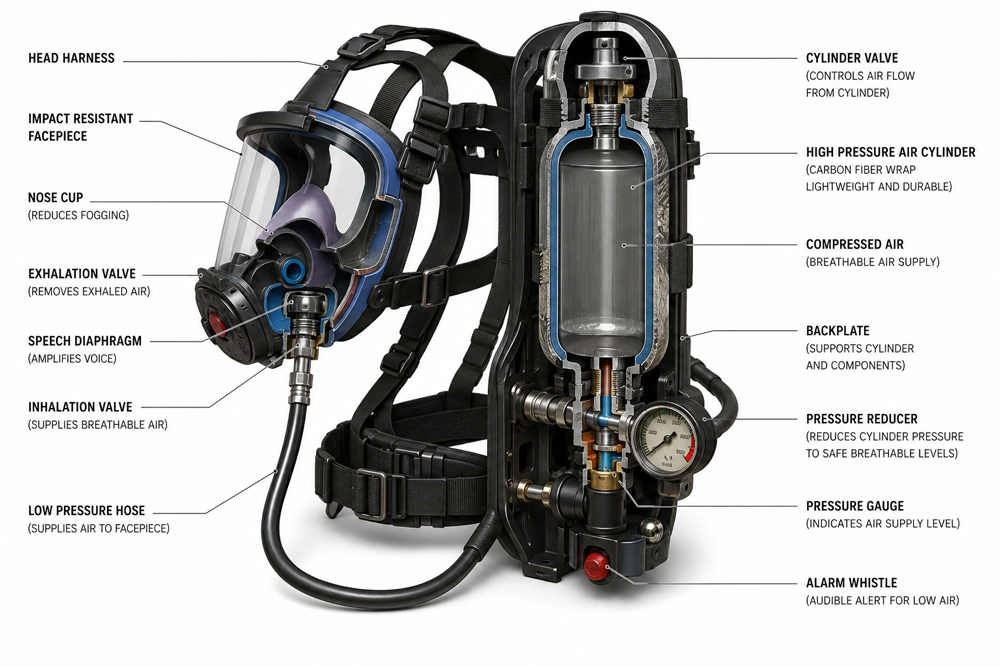
🔹 How They Work:
- SCBAs use a high-pressure air cylinder (typically 2,216 to 4,500 psi) worn on the back, supplying air through a regulator.
- Air time is limited (typically 30-60 minutes, realistically ~15-45 minutes due to stress, workload, and breathing rate).
🔹 Advantages:
✅ Total mobility – Since SCBAs are independent of external air sources, they allow freedom of movement in any direction.
✅ Immediate response ready – Perfect for emergencies, unknown atmospheres, and IDLH conditions.
✅ No dependency on external supply – No hoses that can get damaged or limit movement.
🔹 Disadvantages:
❌ Limited air supply – Once the air in the tank runs out, you must exit immediately.
❌ Heavy and bulky – A standard SCBA can weigh 25-35 pounds, which adds physical strain.
❌ Heat buildup – Increases body temperature and fatigue, reducing work time.
🔹 Best Used For:
- Emergency response to chemical spills, unknown vapors, or fire incidents.
- Rescue operations in IDLH atmospheres.
- Situations where full mobility is required, such as exploring unknown hazardous zones.
- Short-duration work in oxygen-deficient environments.
Common Mistakes
Examples:
Choosing an Air-purifying Respirator (APR) instead of SCBA
Using SAR without escape bottle
Ignoring hose routing
Entering unknown atmosphere
Failing air monitoring
Poor fit testing
Skipping inspection
Using damaged airlines
Inspection Checklist
Before Use:
☐ Airline inspected
☐ Cylinder pressure
☐ Regulator
☐ Facepiece
☐ Alarm
☐ Connections
☐ Air quality
☐ Escape bottle (SAR)
Regulatory & HAZWOPER Compliance
Both SARs and SCBAs fall under OSHA 29 CFR 1910.120 (HAZWOPER) and 29 CFR 1910.134 (Respiratory Protection).
🔹 SCBAs are required for entry into IDLH conditions.
🔹 SARs with an escape bottle may be acceptable in some non-IDLH hazardous environments.
🔹 All users must be properly trained in donning, doffing, and emergency procedures.
Final Thought
If you need to move freely and face unknown hazards, SCBA is your go-to. If you’re working in a controlled space for an extended period, SARs are the better option (as long as there’s a backup escape bottle).
Both have critical roles at HAZWOPER sites, and choosing the right one can mean the difference between life and death in hazardous environments.
Frequently Asked Questions
What is the difference between an SCBA and a supplied-air respirator (SAR)?
An SCBA supplies breathing air from a compressed air cylinder carried by the wearer. SARs delivers breathable air through an airline connected to a remote air source, allowing for longer work durations while limiting the wearer’s mobility.
Which respirator provides the highest level of respiratory protection?
Both SCBAs and properly configured pressure-demand SARs provide a high level of respiratory protection. The appropriate choice depends on the workplace hazard assessment, atmospheric conditions, and OSHA respiratory protection requirements.
When should an SCBA be used?
SCBAs are commonly used in IDLH atmospheres, unknown environments, hazardous waste operations, emergency response, firefighting, confined space rescue, and situations where maximum mobility is required.
When is a supplied-air respirator (SAR) the better choice?
SARs are often selected for long-duration tasks such as spray painting, abrasive blasting, tank cleaning, industrial maintenance, and other operations where a continuous supply of breathable air is beneficial and worker mobility is less restricted.
Can a supplied-air respirator be used in an IDLH atmosphere?
Yes. OSHA permits certain pressure-demand supplied-air respirators to be used in IDLH atmospheres when they are equipped with an auxiliary self-contained escape air supply and all applicable respiratory protection requirements are met.
Why is an SCBA preferred for emergency response?
An SCBA allows responders to carry their own breathing air, providing unrestricted movement without relying on an external airline. This makes it well suited for rapidly changing emergencies, hazardous waste incidents, and rescue operations.
Which respirator is better for long-duration work?
A supplied-air respirator is generally the better choice for extended work because it provides a continuous supply of breathing air from a remote source. Workers are not limited by the capacity of a compressed air cylinder.
Can air-purifying respirators (APRs) replace an SCBA or SAR?
No. Air-purifying respirators remove contaminants from the surrounding air but do not supply oxygen. They should never be used in oxygen-deficient or IDLH atmospheres or where contaminants are unknown.
How do employers determine which respirator to use?
Employers should perform a documented hazard assessment that considers atmospheric testing, oxygen concentration, contaminant type and concentration, exposure limits, work duration, mobility requirements, and emergency response considerations before selecting respiratory protection.
Are SCBAs and SARs used during HAZWOPER operations?
Yes. Both respirator types may be used during HAZWOPER operations depending on the hazards identified through air monitoring and the required level of respiratory protection. SCBAs are commonly used during emergency response and unknown atmospheric conditions, while SARs may be appropriate for certain planned operations where continuous breathing air is advantageous.
What OSHA standard governs respiratory protection?
OSHA’s Respiratory Protection Standard, 29 CFR 1910.134, establishes requirements for respirator selection, medical evaluations, fit testing, training, inspection, maintenance, and use. Employees covered by HAZWOPER must also comply with applicable respiratory protection requirements under 29 CFR 1910.120.
Why is proper respirator selection important?
Selecting the correct respirator protects workers from hazardous airborne contaminants while helping employers comply with OSHA regulations. A proper hazard assessment, atmospheric monitoring, employee training, and routine equipment inspections are all essential components of an effective respiratory protection program.
Sources
Emergency Response and Preparedness
OSHA HAZWOPER Hands-on Training Requirement
Medical Surveillance Requirements
U.S. Occupational Safety and Health Administration
https://www.osha.gov/laws-regs/standardinterpretations/1992-08-27-1
U.S. Environmental Protection Agency
https://www.epa.gov/laws-regulations/summary-resource-conservation-and-recovery-act
Related Articles
Building a HAZWOPER Safety Culture
Hands-on Training Discussions with U.S. OSHA