Summary:
The Lifeline of HAZWOPER and HAZMAT Response
The Self-Contained Breathing Apparatus (SCBA) is a critical part of an individuals personal protective equipment (PPE). In the high-risk world of Hazardous Waste Operations and Emergency Response (HAZWOPER), few pieces of PPE are as vital—or as trusted—as the SCBA.
When entering environments filled with toxic gases, vapors, or particulates—or where oxygen levels are dangerously low—workers must rely on an SCBA to breathe safely. The Occupational Safety and Health Administration (OSHA), through 29 CFR 1910.134 (Respiratory Protection) and 29 CFR 1910.120 HAZWOPER, mandates that employees who may be exposed to airborne contaminants in concentrations exceeding permissible limits must use appropriate respiratory protection. The SCBA stands at the top of that hierarchy, providing the highest level of respiratory defense during Level A and Level B HAZWOPER operations. It is, quite literally, a worker’s lifeline when the surrounding atmosphere can kill in seconds.
Key Takeaways
- An SCBA is a respiratory protection device that provides the user with a portable supply of breathable air.
- SCBAs are used in environments that are oxygen-deficient, contaminated, or immediately dangerous to life or health (IDLH).
- SCBAs are commonly used during HAZWOPER operations, hazardous materials response, confined space entry, firefighting, and emergency rescue activities.
- Most industrial SCBAs use compressed Grade D breathing air stored in a high-pressure cylinder.
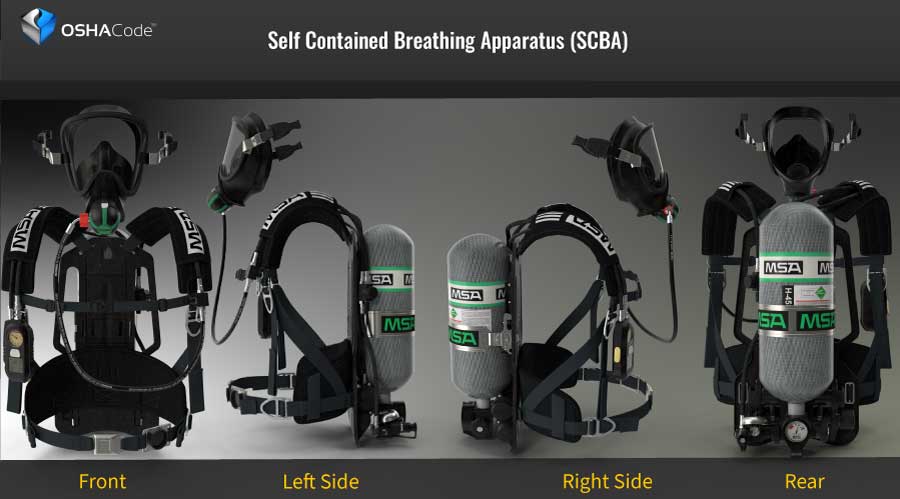
- A typical SCBA consists of a cylinder, regulator, harness assembly, pressure gauges, alarms, and a full-face respirator.
- Positive-pressure SCBAs help prevent contaminants from entering the facepiece during use.
- SCBAs are required when air-purifying respirators (APRs) cannot provide adequate protection against workplace hazards.
- OSHA requires medical evaluations, fit testing, training, and maintenance programs for employees who use SCBAs.
- Users must inspect SCBAs before each use and remove defective equipment from service immediately.
- SCBA use can increase heat stress, fatigue, and physical workload, making proper training and fitness essential.
- Emergency escape SCBAs are designed for evacuation only and are not intended for routine work operations.
- Proper SCBA training helps workers recognize hazards, conserve air, respond to emergencies, and safely operate in hazardous atmospheres.
What Is a Self-Contained Breathing Apparatus?
An SCBA is a respiratory device that supplies breathable air from a compressed air cylinder carried by the user, rather than relying on ambient air. It allows workers to operate independently in hazardous or oxygen-deficient environments, free from exposure to toxic vapors, smoke, dusts, or biological contaminants. Unlike APRs that filter existing air, SCBAs deliver clean, compressed air directly through a regulator and facepiece, ensuring complete isolation from the environment. This makes them indispensable during HAZWOPER site entries, confined space rescues, chemical spill responses, and firefighting operations where air quality cannot be guaranteed. OSHA and the National Fire Protection Association (NFPA) classify SCBAs as part of atmosphere-supplying respirators, and they are the standard respiratory protection for any IDLH atmosphere.
Types of SCBA Systems
There are two main categories of SCBAs used in hazardous waste and emergency response operations: Open-Circuit and Closed-Circuit systems. Both serve the same core purpose—supplying breathable air—but they operate differently depending on mission needs and duration.
Open-Circuit SCBA: This is the most common type, used by firefighters, hazardous materials (HAZMAT) responders, and environmental cleanup crews. In an open-circuit system, compressed air is stored in a high-pressure cylinder (typically 2,216 or 4,500 psi) and delivered to the user through a regulator and facepiece. Exhaled air is vented into the atmosphere. Depending on the cylinder size and breathing rate, these units usually provide 30 to 60 minutes of air. They are lightweight, reliable, and ideal for rapid-response or short-duration missions.
Closed-Circuit SCBA (Rebreather): In closed-circuit systems, exhaled air is recycled by removing carbon dioxide through chemical filters and replenishing oxygen from an internal source. This allows for extended use—often up to four hours of continuous breathing time. Closed-circuit SCBAs are used in long-duration operations, mine rescues, confined space entries, and other scenarios where refilling air cylinders is impractical. Although heavier and more complex, they excel in endurance and efficiency.
Some manufacturers also produce escape-only SCBAs, designed for emergency evacuation from contaminated areas. These compact units provide 5 to 15 minutes of breathable air, giving workers just enough time to exit a hazardous environment safely.

Minimum Air Quality Standards for SCBA Systems
The quality of air supplied to an SCBA must meet the Compressed Gas Association (CGA) Grade D breathing air standard, as required by OSHA 29 CFR 1910.134(i). This ensures that the air workers breathe is clean, safe, and contaminant-free. According to Grade D standards, SCBA breathing air must contain:
-
Oxygen content: 19.5% to 23.5%
-
Carbon monoxide (CO): Less than 10 parts per million (ppm)
-
Carbon dioxide (CO₂): Less than 1,000 ppm
-
Particulate matter: No more than 5 mg/m³
-
Hydrocarbon vapor or mist: No more than 5 mg/m³
-
No noticeable odor or taste
Air must be produced and stored in systems that are tested regularly, free from oil carryover, and protected against contamination. Employers must document testing results and maintain maintenance logs to demonstrate compliance. This level of scrutiny ensures that every breath drawn through an SCBA is as clean as the air outside the hazard zone.
Where SCBAs Are Used
SCBAs are essential in any workplace or operation where atmospheric hazards are unknown or exceed OSHA’s permissible exposure limits. These environments are classified as IDLH atmospheres, where life-threatening conditions can occur instantly. Common examples include:
-
HAZWOPER Level A and Level B operations at chemical spill or waste remediation sites.
-
Firefighting and industrial response involving smoke, combustion gases, and unknown vapors.
-
Confined spaces such as tanks, tunnels, or sewers, where oxygen deficiency or gas accumulation is a risk.
-
Environmental emergencies, such as refinery explosions, train derailments, or industrial accidents.
-
Hazardous material transportation incidents where responders must approach leaking containers or tank cars.
-
Waste treatment, storage, and disposal facilities (TSDFs) where off-gassing or chemical decomposition can create toxic atmospheres.
In each of these scenarios, SCBAs protect workers from inhaling harmful substances while allowing them to perform rescue, containment, or cleanup activities efficiently. They are not optional; they are the difference between safe entry and fatal exposure.
Inspection, Maintenance, and Fit Testing
Proper inspection and maintenance are critical to SCBA reliability. OSHA requires employers to establish a written respiratory protection program, including regular inspections, fit testing, and preventive maintenance schedules. Users must inspect their SCBA before every use, checking cylinder pressure (at least 90% of full capacity), regulator function, straps, facepiece seals, and alarms. Cylinders must undergo hydrostatic testing every 3 to 5 years, depending on cylinder material, and air refilling stations must meet CGA Grade D standards. Annual fit testing ensures the facepiece seals correctly against the user’s skin—any leak can compromise safety in seconds.
Training is equally important. Workers must be proficient in donning and doffing the unit, switching to emergency air supplies, managing limited visibility, and recognizing alarm signals indicating low air pressure. These hands-on skills are reinforced in HAZWOPER 40-hour and 24-hour certification courses, where participants learn not only how to wear an SCBA, but how to think and move while wearing one in a real emergency.
Components of a Self-Contained Breathing Apparatus (SCBA)
The SCBA is a highly engineered life-support system designed to provide breathable air to workers operating in hazardous or oxygen-deficient environments. It is the backbone of respiratory protection during HAZWOPER operations, firefighting, confined space entries, and hazardous materials response—any setting where the surrounding air cannot be trusted. Every component of an SCBA plays a critical role in ensuring a continuous, safe, and controlled air supply to the user. Together, these components form a seamless system that keeps workers alive in atmospheres that are IDLH. Below is a detailed narrative describing the major components of a standard open-circuit SCBA and how each part functions.
1. High-Pressure Air Cylinder
At the heart of the SCBA system is the high-pressure air cylinder, which stores clean, compressed breathing air. This is not oxygen—it’s filtered, compressed atmospheric air that meets CGA Grade D breathing air standards (19.5–23.5% oxygen, minimal contaminants, and no noticeable odor). Cylinders are typically constructed of aluminum, carbon fiber, or composite materials, and they are pressurized to 2,216 psi (low-pressure) or 4,500 psi (high-pressure). The cylinder’s capacity—measured in cubic feet or liters—determines how long the air supply will last, usually between 30 to 60 minutes, depending on breathing rate and workload. Each cylinder includes a pressure gauge and a cylinder valve assembly to control airflow. Cylinders must undergo hydrostatic testing every three or five years to ensure integrity and are visually inspected before every use for cracks, corrosion, or pressure loss.
Functionally, the cylinder is the SCBA’s “air tank,” providing the lifeline of breathable air that isolates the user from the external environment.
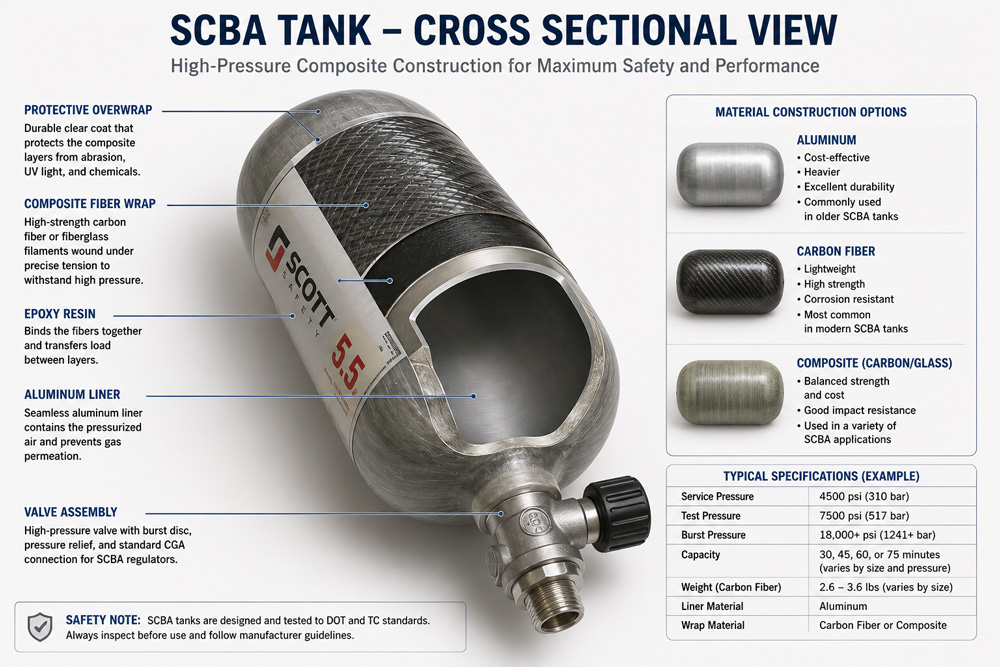
2. Cylinder Valve and Handwheel Assembly
The valve assembly is mounted on the top of the cylinder and acts as the gateway controlling the release of compressed air into the SCBA system. The handwheel—a round, ridged knob—allows the user to manually open or close the valve. When opened, air travels from the cylinder into the high-pressure hose, initiating airflow to the pressure reducer or first-stage regulator. The valve assembly often includes a burst disc (safety relief device) to prevent over-pressurization and a check valve to ensure one-way airflow. In modern SCBAs, the valve assembly also incorporates a Quick-Connect coupling for fast cylinder replacement during emergency operations.
Functionally, the valve controls the start and stop of air flow, and the handwheel allows precise user control—even while wearing bulky gloves or chemical-resistant suits.
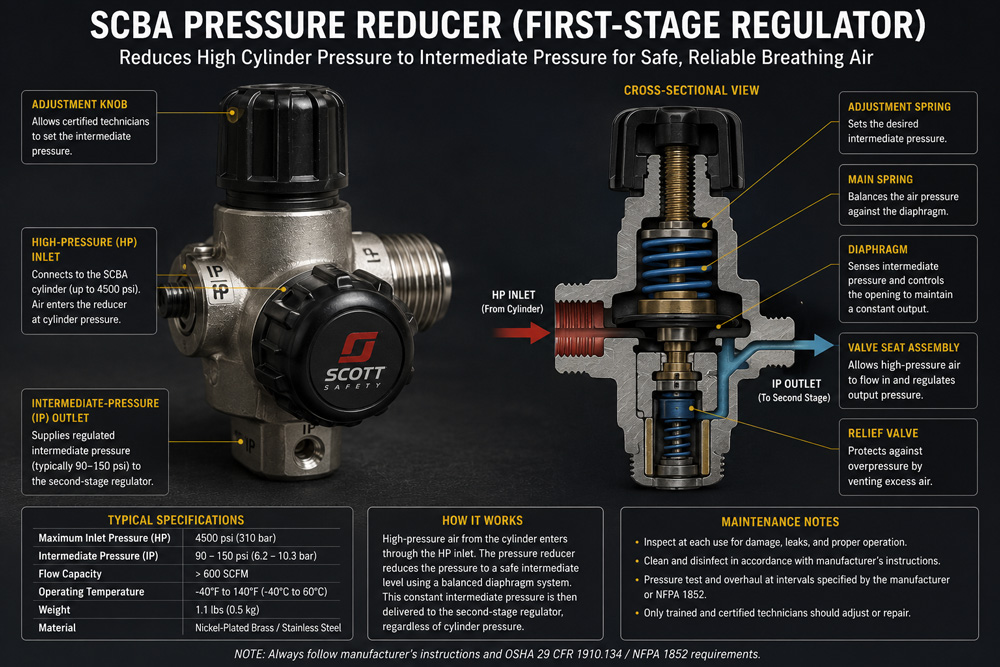
3. Pressure Reducer (First-Stage Regulator)
Once air leaves the high-pressure cylinder, it travels into the pressure reducer, also known as the first-stage regulator. This component reduces the extremely high cylinder pressure (up to 4,500 psi) to an intermediate pressure (around 80–125 psi). This step is crucial because the air delivered to the user’s facepiece must be at a safe, breathable pressure, not the dangerous levels stored inside the tank. The pressure reducer also helps maintain a steady airflow regardless of cylinder pressure, ensuring that the user receives consistent air volume as the tank depletes.
In many SCBA designs, the pressure reducer is housed within the backplate assembly, protected from impacts. It often includes a low-pressure alarm system that activates when cylinder pressure drops below 20–25% of capacity—alerting the user that their air supply is running low.
Functionally, the pressure reducer is the “control center” that ensures the user receives steady, breathable air instead of high-pressure bursts.
4. High-Pressure and Low-Pressure Hoses
The SCBA system uses a series of reinforced air hoses to transport air from the cylinder to the regulator and then to the facepiece. The high-pressure hose connects the cylinder valve to the first-stage regulator, designed to withstand pressures of several thousand psi. The low-pressure hose carries air from the regulator to the facepiece at a safe, breathable level.
Some SCBAs also include bypass hoses or emergency air supply lines that allow users to share air with another worker during rescue operations. All hoses are made from durable, chemical-resistant materials such as neoprene or reinforced rubber to prevent leaks or degradation from chemical contact.
Functionally, the hose system is the “arterial network” of the SCBA—delivering clean air where it’s needed while maintaining flexibility and safety.
5. Regulator (Second-Stage Regulator)
The second-stage regulator—often mounted directly on or near the facepiece—further reduces air pressure and delivers it to the user on demand. Modern regulators are “pressure-demand” systems, meaning they supply air automatically when the user inhales and stop when the user exhales. This design conserves air and maintains a positive pressure inside the mask to prevent contaminants from leaking in. In the event of regulator failure, many SCBAs feature an emergency bypass valve that allows manual airflow to the facepiece.
Functionally, the second-stage regulator ensures that air delivery matches the user’s breathing pattern—steady, comfortable, and responsive.
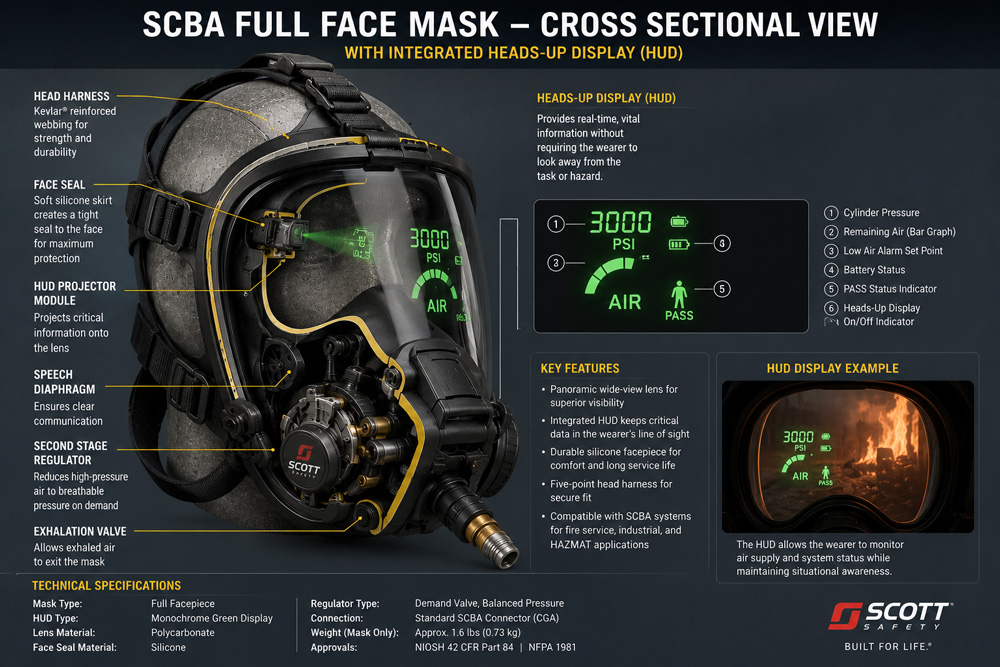
6. Facepiece (Full Face Mask)
The facepiece, also called the mask, is one of the most visible and crucial parts of an SCBA. It creates a tight seal around the user’s face, completely isolating the respiratory system from the environment. Made from heat-resistant silicone or neoprene rubber, the mask includes a polycarbonate lens for visibility, exhalation valves, and communication ports. The facepiece connects directly to the regulator, ensuring that the user receives filtered air at the correct pressure.
Some modern SCBAs feature voice amplifiers or radio-integrated microphones to improve communication in noisy or confined environments. A properly fitted facepiece is vital—any leak breaks the protective barrier and can allow contaminants inside. OSHA requires annual fit testing for all SCBA users to verify mask integrity and fit.
Functionally, the facepiece is the “shield” of the SCBA—keeping hazards out while delivering the air of life in.
7. Harness and Backframe Assembly
The harness and backframe form the physical structure that holds the entire SCBA on the user’s body. The backframe is typically made of lightweight aluminum or composite materials, designed to cradle the air cylinder securely. The harness straps—usually padded and adjustable—distribute the SCBA’s weight evenly across the shoulders, chest, and waist. Quick-release buckles and ergonomic designs allow for rapid donning and doffing, which is essential during emergencies.
Some advanced models feature integrated PASS (Personal Alert Safety Systems) that emit loud alarms if the user becomes motionless or distressed. This feature, combined with reflective surfaces and electronic tracking, enhances safety during low-visibility or IDLH operations.
Functionally, the harness is the “backbone” of the SCBA—providing comfort, stability, and mobility while ensuring the system remains securely in place.

8. PASS Device (Personal Alert Safety System)
Modern SCBAs often include an integrated PASS device, an electronic alarm that monitors user motion. If the wearer remains motionless for more than 30 seconds—or manually activates the alarm—it emits a loud, high-pitched sound to alert nearby personnel. The PASS device helps rescuers locate incapacitated workers in smoky, dark, or contaminated environments.
Many PASS units are now part of smart SCBA systems, capable of transmitting data—such as air pressure, alarm status, and user location—to incident command in real time.
Functionally, the PASS device is the “safety sentinel,” constantly monitoring the wearer’s status and alerting others to danger.
9. Pressure Gauge and Heads-Up Display (HUD)
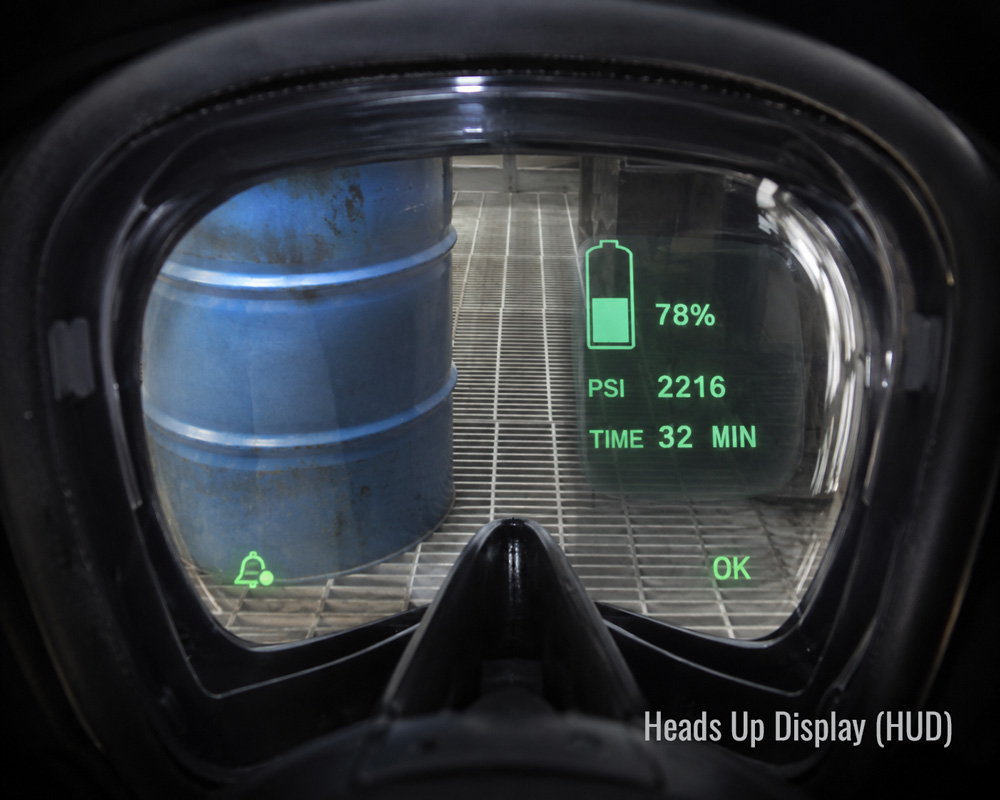
Every SCBA includes a pressure gauge that allows users to monitor their remaining air supply. Gauges are often mechanical but are increasingly supplemented by digital Heads-Up Displays (HUDs) integrated inside the facepiece. These displays show real-time air pressure levels, often using LED color codes—green (full), yellow (half), and red (low). Some systems also include vibrating alarms or audible beeps that warn users as air pressure drops below safe limits.
Functionally, the gauge and HUD serve as the “dashboard” of the SCBA, giving the user constant awareness of their remaining air and ensuring no one runs out unexpectedly.
Advancements in SCBA Technology
Modern SCBAs have evolved dramatically from their early designs. Today’s units feature lightweight composite cylinders, digital pressure gauges, and integrated electronic monitoring systems. Many include HUDs that project remaining air time directly inside the facepiece, reducing guesswork during critical operations. Advanced PASS systems automatically trigger alarms if a user becomes motionless, alerting team members to a potential rescue situation. Some newer SCBAs even integrate wireless telemetry, transmitting real-time air pressure, location, and physiological data to incident commanders—a breakthrough that enhances situational awareness and overall team safety.
Conclusion: Why SCBAs Are the Heart of HAZWOPER Safety
In every hazardous environment—whether a leaking chemical tank, a smoke-filled confined space, or an emergency spill site—the SCBA stands as the ultimate line of defense between a worker and the invisible dangers around them. SCBAs embody the spirit of HAZWOPER compliance: preparedness, protection, and prevention. They ensure that workers can perform their duties safely, without compromising their health or their lives. Understanding the types of SCBAs, the air quality standards, and where and how they’re used is essential for every safety professional, emergency responder, and hazardous waste worker. When the air itself becomes your enemy, the SCBA becomes your greatest ally—your connection to life, and your assurance that you can do the job and go home safely.
Frequently Asked Questions
What is a Self-Contained Breathing Apparatus (SCBA)?
An SCBA is a respiratory protection device that supplies the wearer with breathable air from a compressed air cylinder carried on the user’s back. SCBAs allow workers to operate safely in hazardous, toxic, or oxygen-deficient environments.
What does SCBA stand for?
SCBA stands for Self-Contained Breathing Apparatus. The term refers to a respirator system that carries its own air supply and does not rely on the surrounding atmosphere for breathing air.
When is an SCBA required?
An SCBA is required when workers may be exposed to oxygen-deficient atmospheres, unknown airborne contaminants, toxic gases, or conditions classified as IDLH.
What is an IDLH atmosphere?
IDLH stands for Immediately Dangerous to Life or Health. An IDLH atmosphere presents an immediate threat to life, may cause irreversible health effects, or could impair a worker’s ability to escape safely.
What are the main components of an SCBA?
A typical SCBA includes a compressed air cylinder, pressure regulator, harness assembly, facepiece, pressure gauges, warning alarms, and connecting hoses that deliver breathable air to the user.
How long does an SCBA air cylinder last?
The duration of an SCBA depends on cylinder size, work rate, breathing rate, and environmental conditions. Common industrial SCBAs are rated for approximately 30 to 60 minutes under ideal conditions, although actual service time is often less.
What is the difference between an SCBA and an air-purifying respirator?
An SCBA provides its own supply of breathable air, while an air-purifying respirator filters contaminants from the surrounding atmosphere. SCBAs are used when contaminants are unknown, highly toxic, or when oxygen levels are inadequate.
Are SCBAs required for Level A and Level B PPE?
Yes. Level A PPE typically requires a positive-pressure SCBA worn inside a fully encapsulating chemical-resistant suit. Level B PPE also generally requires an SCBA but provides a lower level of skin protection.
Does OSHA require SCBA training?
Yes. OSHA requires employees to receive training on respirator use, limitations, inspection procedures, maintenance requirements, emergency operations, and proper use before being assigned work requiring an SCBA.
Is medical clearance required before using an SCBA?
Yes. Employees must receive a medical evaluation to determine whether they are physically capable of safely wearing and using an SCBA before respirator use is permitted.
Is fit testing required for SCBA users?
Yes. OSHA requires fit testing for tight-fitting respirators, including SCBA facepieces, to ensure an effective seal and adequate respiratory protection.
What is positive-pressure SCBA?
A positive-pressure SCBA maintains a slight positive pressure inside the facepiece, helping prevent hazardous contaminants from entering through leaks in the seal.
Can an SCBA be used for confined space entry?
Yes. SCBAs are commonly used during confined space entry when atmospheric hazards, oxygen deficiency, or toxic contaminants may be present.
How often should an SCBA be inspected?
SCBAs should be inspected before each use and maintained according to manufacturer recommendations and employer respiratory protection programs. Any defective equipment should be removed from service immediately.
What are the limitations of an SCBA?
SCBAs add weight and physical strain to the user, have a limited air supply, may restrict movement, and require extensive training, maintenance, and medical qualification. Despite these limitations, they provide the highest level of respiratory protection available for many hazardous environments.
What OSHA standard covers SCBA use?
SCBA use is primarily governed by OSHA’s Respiratory Protection Standard, 29 CFR 1910.134. Additional requirements may apply under standards such as HAZWOPER, Confined Spaces, and Emergency Response regulations.
Ready to Strengthen Your Respiratory Protection Knowledge?
Understanding how to properly select, inspect, and use an SCBA is essential for protecting workers in hazardous atmospheres. Whether you work in hazardous waste operations, emergency response, industrial safety, confined space entry, or environmental remediation, proper respiratory protection training can help reduce risk and improve workplace safety.
OSHACode offers comprehensive online safety training designed to help workers and employers better understand OSHA requirements, hazard recognition, PPE, respiratory protection, and HAZWOPER compliance. Explore our industry-leading HAZWOPER training courses and take the next step toward building a safer, more knowledgeable workforce.
Start your training today and gain the knowledge needed to work safely in hazardous environments.
Related Articles
Hands-on Training Discussions with U.S. OSHA
PPE Importance in HAZWOPER Operations
Emergency Response and Preparedness
OSHA HAZWOPER Hands-on Training Requirement
Sources
U.S. Occupational Safety and Health Administration
https://www.osha.gov/laws-regs/standardinterpretations/1994-04-25-1