
Summary
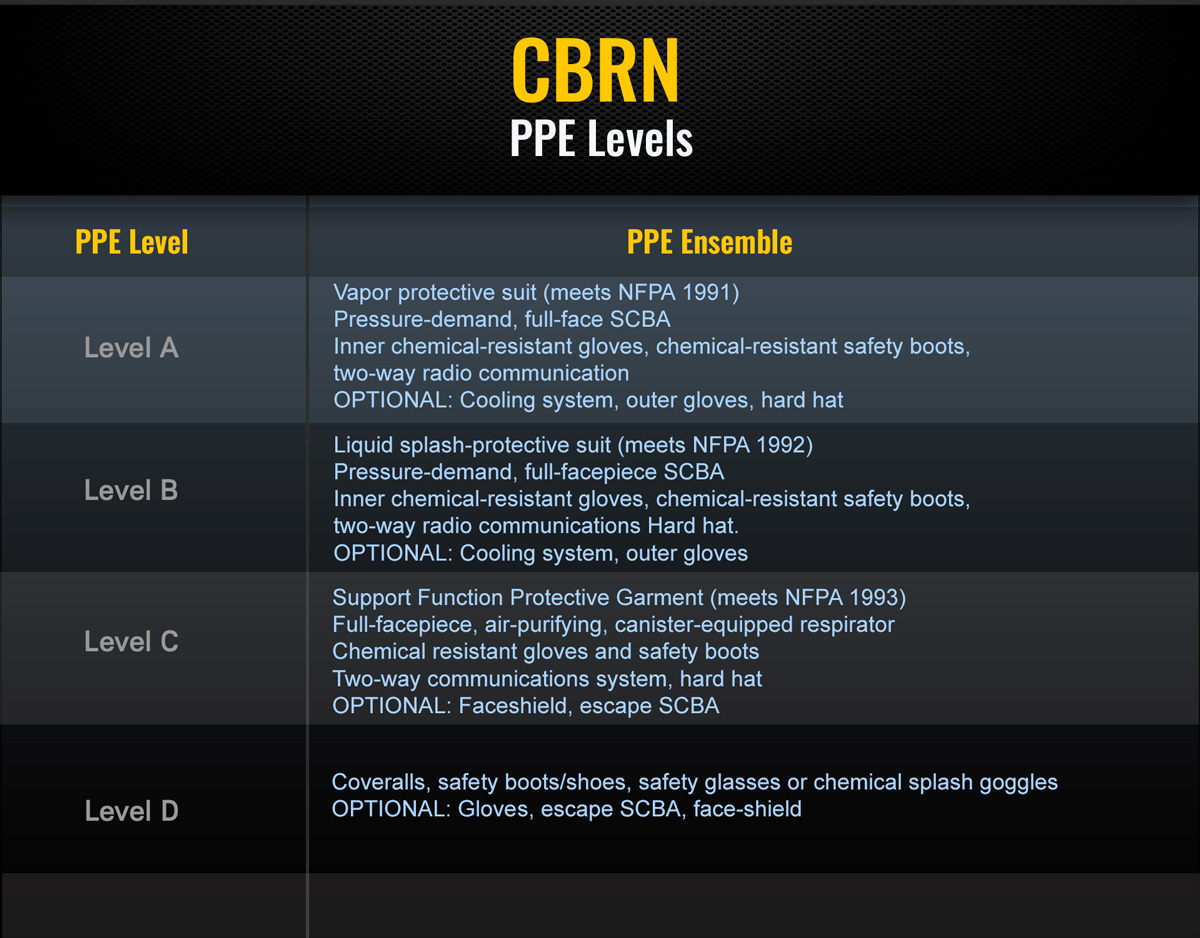
Chemical, Biological, Radiological, and Nuclear (CBRN) personal protective equipment (PPE) provides specialized protection for emergency responders operating in environments contaminated by highly hazardous airborne agents, toxic industrial chemicals, biological pathogens, radioactive particulates, and other dangerous substances. Although CBRN response often uses the familiar Occupational Safety and Health Administration (OSHA) Levels A, B, C, and D framework, equipment may incorporate CBRN-tested respirators, protective garments, communication systems, and decontamination-compatible materials. Selecting the correct PPE requires evaluating atmospheric hazards, oxygen concentration, contaminant characteristics, skin hazards, and whether conditions are Immediately Dangerous to Life or Health (IDLH). Proper PPE selection must always be supported by atmospheric monitoring, incident command, decontamination procedures, and responder training.
Key Takeaways
- CBRN PPE is selected using the same hazard-assessment principles that govern OSHA HAZWOPER PPE selection.
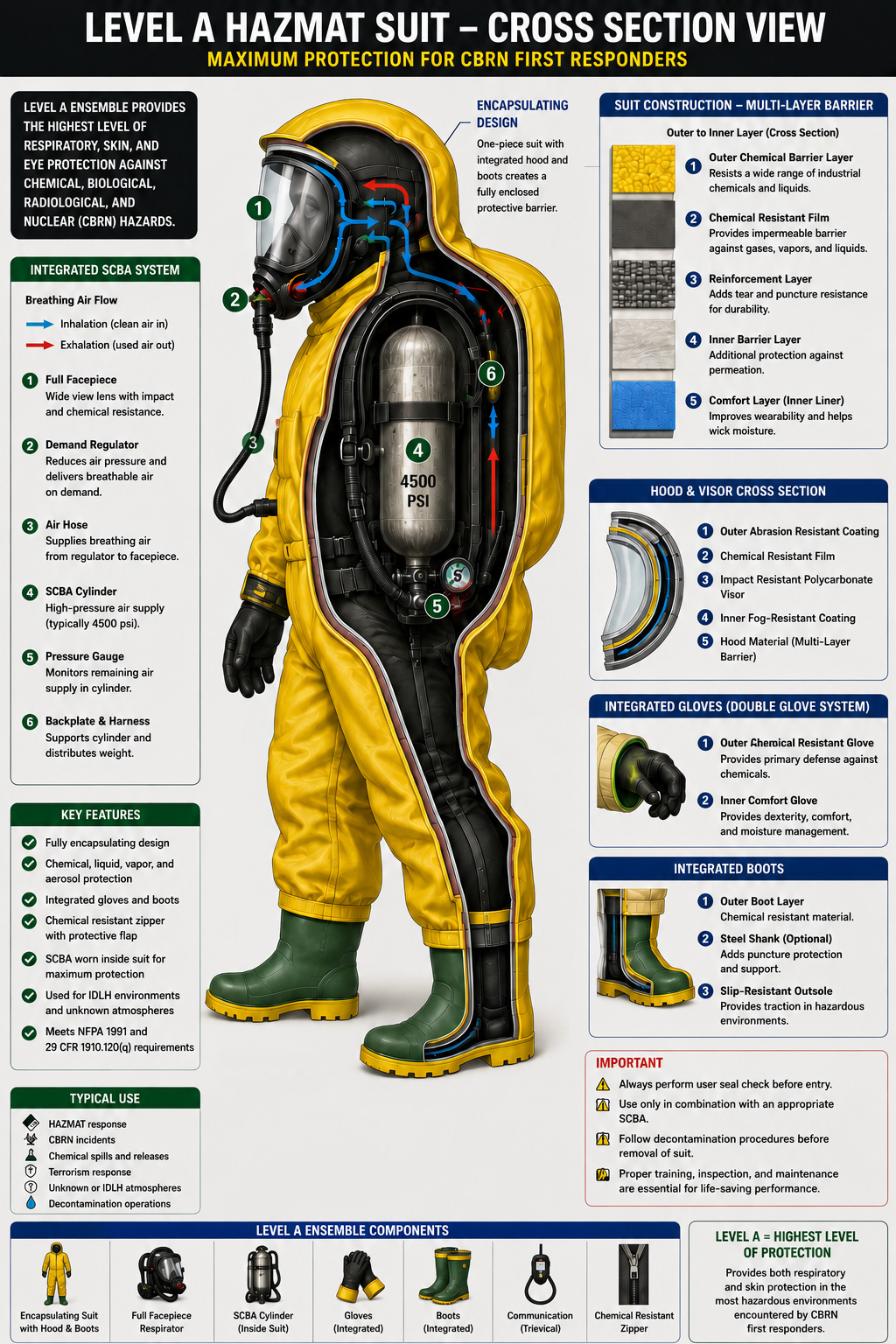
- Level A provides the highest respiratory and skin protection.
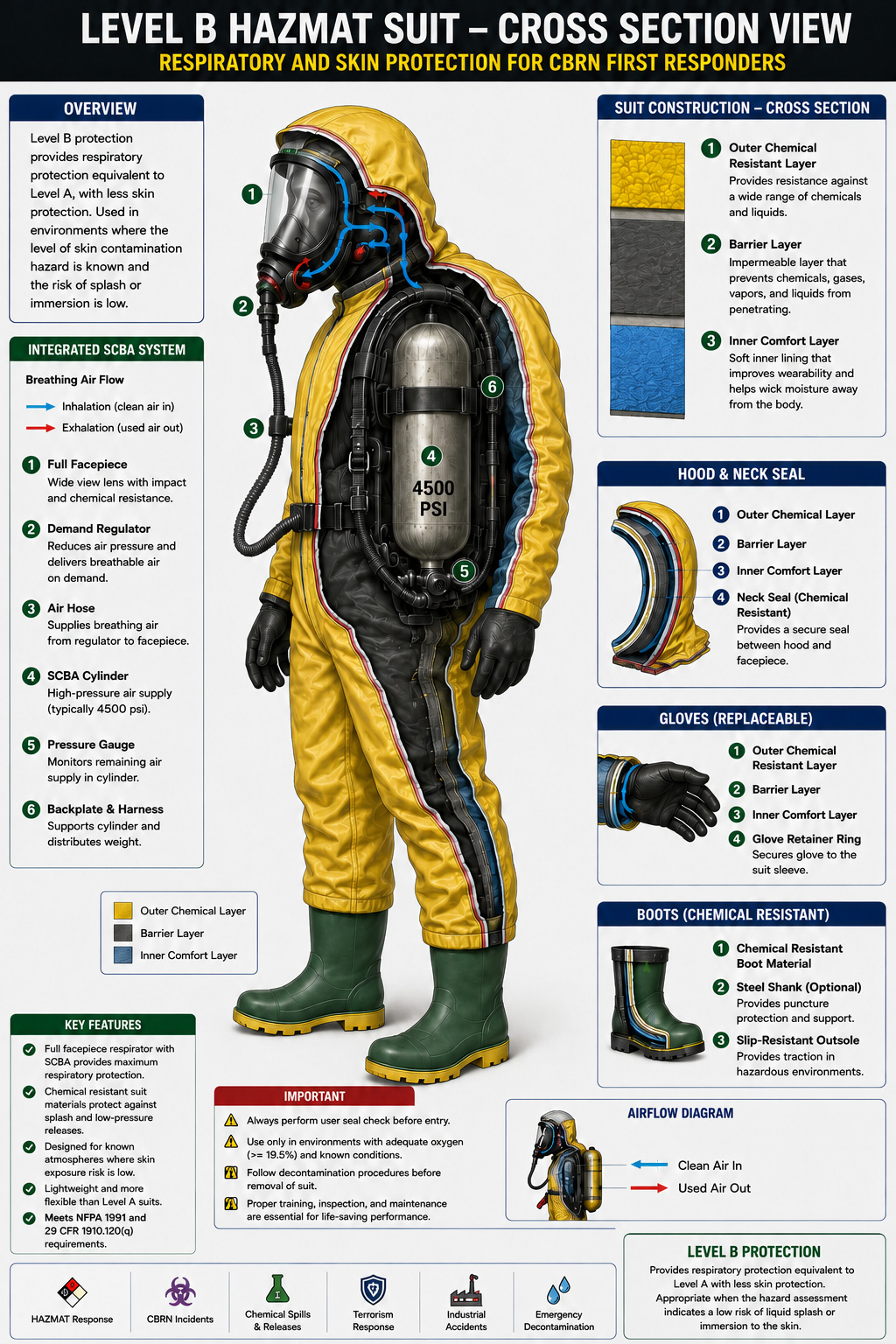
- Level B provides maximum respiratory protection with reduced skin protection compared to Level A.
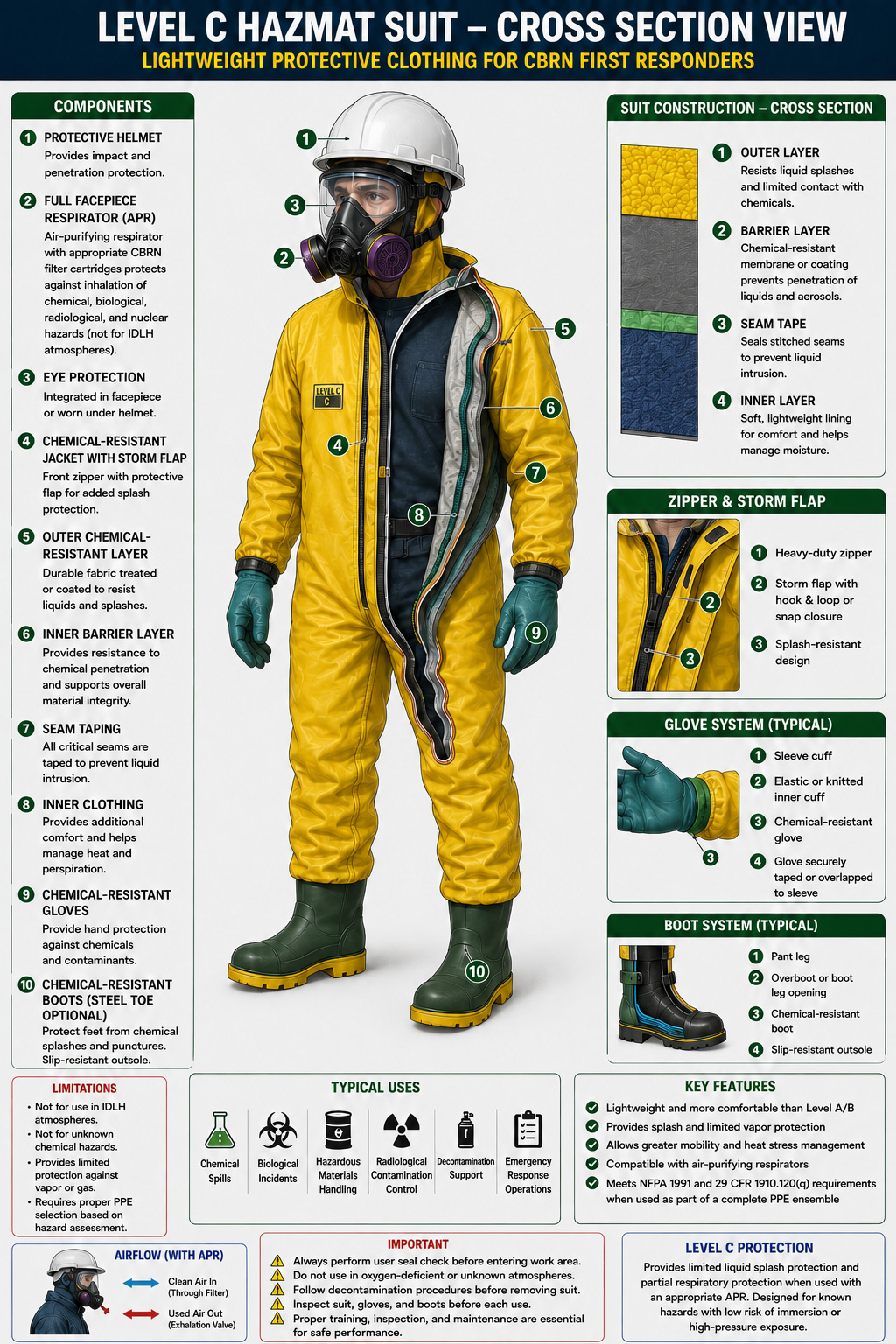
- Level C may be appropriate only when contaminants are identified, concentrations are known, and air-purifying respirators are suitable.
- Level D provides minimal protection and is used only when respiratory or skin hazards are absent.
- CBRN-approved respirators and protective clothing provide additional assurance for emergency-response operations involving CBRN hazards.
- Continuous air monitoring is essential because PPE selection may change as conditions evolve.
- Decontamination procedures are just as important as PPE selection.
CBRN PPE Levels
| PPE Level | Respiratory Protection | Skin Protection | Typical CBRN Applications |
|---|---|---|---|
| Level A | Pressure-demand SCBA | Fully encapsulating vapor-protective suit | Unknown agents, vapor hazards, terrorist incidents, IDLH atmospheres |
| Level B | Pressure-demand SCBA | Splash-protective chemical suit | Known respiratory hazards with lower vapor skin hazards |
| Level C | CBRN APR or PAPR | Chemical-resistant clothing | Known contaminants below IDLH with adequate oxygen |
| Level D | None or task-specific | Standard work clothing | Support operations outside contaminated areas |
Typical CBRN Incidents and PPE
| Incident | Typical Initial PPE | Primary Hazard |
|---|---|---|
| Unknown chemical release | Level A | Unknown vapor exposure |
| Industrial chlorine release | Level A or B | Respiratory toxicity |
| Radiological contamination | Level C (if conditions permit) | Radioactive particulates |
| Biological incident | Level C or higher | Infectious aerosols |
Introduction

By the 1980s and 1990s, HAZMAT suits had evolved into the four-tier system (Levels A–D) we know today. Materials like butyl rubber, Tychem®, and Viton® offered unparalleled resistance to chemical permeation, and Self-Contained Breathing Apparatus (SCBA) technology gave responders true independence from contaminated air. Interestingly, NASA’s innovations in space suit design—airtight seals, pressurization, and mobility—directly influenced modern Level A HAZMAT suits.
Today, HAZMAT suits represent more than just protective clothing; they embody decades of engineering, experience, and sacrifice. They have been used in the cleanup of the Chernobyl disaster, the Space Shuttle Columbia recovery, and countless hazardous waste sites worldwide. Each suit tells a story of humanity’s determination to confront danger safely—whether facing a toxic spill, a biological outbreak, or a chemical fire. The journey from crude rubber garments to today’s advanced, life-saving ensembles reflects how far we’ve come in the pursuit of safety, science, and survival.
CBRN Level A Ensemble
CBRN Level B Ensemble
CBRN Level C Ensemble
CBRN Level D Ensemble
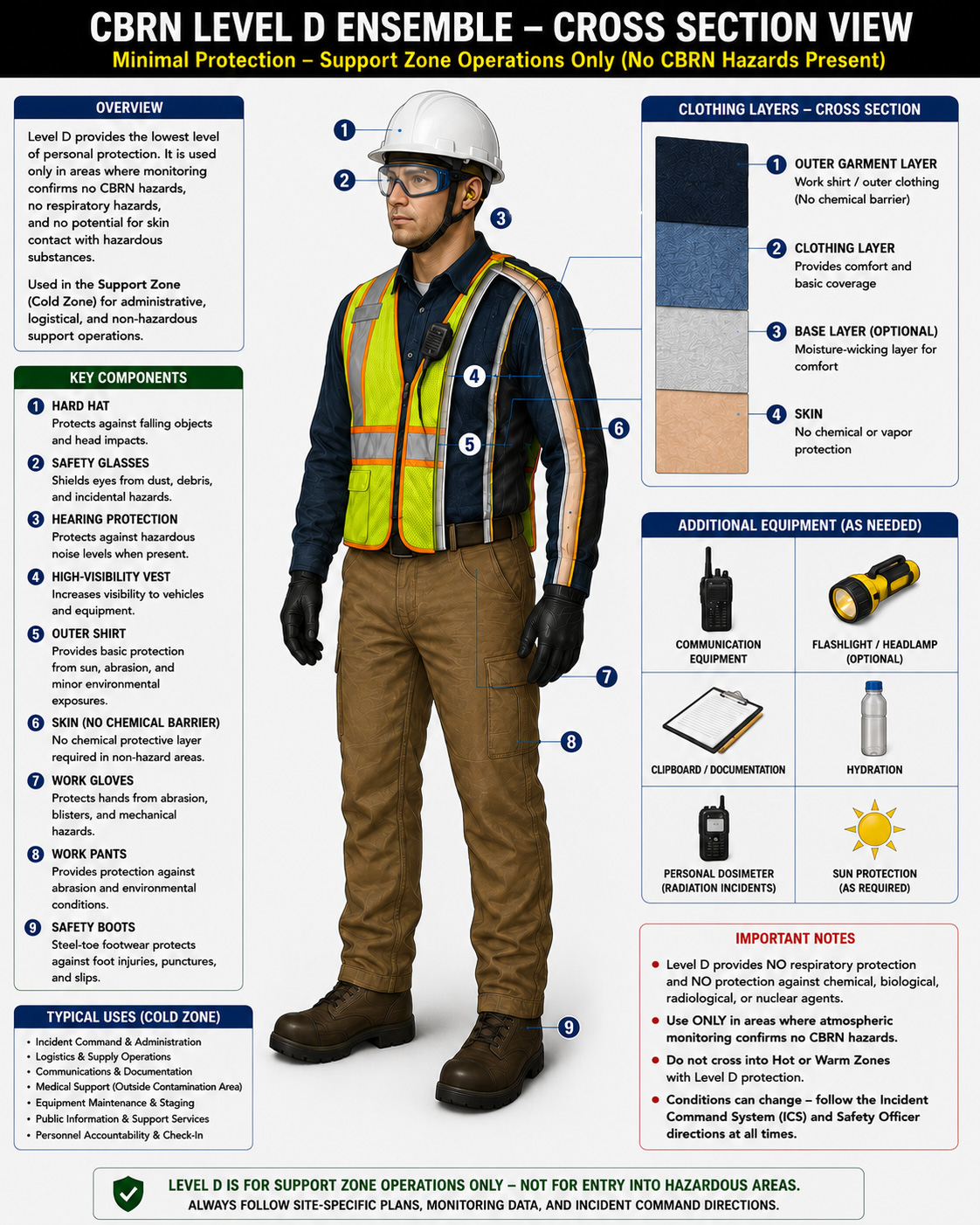
CBRN Level D ensemble provides the lowest level of personal protective equipment and is used only when the hazard assessment confirms that no respiratory hazards, skin hazards, or chemical splash hazards are present. Unlike Levels A, B, and C, Level D does not include respiratory protection and should never be used in contaminated atmospheres or where responders may encounter chemical, biological, radiological, or nuclear agents. Instead, Level D is intended for personnel performing support activities outside contaminated areas where routine occupational hazards, rather than CBRN hazards, are the primary concern.
Within a CBRN incident, Level D protection is generally worn in the Cold Zone, also known as the Support Zone. This area has been established beyond the contamination reduction corridor and outside the exclusion zone where monitoring has confirmed that hazardous contaminants are not present at levels requiring specialized PPE. Personnel operating in this zone may include Incident Command staff, logistics personnel, emergency management officials, medical support teams, communications specialists, equipment technicians, and administrative personnel who support response operations without entering contaminated areas.
A typical Level D ensemble consists of standard work clothing appropriate for the assigned task and may include:
- Hard hat or protective helmet
- Safety glasses or safety goggles
- High-visibility safety vest
- Steel-toe safety boots
- Work gloves or task-specific gloves
- Hearing protection when required
- Weather-appropriate clothing
- Personal dosimeter when operating near radiological incidents
- Standard communication equipment
Although the equipment is relatively simple compared with Levels A, B, and C, responders should not underestimate the importance of Level D PPE. Personnel operating in support zones remain exposed to many traditional occupational hazards, including vehicle traffic, heavy equipment, slips and falls, electrical hazards, noise, heat stress, cold stress, ergonomic injuries, and falling objects. Appropriate industrial safety practices remain essential even when chemical contamination is absent.
During CBRN emergency operations, Level D personnel often perform critical functions such as:
- Incident Command operations
- Emergency Operations Center support
- Resource management
- Documentation and recordkeeping
- Communications coordination
- Equipment staging
- Logistics support
- Rehabilitation area operations
- Public information activities
- Personnel accountability
- Supply distribution
- Medical support outside contaminated areas
Because incident conditions may change rapidly, Level D protection is never considered permanent. Atmospheric conditions, weather, wind direction, contaminant migration, or changes in operational activities may require support personnel to upgrade their PPE if contamination expands beyond established boundaries. Continuous perimeter monitoring and routine site assessments help ensure that the Cold Zone remains uncontaminated throughout the response.
One important principle of CBRN response is that PPE selection is dynamic rather than static. Personnel may transition from Level D to Level C—or even higher levels—if assigned to new tasks within contaminated areas. Likewise, responders leaving contaminated zones may downgrade from Level A or B to Level D only after successful decontamination, atmospheric monitoring, and confirmation that contamination has not spread into support areas.
The decision to authorize Level D protection should always be based on documented hazard assessments, atmospheric monitoring results, and approval from the Incident Commander or Safety Officer. Entering a potentially contaminated area wearing only Level D PPE can expose responders to hazardous airborne contaminants, toxic chemicals, biological agents, radioactive particulates, or oxygen-deficient atmospheres without adequate protection.
Although Level D does not include respiratory protection, support personnel should remain familiar with emergency evacuation procedures, contamination control practices, and incident communications. They should understand site control zones, recognize signs of changing conditions, and know how to respond if atmospheric monitoring indicates contaminant migration toward support operations.
In many CBRN incidents, support personnel wearing Level D PPE play an essential role in the success of the overall response. Their responsibilities ensure that emergency responders operating in higher levels of protection receive the equipment, supplies, logistical support, communications, and medical resources needed to safely complete hazardous operations. While they may not enter contaminated environments, their contribution is vital to maintaining an organized, efficient, and safe emergency response.
Within both OSHA HAZWOPER and CBRN emergency-response operations, Level D should always be viewed as support-zone protection rather than hazardous-environment protection. Proper hazard assessment, continuous atmospheric monitoring, effective site control, and disciplined incident management ensure that Level D remains appropriate only where contamination hazards have been eliminated or adequately controlled. By maintaining clear operational boundaries and continuously evaluating changing conditions, emergency response organizations can safely protect both frontline responders and the personnel who support them.
Frequently Asked Questions
What does CBRN stand for?
CBRN stands for Chemical, Biological, Radiological, and Nuclear.
Are CBRN PPE levels different from OSHA HAZWOPER Levels A–D?
The OSHA Levels A–D framework still applies. CBRN response generally uses those same protection levels while selecting equipment appropriate for CBRN hazards and emergency-response operations.
When is Level A required?
Level A should be considered when the atmosphere is unknown, when highly toxic vapors may be present, or when maximum respiratory and skin protection is necessary.
Can Level C PPE be used during a CBRN incident?
Only if contaminants have been identified, oxygen is adequate, concentrations are below IDLH levels, and the selected CBRN air-purifying respirator is appropriate for the hazard.
Why do CBRN responders wear SCBAs?
SCBAs provide breathable air independent of the surrounding atmosphere, making them suitable for unknown, oxygen-deficient, and IDLH environments.
Does a CBRN respirator replace an SCBA?
No. A CBRN APR filters ambient air and cannot be used where the atmosphere is unknown, oxygen deficient, or immediately dangerous to life or health.
What standards apply to Level A suits?
OSHA identifies vapor-protective suits meeting NFPA 1991 as the benchmark for Level A protective clothing.
What is the most important factor when selecting CBRN PPE?
Hazard assessment. PPE selection should always be based on atmospheric monitoring, contaminant identification, oxygen concentration, skin hazards, and the responder’s assigned task.
Choose the Right Level of Protection Before Entering the Hazard Zone
CBRN incidents leave little room for error. Selecting the proper PPE requires more than choosing a suit—it requires understanding atmospheric hazards, respiratory protection, contaminant behavior, skin exposure risks, air monitoring, and decontamination procedures. The correct PPE level protects responders, supports mission success, and helps prevent secondary contamination.
OSHACode® training provides detailed instruction on HAZWOPER PPE Levels A, B, C, and D, respiratory protection, SCBAs, CBRN respirators, air monitoring, decontamination, and emergency response procedures. Combined with employer-provided hands-on training and equipment familiarization, these programs help emergency responders and HAZMAT teams make informed PPE decisions before entering hazardous environments.
Sources
Emergency Response and Preparedness
OSHA HAZWOPER Hands-on Training Requirement
Medical Surveillance Requirements
U.S. Occupational Safety and Health Administration
https://www.osha.gov/laws-regs/standardinterpretations/1992-08-27-1
U.S. Environmental Protection Agency
https://www.epa.gov/laws-regulations/summary-resource-conservation-and-recovery-act
Related Articles
Building a HAZWOPER Safety Culture
HAZWOPER Hands-on Training Discussions with U.S. OSHA
About the Author
This article was written by Clay A. Bednarz, MS, RPIH, founder of National Environmental Trainers® and OSHACode®. Bednarz pioneered the first commercial online HAZWOPER training programs in 1998 and has supported major hazardous waste operations, environmental remediation projects, and emergency response training initiatives nationwide.