

Summary
Few workplace safety regulations have earned the reputation of HAZWOPER. Mention the word to environmental professionals, hazardous materials responders, industrial hygienists, emergency responders, or remediation contractors, and you’ll likely hear stories of abandoned chemical plants, leaking drums, Superfund cleanups, refinery emergencies, and workers wearing fully encapsulating chemical suits.
Over the years, HAZWOPER has become surrounded by myths. Some believe it’s simply another OSHA course. Others think everyone needs a 40-hour certification. Still others assume online training isn’t accepted.
The truth is even more impressive.
HAZWOPER isn’t a myth—it is one of the most comprehensive worker protection standards ever developed, responsible for protecting hundreds of thousands of workers who face some of the most dangerous environments in industry.
Key Takeaways
- HAZWOPER stands for Hazardous Waste Operations and Emergency Response.
- OSHA created the regulation under 29 CFR 1910.120.
- HAZWOPER protects workers exposed to hazardous substances during cleanup, treatment, storage, disposal, and emergency response operations.
- Not everyone needs 40-hour HAZWOPER training.
- Employers must provide site-specific training in addition to classroom instruction.
- Annual refresher training keeps workers current.
- Proper HAZWOPER programs dramatically reduce injuries and hazardous exposures.
“HAZWOPER isn’t dangerous because of the regulation. The regulation exists because the work is dangerous.”
HAZWOPER at a Glance
| Topic | Details |
|---|---|
| OSHA Standard | 29 CFR 1910.120 |
| Applies To | Hazardous waste operations and emergency response |
| Initial Training | 24-Hour or 40-Hour HAZWOPER |
| Annual Training | 8-Hour Refresher |
| Employer Responsibility | Site-specific training and supervised field experience where required |
| Primary Topics | PPE, Air Monitoring, HASP, Medical Surveillance, Decontamination, Emergency Response |
Why Has HAZWOPER Become Legendary?
Some OSHA standards focus on one hazard.
- Lockout/Tagout
- Fall Protection
- Respiratory Protection
- Hazard Communication
HAZWOPER is different.
It combines nearly every major safety discipline into one integrated worker protection program.
A single HAZWOPER project may involve:
- Toxic chemicals
- Radiation
- Explosive atmospheres
- Biological hazards
- Heat stress
- Confined spaces
- Heavy equipment
- Air monitoring
- Medical surveillance
- Emergency response
- Decontamination
- Site control
- Personal protective equipment
Few OSHA standards are as broad or as technically demanding.
That complexity is one reason HAZWOPER has earned legendary status throughout the environmental and industrial safety professions.
Why People Search for HAZWOPER
Every day thousands of workers search for “What is HAZWOPER?”, “Who needs HAZWOPER?”, “Is HAZWOPER required?”, and “Can I take HAZWOPER online?” The reason is simple: HAZWOPER is one of OSHA’s most recognized—and misunderstood—standards. This article separates myth from reality while explaining why HAZWOPER has become the benchmark for hazardous waste worker protection.
The Myth: “HAZWOPER Is Just Another OSHA Course”
Nothing could be further from the truth.
Unlike many safety courses that focus on one topic, HAZWOPER teaches workers how multiple hazards interact simultaneously.
A worker entering an abandoned chemical facility may encounter:
- Oxygen-deficient atmospheres
- Corrosive chemicals
- Unknown vapors
- Structural instability
- Explosive gases
- Confined spaces
- Heat stress
- Heavy machinery
Managing one hazard is difficult.
Managing all of them together requires a structured safety system.
That system is HAZWOPER.
The Legend Begins with OSHA
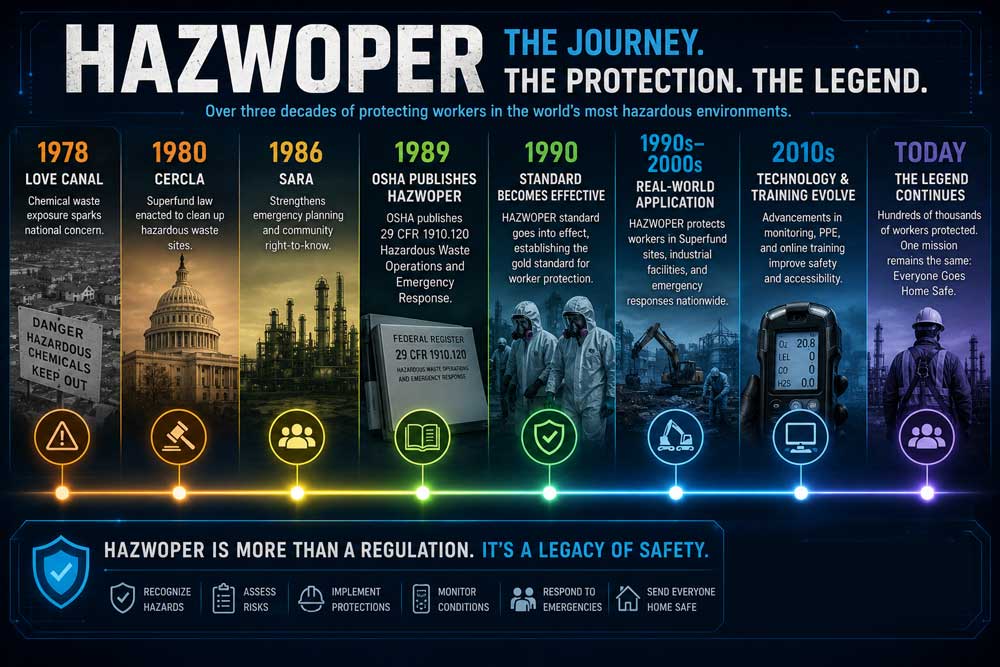
The HAZWOPER regulation emerged during a period when the United States faced increasing numbers of hazardous waste sites requiring cleanup.
Incidents such as:
- Love Canal
- Times Beach
- Chemical waste disposal sites
- Industrial contamination
- Federal Superfund cleanups
demonstrated the need for a comprehensive worker protection standard.
OSHA responded with one of its most detailed regulations.
Today, it remains the benchmark for hazardous waste operations around the world.
What Makes HAZWOPER Different?
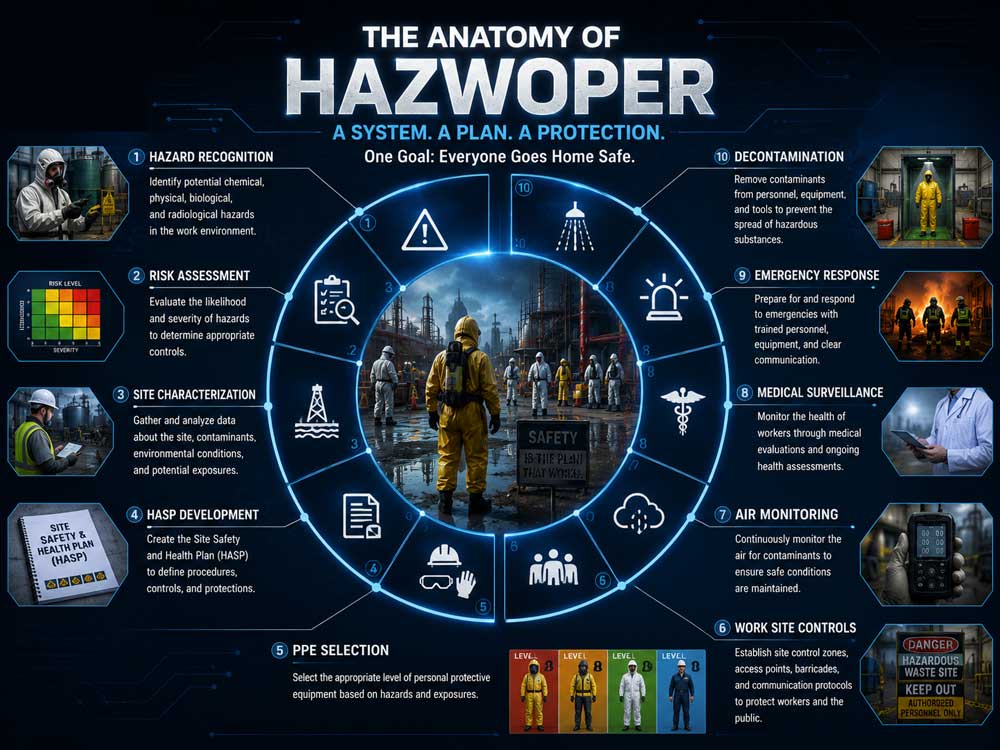
Unlike many OSHA regulations, HAZWOPER requires employers to build an entire safety management system.
Typical components include:
Site Characterization
Every project begins with understanding the hazards.
Workers evaluate:
- Chemicals
- Physical hazards
- Weather
- Terrain
- Utilities
- Existing contamination
- Historical site information
Site Safety and Health Plan (HASP)
The HASP becomes the project’s roadmap.
It identifies:
- Hazards
- PPE requirements
- Air monitoring
- Emergency procedures
- Medical surveillance
- Decontamination
- Site control
- Communication procedures
The HASP evolves as site conditions change.
Air Monitoring
One of HAZWOPER’s most recognizable elements is continuous air monitoring.
Workers may use:
- Four-gas monitors
- Photoionization Detectors (PID)
- Flame Ionization Detectors (FID)
- Radiation meters
- Colorimetric tubes
Monitoring determines whether conditions remain safe throughout the project.
Personal Protective Equipment
HAZWOPER introduced many workers to the four PPE protection levels:
- Level A
- Level B
- Level C
- Level D
Selecting the wrong PPE can create just as much danger as selecting too little.
Employers perform hazard assessments before determining the proper level of protection.
Medical Surveillance
Workers exposed to hazardous substances receive medical evaluations before, during, and after assignments when required.
Medical surveillance helps identify health effects before they become serious illnesses.
Decontamination
One of the most recognizable HAZWOPER practices is the decontamination corridor.
Personnel, equipment, and sampling tools pass through carefully designed decontamination stations before leaving contaminated areas.
This prevents hazardous substances from spreading beyond the work zone.
The Myth: Everyone Needs 40-Hour HAZWOPER
This is one of the most common misconceptions.
HAZWOPER training depends on job responsibilities.
Common options include:
| Employee Role | Typical Training |
|---|---|
| General site workers with routine hazardous waste exposure | 40-Hour HAZWOPER |
| Workers with occasional, limited exposure | 24-Hour HAZWOPER |
| Previously trained personnel | 8-Hour Annual Refresher |
| Emergency responders | HAZWOPER Emergency Response Training |
The Myth: Online HAZWOPER Isn’t Accepted
OSHA permits the knowledge-based portion of HAZWOPER training to be completed online.
Employers remain responsible for providing:
- Site-specific instruction
- Equipment familiarization
- Hands-on PPE
- Air monitoring equipment
- Decontamination procedures
- Emergency response drills
- Three days of supervised field experience for 40-hour HAZWOPER personnel
The combination of online learning and employer-provided practical training creates an effective and compliant program.
Why Employers Continue to Invest in HAZWOPER
The benefits extend far beyond regulatory compliance.
Organizations report improvements in:
- Hazard recognition
- Emergency preparedness
- Incident prevention
- Worker confidence
- Regulatory compliance
- Documentation
- Safety culture
- Operational consistency
When workers understand hazards before entering a site, projects become safer and more efficient.
The Human Side of HAZWOPER
Behind every regulation is a simple objective:
Everyone goes home safely.
HAZWOPER isn’t about paperwork.
It isn’t about certificates.
It isn’t about checking boxes.
It’s about preventing workers from becoming victims of hazards they cannot see, smell, or predict.
Every air monitor alarm…
Every PPE inspection…
Every decontamination line…
Every emergency drill…
exists because someone, somewhere, learned an important lesson the hard way.
The Legend Continues
For more than three decades, HAZWOPER has protected environmental professionals, industrial workers, emergency responders, military personnel, utility crews, and hazardous materials specialists.
Technology has changed.
Equipment has improved.
Air monitoring instruments have become smarter.
Training has moved online.
Yet the principles behind HAZWOPER remain remarkably consistent:
- Identify hazards.
- Assess risks.
- Protect workers.
- Monitor conditions.
- Adapt to changing environments.
- Never compromise safety.
That enduring philosophy is why HAZWOPER continues to be respected across industries.
It isn’t legendary because it’s difficult.
It’s legendary because it works.
The Numbers Behind the Legend
- 29 CFR 1910.120
- 5 major categories of covered operations
- 4 PPE protection levels
- 40-hour initial training
- 24-hour initial training
- 8-hour annual refresher
- 3 days supervised field experience (40-Hour)
- 1 day supervised field experience (24-Hour)
Myth vs Reality
| Myth | Reality |
|---|---|
| Everyone needs 40-Hour HAZWOPER | Training depends on job duties |
| Online training isn’t OSHA accepted | OSHA permits the knowledge portion online; employers provide required site-specific training and supervised field experience where applicable. (OSHA) |
| HAZWOPER equals OSHA 10 | Completely different standards |
| HAZWOPER is only for Superfund | It covers multiple categories of hazardous waste operations and emergency response. (OSHA) |
| Once certified, you’re done | Annual refresher training is required to maintain compliance. (OSHACode® EHS Training) |
Become Part of the Next Generation of HAZWOPER Professionals
Frequently Asked Questions
What does HAZWOPER stand for?
HAZWOPER stands for Hazardous Waste Operations and Emergency Response, OSHA’s comprehensive standard for protecting workers involved in hazardous waste operations and emergency response activities.
Who needs HAZWOPER training?
Employees involved in hazardous waste site cleanup, treatment, storage and disposal facilities (TSDFs), and emergency response to hazardous substance releases may require HAZWOPER training based on their job duties.
Is HAZWOPER training required every year?
Initial HAZWOPER training is followed by an 8-hour annual refresher to maintain knowledge and stay current with regulations and best practices.
Can HAZWOPER training be completed online?
Yes. OSHA permits the knowledge-based portion of HAZWOPER training to be completed online. Employers must also provide site-specific, hands-on training and supervised field experience where required.
What is the difference between 24-hour and 40-hour HAZWOPER?
The 40-hour course is intended for workers with routine or substantial hazardous waste exposure, while the 24-hour course is designed for employees with occasional, limited exposure who perform specific tasks under defined conditions.
Why is HAZWOPER considered one of OSHA’s most comprehensive standards?
Because it integrates hazard recognition, site characterization, air monitoring, PPE selection, medical surveillance, decontamination, emergency response, and site safety planning into a single worker protection program.
Train Smarter with OSHACode
For more than three decades, HAZWOPER has protected workers in some of the most hazardous environments on Earth—from Superfund cleanups and chemical manufacturing to emergency response and environmental remediation. Technologies will evolve, equipment will improve, and training methods will continue to advance. But one principle will never change: workers deserve to return home safely at the end of every shift. That is why HAZWOPER remains more than an OSHA regulation—it is the gold standard for hazardous waste worker protection.
Sources
Emergency Response and Preparedness
OSHA HAZWOPER Hands-on Training Requirement
Medical Surveillance Requirements
U.S. Occupational Safety and Health Administration
https://www.osha.gov/laws-regs/standardinterpretations/1992-08-27-1
U.S. Environmental Protection Agency
https://www.epa.gov/laws-regulations/summary-resource-conservation-and-recovery-act
Related Articles
Building a HAZWOPER Safety Culture
Hands-on Training Discussions with U.S. OSHA
About the Author
This article was written by Clay A. Bednarz, MS, RPIH, founder of National Environmental Trainers® and OSHACode®. Bednarz pioneered the first commercial online HAZWOPER training programs in 1998 and has supported major hazardous waste operations, environmental remediation projects, and emergency response training initiatives nationwide.