
Summary
HAZMAT suits provide critical protection for workers and emergency responders who may be exposed to hazardous chemicals, toxic vapors, biological agents, or other dangerous substances. Selecting the appropriate level of protection depends on a site-specific hazard assessment that considers the type of contaminant, route of exposure, air monitoring results, oxygen concentration, and the work being performed. OSHA’s HAZWOPER standard recognizes four levels of personal protective equipment (PPE)—Level A, Level B, Level C, and Level D—with each level offering a different degree of respiratory and skin protection. Understanding the capabilities and limitations of each protection level helps employers choose the proper equipment while reducing the risk of worker exposure and maintaining OSHA compliance.
Key Takeaways
-
HAZMAT suits are designed to protect workers from hazardous chemicals, biological agents, radioactive contaminants, and other workplace hazards based on the specific risks identified during a hazard assessment.
-
OSHA’s HAZWOPER standard recognizes four PPE protection levels—Level A, Level B, Level C, and Level D—with each providing a different combination of respiratory and skin protection.
-
Level A provides the highest level of respiratory and skin protection and is used when the hazard is unknown or when maximum protection is required.
-
Level B provides the highest level of respiratory protection using a self-contained breathing apparatus (SCBA) but offers less skin protection than Level A.
-
Level C uses an air-purifying respirator (APR) or powered air-purifying respirator (PAPR) when contaminants are known, oxygen levels are adequate, and air-purifying respirators are appropriate.
-
Level D consists of standard work clothing and provides minimal protection. It should only be used when no respiratory or significant skin hazards are present.
-
Selecting the proper hazmat suit requires evaluating chemical hazards, exposure routes, atmospheric conditions, oxygen concentration, and the specific tasks employees will perform.
-
Air monitoring plays a critical role in determining the appropriate level of protection and identifying when PPE should be upgraded or downgraded as site conditions change.
-
HAZMAT suits must be used with compatible gloves, boots, respiratory protection, and other PPE to provide complete worker protection.
-
Proper training, equipment inspection, maintenance, and employer-provided site-specific instruction are essential for ensuring hazmat suits perform as intended and help protect workers during hazardous waste operations and emergency response activities.

What Are HAZMAT Suits?
A HAZMAT (hazardous materials) suit is a modern day body of armor specialized to be a protective garment designed to shield workers from dangerous chemicals, toxic atmospheres, and other hazardous environments. The materials and construction of these suits vary depending on the type and severity of the substances involved, ensuring the appropriate level of resistance to chemical, biological, radiological, or particulate hazards. Commonly worn by emergency responders who are Hazardous Waste Operations and Emergency Response (HAZWOPER) trained, and workers handling contamination or cleanup operations.
From frontline healthcare workers battling infectious diseases to emergency responders confronting toxic chemical releases, HAZMAT suits stand as the final line of defense between safety and catastrophe. These protective ensembles are more than just gear — they are the modern equivalent of armor, purpose-built to guard against the unseen enemies of the industrial and biological age.
HAZMAT protective suits are engineered from durable, high-performance materials that provide both safety and reliability. Although they can be costly, their critical purpose is to prevent injury, illness, and exposure when operating in environments where hazardous substances pose significant risks. According to the Occupational Safety and Health Administration (OSHA) Title 29 Code of Federal Regulations (CFR) 1910.120 Appendix B, HAZMAT suits are rated by different levels based on the protection they provide to the wearer. The levels range from A-D, with A being the most complex and providing the highest level of protection.
The U.S. Department of Homeland Security defines a HAZMAT suit as “an overall garment worn to protect people from hazardous materials or substances, including chemicals, biological agents, or radioactive materials.”
There are four levels of HAZMAT protection as designated by the Environmental Protection Agency (EPA) and OSHA, ranging from level A (most protective) to level D (least protective). The ensemble must be tailored to the specific situation and hazardous material encountered. The bottom line – the level of protection assigned for a particular situation must adequately protect the wearer from the anticipated physical, chemical, and biological hazards.
Let’s go through these HAZMAT/HAZWOPER four levels of protection.
HAZMAT Level A
Maximum Protection
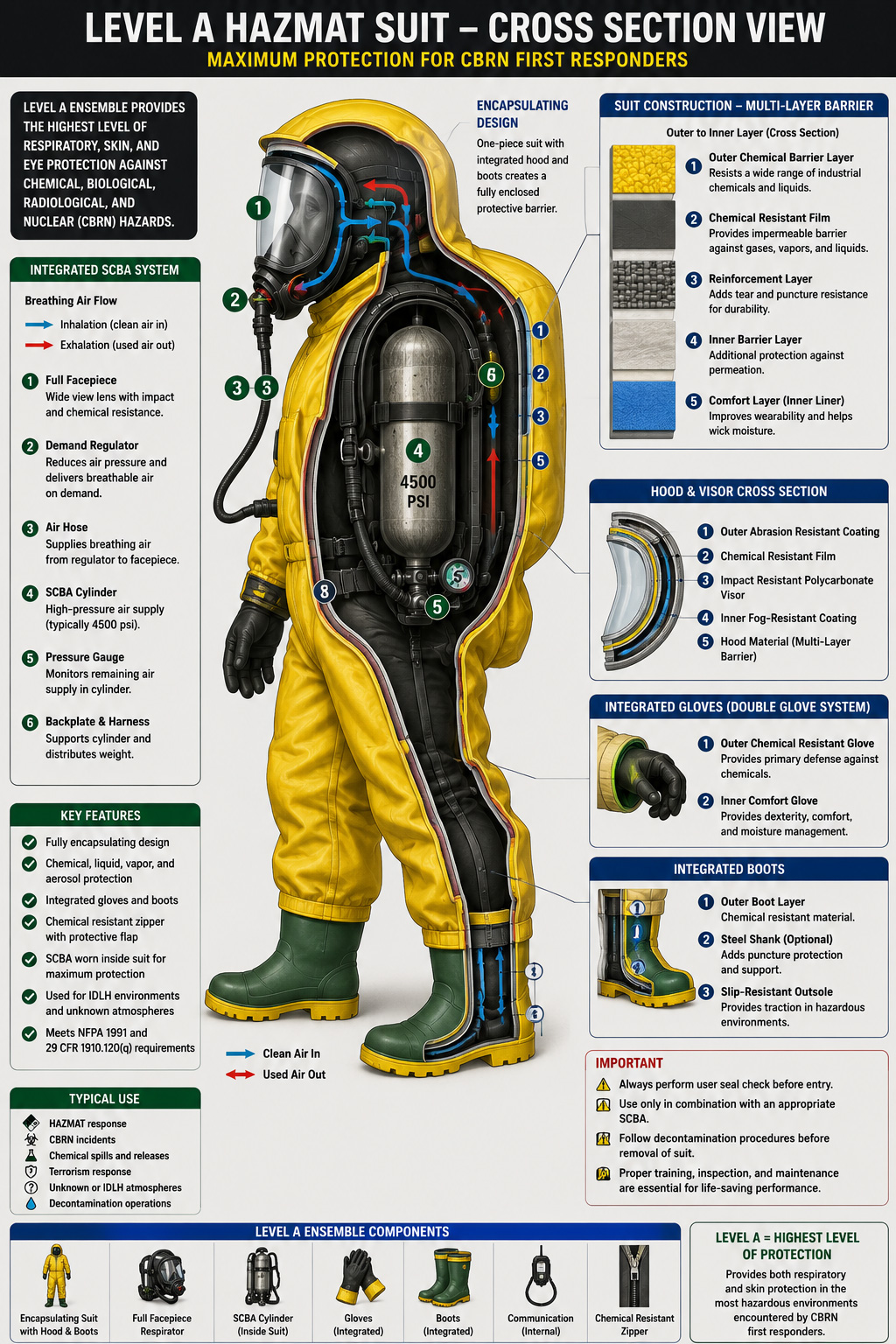
Level A protection is required when workers face the highest potential for exposure to hazardous chemicals—particularly in environments containing unknown substances, toxic vapors, or IDLH (Immediately Dangerous to Life or Health) conditions. This level offers the maximum defense against chemical solids, liquids, mists, vapors, and gases.
A fully encapsulating, vapor-tight suit is worn along with a self-contained breathing apparatus (SCBA) or supplied air respirator (SAR) to ensure complete separation from the contaminated environment. Additional components typically include inner and outer chemical-resistant gloves, chemical-resistant boots, and reliable communication equipment. Level A is suitable for oxygen-deficient atmospheres containing less than 19.5% oxygen and situations where absolute protection is essential.
HAZMAT Level B
High Respiratory Protection with Splash Resistance
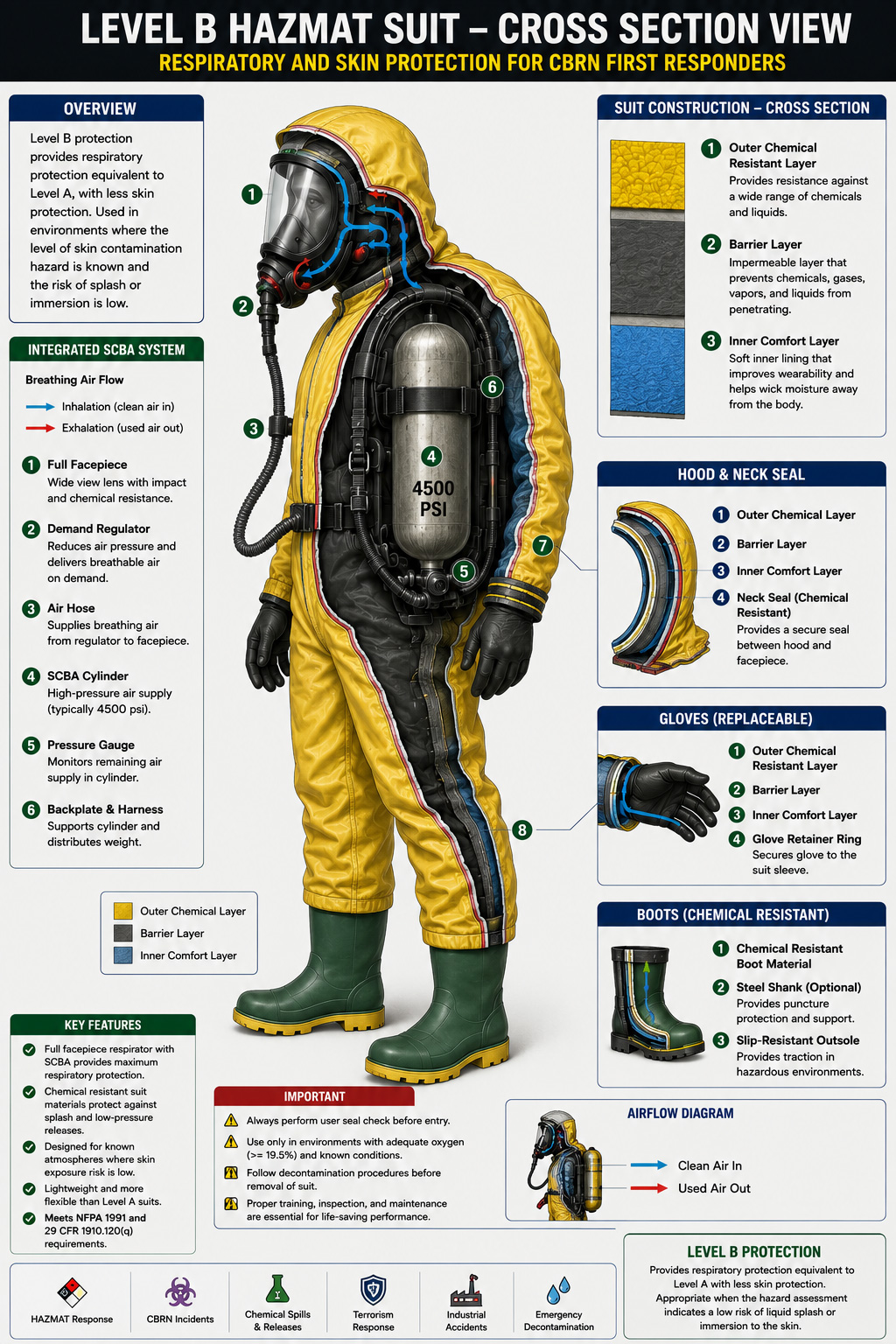
Level B protection is selected when the greatest risk comes from inhalation hazards rather than direct skin exposure. Workers wear a non-encapsulating, splash-protective suit combined with an SCBA or SAR to guard against toxic vapors and oxygen-deficient atmospheres. Although not fully vapor-tight like Level A, Level B still delivers strong chemical resistance against splashes and airborne contaminants.
HAZMAT Level C
Moderate Protection with Air-Purifying Respirators
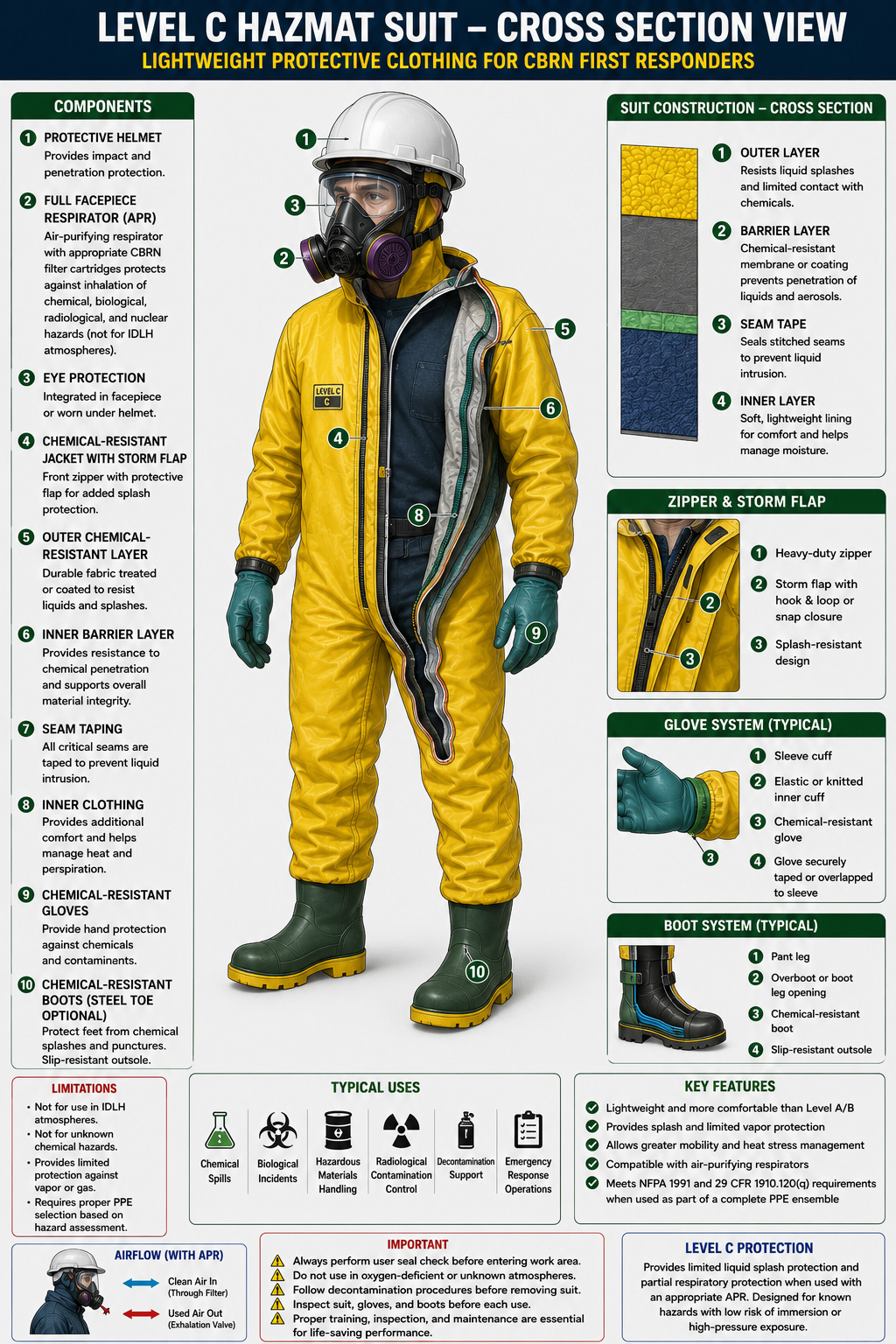
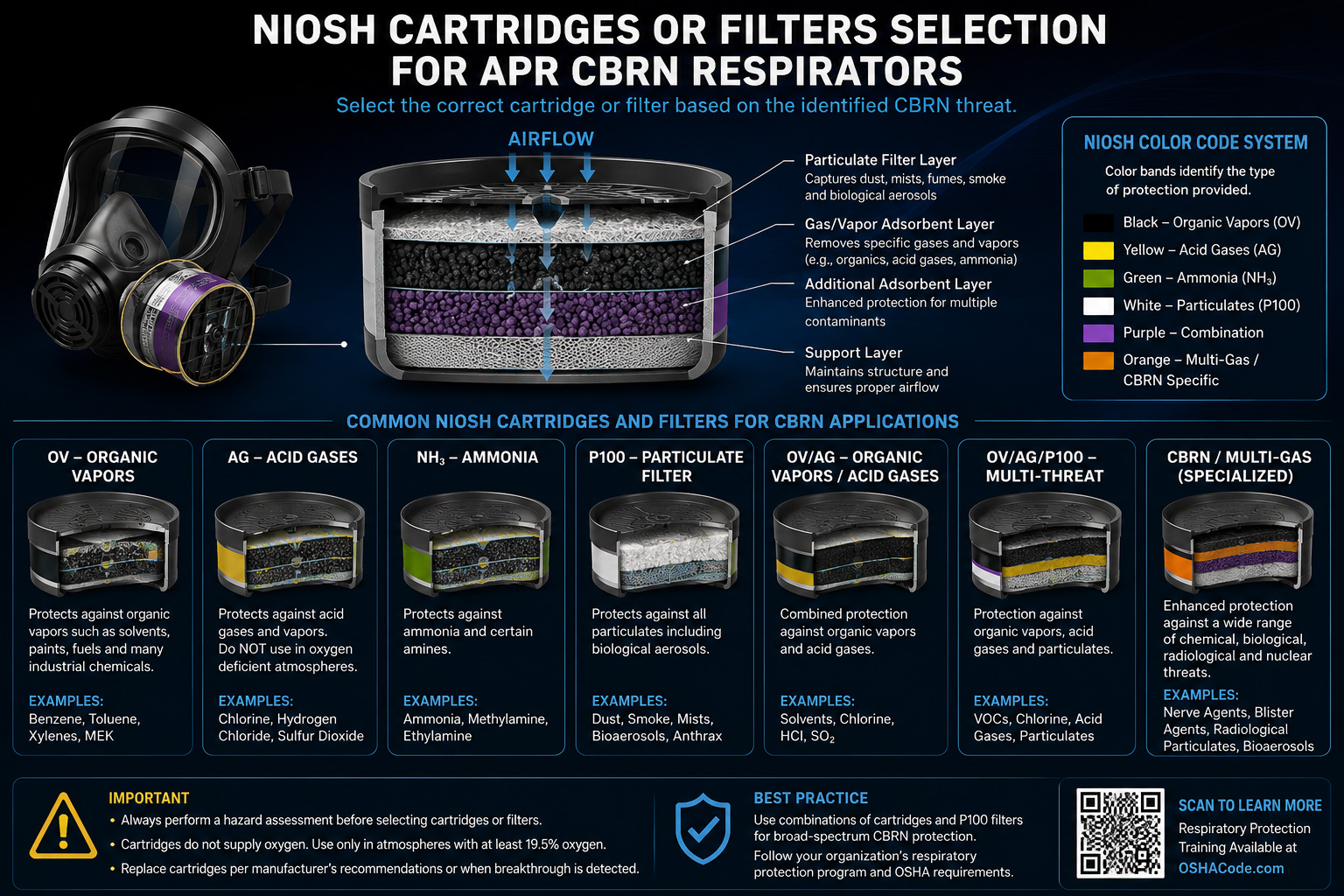
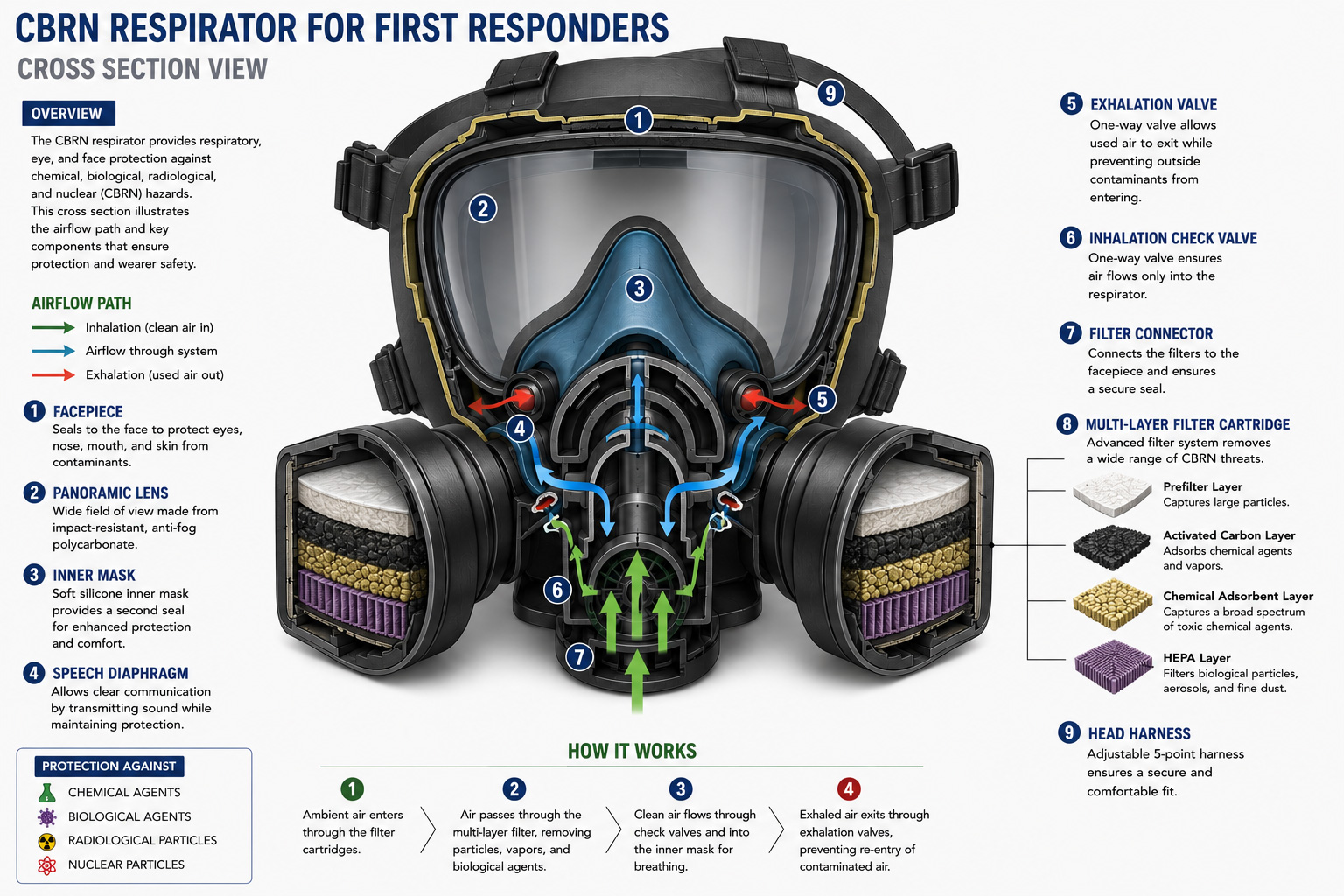
Level C gear is used when the hazardous atmosphere is known, monitored, and confirmed to contain sufficient oxygen—meaning air-purifying respirators (APRs) can be safely used. The suit provides resistance to harmful liquids and particulates, but does not protect fully against vapor infiltration. Level C also incorporates protective gloves, boots, and often chemical-resistant face shields or hoods.
HAZMAT Level D
Basic Workplace Protection
Level D represents the lowest protection level and is intended for work environments where no respiratory hazards or significant risk of chemical exposure exists. Typically consisting of basic work clothing or standard coveralls, safety glasses, gloves, and boots, Level D is used only where contaminants pose minimal threat. It offers no protection against chemical splashes, vapors, or IDLH conditions.
Conclusion
EPA and OSHA recognize four levels of HAZMAT protective suits—Level A, Level B, Level C, and Level D—each designed to match the degree of risk workers face from hazardous substances. Level A suits provide the maximum protection, with a fully encapsulated chemical-resistant suit and SCBA, used in environments where hazards are highly toxic or unidentified. Level B suits still require SCBA but are less skin-protective, making them suitable when the primary danger is from inhalation rather than skin contact. Level C suits are chosen when the specific chemical hazard is known, oxygen levels are sufficient, and air-purifying respirators can be safely used, paired with splash-protective clothing and gloves. Level D represents the lowest level, essentially standard work clothing with minimal protection, appropriate only when there is no risk of chemical exposure.
Today, HAZMAT suits are indispensable across industries.
-
Hazardous waste workers rely on them during cleanup operations under OSHA’s HAZWOPER standard (29 CFR 1910.120) to prevent chemical burns, respiratory injury, or contamination.
-
Nuclear technicians wear specialized radiation-resistant suits to prevent exposure to ionizing particles.
-
Emergency responders deploy in Level A vapor-tight suits when facing unknown chemical releases, spills, or terrorist incidents.
-
And in modern healthcare, doctors and nurses treating patients infected with Ebola, COVID-19, or other highly contagious pathogens depend on biological containment suits to block airborne or droplet transmission.
Each generation of suits has evolved with advancements in material science — from butyl rubber and Teflon® composites to Tyvek® laminates and multi-layer vapor barriers that offer flexibility without sacrificing impermeability. These innovations allow workers to perform complex, high-risk operations while maintaining mobility, visibility, and most importantly, protection.

Select the Right HAZMAT Suit Before You Enter the Hazard Zone
The effectiveness of a HAZMAT suit depends on more than the suit itself—it depends on selecting the correct protection level for the hazards you are likely to encounter. Level A, B, C, and D ensembles each provide a different combination of respiratory and skin protection, and choosing the wrong level can expose workers to unnecessary risks or reduce their ability to perform critical tasks safely. OSHA emphasizes that PPE selection should always be based on a documented hazard assessment, atmospheric monitoring, contaminant identification, and the specific work being performed.
OSHACode® provides comprehensive online HAZWOPER training covering HAZMAT suit protection levels, respiratory protection, SCBAs, air-purifying respirators, air monitoring, decontamination procedures, and OSHA’s PPE selection process. Our courses help workers, supervisors, emergency responders, and employers understand not only what equipment to wear—but why it is selected, when protection levels should change, and how to safely apply OSHA’s HAZWOPER requirements in real-world operations.
The safest responder isn’t the one wearing the most PPE—it’s the one wearing the right PPE, selected through sound hazard assessment, supported by continuous air monitoring, and backed by proper training.
FAQs
What are the four OSHA HAZMAT suit protection levels?
OSHA and EPA recognize four levels of HAZMAT protection: Level A, Level B, Level C, and Level D. Level A provides the highest level of respiratory and skin protection, while Level D provides the lowest level of protection and is used only when no significant respiratory or skin hazards are present.
What is a Level A HAZMAT suit?
A Level A HAZMAT suit is a fully encapsulating, vapor-tight chemical protective suit worn with a self-contained breathing apparatus (SCBA). It provides the highest degree of respiratory, skin, and eye protection and is used when hazardous substances are unknown or present at IDLH concentrations.
When should Level A protection be used?
Level A protection is required when workers face unknown chemicals, highly toxic vapors, oxygen-deficient atmospheres, or substances that can be absorbed through the skin. It is commonly used during initial emergency response and hazardous waste site entry operations.
What is the difference between Level A and Level B protection?
Both Level A and Level B require SCBA for maximum respiratory protection. However, Level A uses a fully encapsulating vapor-tight suit, while Level B uses a splash-protective suit that provides less skin protection. Level B is appropriate when respiratory hazards are present but severe skin absorption hazards are not expected.
What is Level C PPE used for?
Level C PPE is used when airborne contaminants are known, oxygen levels are above 19.5%, and air-purifying respirators can safely protect workers. Level C typically includes an air-purifying respirator, chemical-resistant clothing, gloves, and boots.
What is Level D protection?
Level D protection consists of standard work clothing, safety glasses, gloves, and boots. It provides minimal protection and is appropriate only when there are no respiratory hazards and little risk of chemical exposure.
What does SCBA stand for?
SCBA stands for Self-Contained Breathing Apparatus. It supplies clean breathing air from a compressed cylinder and is commonly used with Level A and Level B protective ensembles in hazardous environments.
How are HAZMAT suit protection levels selected?
Protection levels are selected through a hazard assessment that evaluates the chemicals present, exposure routes, airborne concentrations, oxygen levels, work tasks, and environmental conditions. The chosen ensemble must adequately protect workers from anticipated hazards.
Are HAZMAT suit levels the same as HAZWOPER PPE levels?
Yes. OSHA’s HAZWOPER standard uses the same Level A, B, C, and D PPE classifications for hazardous waste operations and emergency response activities. Employers must select the appropriate level based on site conditions and exposure risks.
Can workers upgrade or downgrade PPE levels during an operation?
Yes. PPE levels may be upgraded or downgraded as conditions change and additional information becomes available through air monitoring, site characterization, or hazard assessments. Employers must continuously evaluate whether the assigned level remains appropriate.
What are the limitations of Level A HAZMAT suits?
Although Level A suits provide maximum protection, they can reduce mobility, limit visibility, increase heat stress, complicate communication, and restrict work duration due to SCBA air supply limitations.
Do HAZMAT suits protect against all chemicals?
No. No single suit material protects against every chemical. Employers must evaluate chemical compatibility, permeation rates, and manufacturer specifications to ensure the selected suit material is appropriate for the hazards present.
Are HAZMAT suits required for all hazardous materials incidents?
No. The required level of protection depends on the specific hazards involved. Some situations may require Level A protection, while others can be safely managed with Level B, Level C, or even Level D PPE depending on exposure risks and site conditions.
Who uses Level A HAZMAT suits?
Level A suits are commonly used by HAZMAT response teams, emergency responders, hazardous waste cleanup contractors, EPA response personnel, and specialized industrial response teams when dealing with unknown or highly toxic chemical releases.
What OSHA regulation addresses HAZMAT suit protection levels?
HAZMAT suit protection levels are addressed within OSHA’s Hazardous Waste Operations and Emergency Response (HAZWOPER) standard, 29 CFR 1910.120. Appendix B provides guidance for selecting appropriate PPE levels based on anticipated hazards.
About the Author
This article was written by Clay A. Bednarz, MS, RPIH, founder of National Environmental Trainers® and OSHACode®. Bednarz pioneered the first commercial online HAZWOPER training programs in 1998 and has supported major hazardous waste operations, environmental remediation projects, and emergency response training initiatives nationwide.