

Summary
HAZWOPER Level C personal protective equipment (PPE) is selected when the type and concentration of airborne contaminants are known, measured, and within the safe operating limits of an approved air-purifying respirator (APR). It provides a lower level of respiratory protection than Level A or Level B because it relies on cartridges or canisters to filter contaminants from the surrounding air rather than supplying independent breathing air.
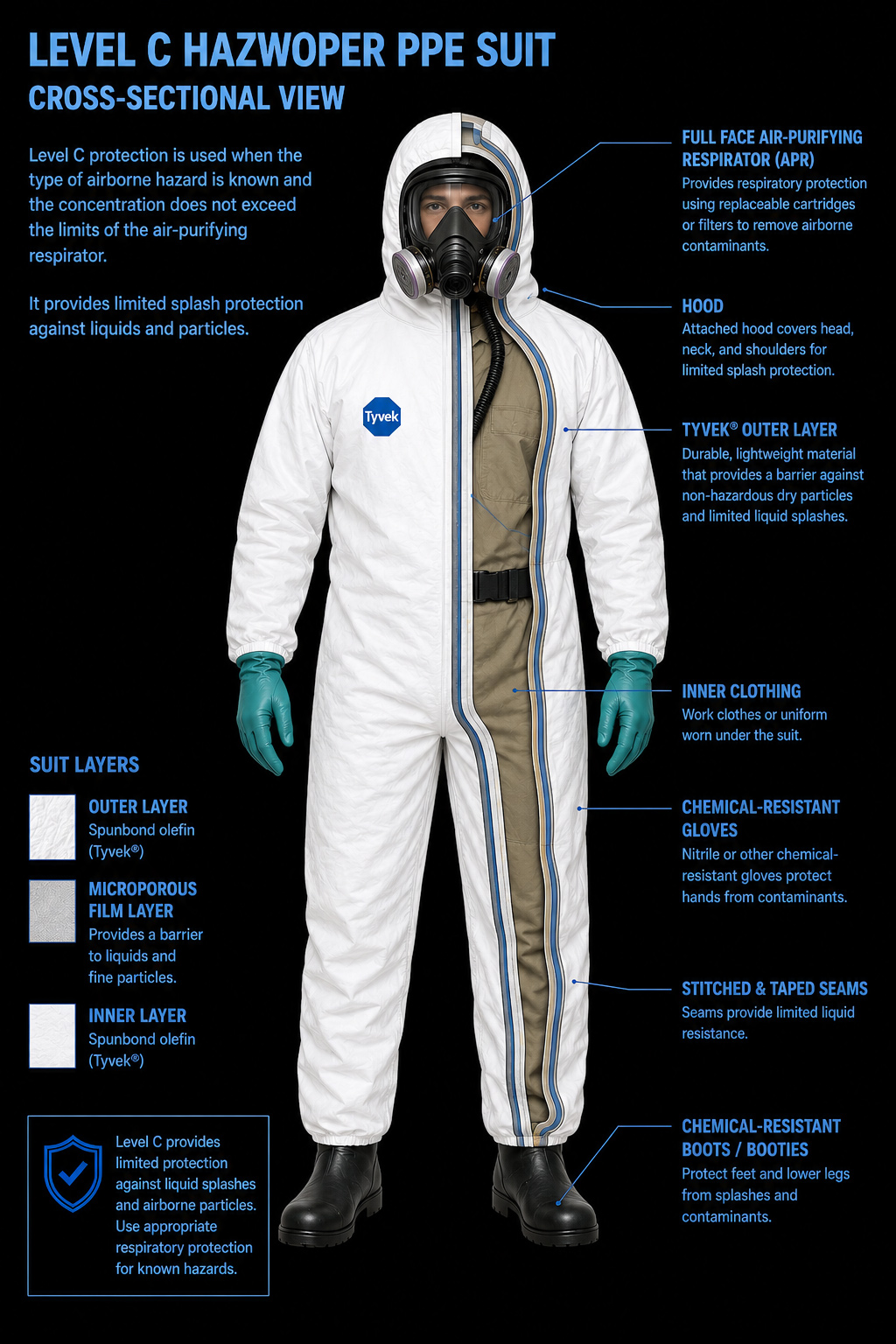
A typical Level C ensemble includes a full-face or half-mask APR, chemical-resistant clothing, gloves, boots, eye protection as needed, and other protective equipment selected through the site-specific hazard assessment. Level C may be appropriate for planned hazardous waste operations, remediation work, sampling, decontamination, and other tasks where monitoring confirms that oxygen levels are adequate, contaminants are identified, and conditions are not Immediately Dangerous to Life and Health (IDLH).
Level C PPE should never be used in unknown atmospheres, oxygen-deficient environments, or conditions where contaminant concentrations may exceed the protection capability of the selected respirator. Employers must use air monitoring, hazard assessment, cartridge-change schedules, medical evaluations, fit testing, training, and the site Health and Safety Plan (HASP) to determine whether Level C is appropriate for the task. OSHA’s Hazardous Waste Operations and Emergency Response (HAZWOPER) standard explains that PPE must be selected to protect workers from the specific hazards they are likely to encounter.
Key Takeaways
- Level C PPE is used when airborne contaminants are identified, measured, and within the operating limits of an approved APR.
- Level C provides less respiratory protection than Level A and Level B because it does not supply independent breathing air.
- A typical Level C ensemble may include an APR, chemical-resistant coveralls or splash suit, gloves, chemical-resistant boots, and eye or face protection as required.
- Level C is not appropriate for unknown atmospheres, oxygen-deficient environments, or IDLH conditions.
- Atmospheric monitoring must confirm that oxygen is adequate and that contaminant concentrations remain within the capabilities of the selected respirator and cartridges.
- Cartridge and canister selection must match the contaminant hazard; an APR cannot protect against every gas, vapor, particulate, or chemical exposure.
- Employers must establish cartridge-change schedules rather than relying only on odor, taste, or irritation to determine when cartridges need replacement.
- Workers who wear tight-fitting APRs must complete required medical evaluations, fit testing, training, inspection, and maintenance under the employer’s respiratory protection program.
- Chemical-resistant clothing, gloves, and boots must be selected for the specific contaminants and potential skin-contact hazards present at the site.
- The site-specific HASP should define the PPE level, respiratory protection, decontamination procedures, monitoring requirements, and conditions that require upgrading to Level B or Level A.
- Level C may be suitable for planned remediation, sampling, decontamination, and waste-handling tasks only when conditions remain characterized and controlled.
- If monitoring shows changing conditions, rising contaminant concentrations, oxygen deficiency, or an unknown hazard, workers must leave the area or upgrade respiratory protection as directed by the HASP.
Level C PPE Cross Sectional
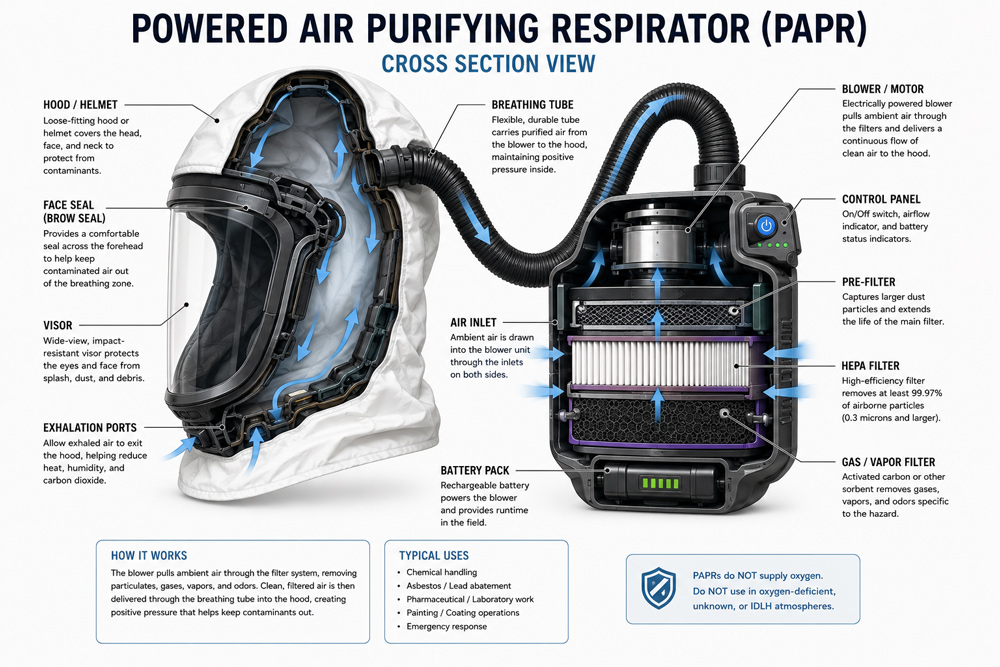
Powered Air Purifying Respirator (PAPR)
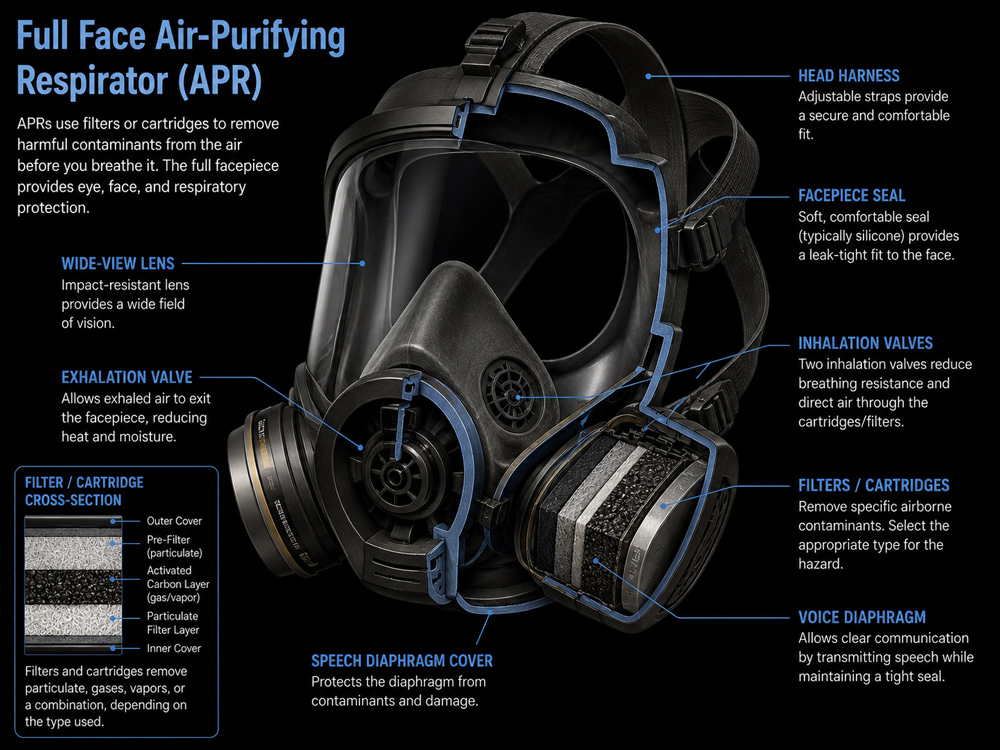
Full Face Air Purifying Respirator (APR)
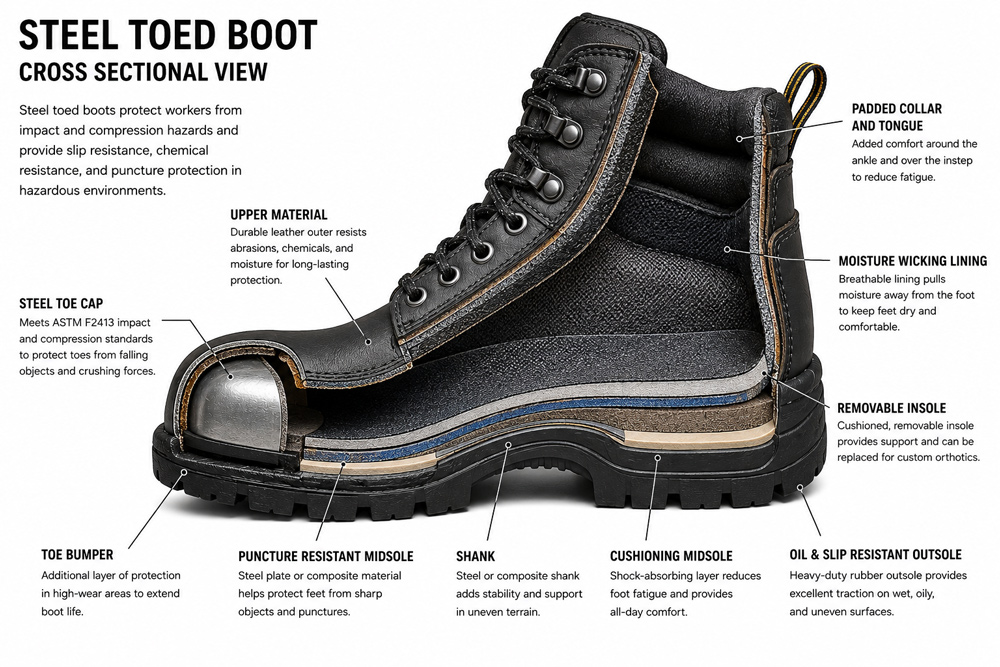
Steel Toed Boot
Chemical Gloves

Level C PPE: Moderate Protection for Known Hazards
Level C PPE is used in HAZWOPER when:
✅ The airborne contaminant is known and below IDLH levels.
✅ Oxygen levels are safe (above 19.5%).
✅ Skin protection is not critical (chemicals do not pose a significant skin absorption hazard).
1. Components of Level C PPE
| PPE Component | Purpose | Example Equipment |
|---|---|---|
| Respirator | Protects against airborne contaminants (vapors, gases, dusts, mists) | Full-face or half-face APR or Powered Air-Purifying Respirator (PAPR) |
| Protective Suit | Shields body from chemical splashes, dust, and debris | Tyvek® suit, chemically resistant coveralls |
| Gloves | Prevents direct contact with hazardous substances | Nitrile, neoprene, butyl, or PVC gloves (chemical-resistant, task-dependent) |
| Boots (Chemical-Resistant) | Protects feet from chemical exposure | Steel-toe, chemical-resistant rubber or PVC boots |
| Face Shield / Safety Goggles | Eye protection from splashes and debris | Safety goggles or full-face respirator |
| Hard Hat (if required) | Head protection in construction or falling object hazards | Hard hat |
2. When is Level C PPE Used?
✅ Appropriate Situations:
- Known airborne contaminants below IDLH limits.
- Adequate oxygen levels (>19.5%) (not for oxygen-deficient environments).
- No risk of severe skin absorption from chemicals.
❌ Not Suitable for:
- IDLH conditions (Level A or B required).
- Oxygen-deficient environments (<19.5%) (Self Contained Breathing Apparatus is required).
- Hazardous chemicals that can be absorbed through the skin (Level B required).
3. HAZWOPER Applications for Level C PPE
| Task | Common Hazards | Level C PPE Justification |
|---|---|---|
| Non-IDLH chemical spill cleanup | Organic vapors, low-toxicity dusts | APR provides adequate protection |
| Lead or Asbestos Abatement | Toxic particulates (lead, asbestos) | P100 filters capture airborne particles |
| Pesticide Handling | Low-concentration vapors & aerosols | Organic vapor cartridge + protective clothing |
| Industrial Maintenance & Cleanup | Solvent exposure, fuel residues | Chemical-resistant gloves & APR |
4. Respirator Selection for Level C PPE
| Respirator Type | Protection Level | Example Use Case |
|---|---|---|
| Half-Face APR | APF 10 | Dusts, mists, low-vapor concentrations |
| Full-Face APR | APF 50 | Organic vapors, toxic gases, higher exposure risk |
| PAPR (Powered APR) | APF 25-1,000 | Extended use, higher contamination levels |
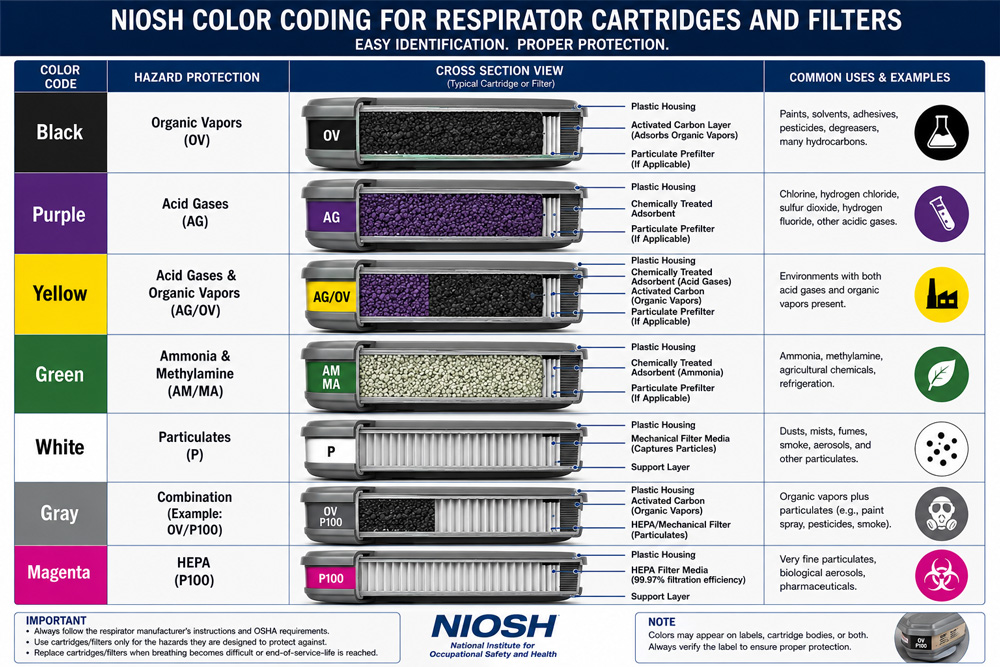
Note: Cartridges and filters must match specific hazards (e.g., NIOSH color-coded system: Organic Vapor (black), Acid Gas (white), P100 (magenta) for particulates).
NIOSH Color Coding for Cartridges and Filters

5. Summary of Level C PPE
- Respiratory protection (APR or PAPR) is required.
- Used when contaminants are known and below IDLH levels.
- Not for oxygen-deficient environments or severe skin hazard chemicals.
- Common in cleanup, abatement, and industrial maintenance.
Select the Right Level C Protection Before Work Begins
Level C PPE can be an effective choice when the airborne hazard is known, concentrations are within the limits for an air-purifying respirator, oxygen is adequate, and the selected cartridge or filter is approved for the contaminants present. A Level C ensemble may include a NIOSH-approved full-face APR, hooded chemical-resistant clothing such as a Tyvek® coverall, chemical-resistant gloves, and protective boots. It is not appropriate for unknown, oxygen-deficient, or IDLH atmospheres.
OSHACode® HAZWOPER training helps workers understand PPE selection, respiratory protection, hazard recognition, decontamination, and the limits of each protective ensemble. Build the knowledge foundation online, then reinforce it with employer-provided, site-specific practice using the actual PPE, respirators, monitoring instruments, and procedures your team will use.
Choose the HAZWOPER training that helps your workforce recognize when Level C is appropriate—and when a higher level of protection is required.
Frequently Asked Questions
What is HAZWOPER Level C PPE?
HAZWOPER Level C PPE is a protective ensemble used when airborne hazards are known, measured, and within the protection capability of an approved air-purifying respirator. It commonly includes an APR, chemical-resistant clothing, gloves, boots, and other protective equipment selected for the work task.
When is Level C PPE appropriate?
Level C PPE may be appropriate when the contaminant type and concentration are known, oxygen levels are adequate, the atmosphere is not IDLH, and air monitoring confirms that an APR can provide adequate respiratory protection.
What respiratory protection is used with Level C PPE?
Level C PPE generally uses an air-purifying respirator, such as a full-face APR, half-mask APR, or powered air-purifying respirator when appropriate. The respirator, cartridges, filters, and canisters must be selected for the specific contaminants and exposure conditions.
Can Level C PPE be used in an IDLH atmosphere?
No. Level C PPE is not appropriate for Immediately Dangerous to Life and Health atmospheres. IDLH conditions require atmosphere-supplying respiratory protection, such as a pressure-demand SCBA or a properly configured pressure-demand supplied-air respirator with an auxiliary escape air supply.
Can Level C PPE be used in an oxygen-deficient atmosphere?
No. Air-purifying respirators do not supply oxygen. Level C PPE should not be used where oxygen is deficient or where oxygen conditions are unknown. OSHA considers an atmosphere with less than 19.5 percent oxygen to be oxygen deficient.
What is the difference between Level B and Level C PPE?
Level B provides maximum respiratory protection by using an SCBA or other atmosphere-supplying respirator, while Level C uses an air-purifying respirator. Both levels may use chemical-resistant clothing, gloves, and boots, but Level B is selected when respiratory hazards are greater, unknown, or unsuitable for APR use.
Does Level C PPE protect against chemical splashes?
It can, but protection depends on the clothing, gloves, boots, seams, and materials selected for the specific chemical hazard. Level C PPE may include chemical-resistant garments that provide splash protection, but it does not automatically provide the same vapor protection as a fully encapsulating Level A suit.
How do employers select cartridges for a Level C respirator?
Employers must identify the contaminants present and select cartridges, filters, or canisters approved for those hazards. They must also establish a cartridge-change schedule based on objective information, including contaminant concentration, work rate, temperature, humidity, and cartridge service-life data.
Can workers rely on smell to know when APR cartridges need replacement?
No. Odor is not a reliable warning system for cartridge replacement. Some hazardous chemicals have poor warning properties, and exposure may occur before a worker notices an odor. Employers should use a written cartridge-change schedule.
Is fit testing required for Level C PPE?
Fit testing is required when workers use a tight-fitting air-purifying respirator. Employees must also receive a medical evaluation, respirator training, and instruction on inspection, maintenance, cleaning, storage, and limitations before using the respirator.
What monitoring is needed before using Level C PPE?
Employers should conduct air monitoring to evaluate oxygen concentration, flammability, and contaminant levels. Monitoring should continue as needed to verify that conditions remain within the protection limits of the selected respirator and PPE ensemble.
What should workers do if site conditions change while wearing Level C PPE?
Workers should follow the HASP and site emergency procedures. If monitoring indicates an unknown contaminant, oxygen deficiency, rising concentrations, or conditions beyond the protection capability of Level C PPE, workers should leave the area and notify supervision so respiratory protection can be reevaluated.
Is Level C PPE used in HAZWOPER operations?
Yes. Level C PPE may be used during HAZWOPER operations when the site hazard assessment and air monitoring support its use. It is commonly considered for controlled work involving known contaminants, but the HASP—not a generic PPE chart—must determine the correct level for each task.
Sources
Emergency Response and Preparedness
OSHA HAZWOPER Hands-on Training Requirement
Medical Surveillance Requirements
U.S. Occupational Safety and Health Administration
https://www.osha.gov/laws-regs/standardinterpretations/1992-08-27-1
U.S. Environmental Protection Agency
https://www.epa.gov/laws-regulations/summary-resource-conservation-and-recovery-act
Related Articles
Building a HAZWOPER Safety Culture
Hands-on Training Discussions with U.S. OSHA