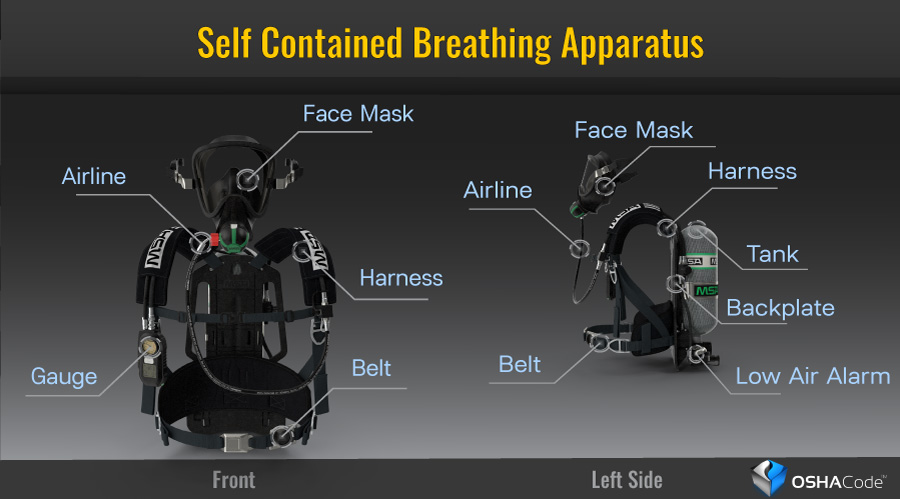
Schematic View of a Self-Contained Breathing Apparatus (SCBA)
A self-contained breathing apparatus (SCBA) is a critical device used in hazardous environments to provide clean, breathable air. It is commonly utilized by firefighters, industrial workers, and rescue personnel working in toxic, smoke-filled, or oxygen-deficient atmospheres.
Key Components of an SCBA
A schematic view of an SCBA highlights the individual components that make up the system and their interconnections. Here’s a breakdown of the essential parts:
- Air Cylinder
- Stores compressed air (usually between 2,200 to 4,500 psi).
- Made of aluminum, steel, or composite materials for durability and weight reduction.
- Includes a cylinder valve to control airflow.
- Pressure Regulator
- Reduces the high-pressure air from the cylinder to a safe and breathable level.
- Ensures steady air supply to the face mask or demand valve.
- Face Mask (Full-Facepiece Respirator)
- Seals around the user’s face to prevent contaminated air entry.
- Contains an exhalation valve to allow the release of carbon dioxide.
- Some masks feature heads-up displays (HUDs) showing remaining air levels.
- Demand Valve (Second-Stage Regulator)
- Supplies air to the user on demand (when they inhale).
- Often equipped with a positive pressure system to prevent contaminants from entering.
- Harness and Backplate
- Holds the air cylinder securely on the user’s back.
- Designed for comfort and stability during high-mobility tasks.
- Pressure Gauge & Warning Alarm
- Displays the air pressure remaining in the cylinder.
- An alarm sounds when air supply is running low (usually at 25% remaining).
- Modern SCBAs may have electronic air monitoring systems.
- Bypass Valve (Emergency Feature)
- Allows manual airflow in case of demand valve failure.
- Used as an emergency override.
How Does an SCBA Work?
- The user wears the SCBA harness and secures the face mask.
- The cylinder valve is opened, allowing high-pressure air to move into the pressure regulator.
- The first-stage regulator reduces the air pressure and supplies it to the demand valve.
- The user inhales, triggering the demand valve, which delivers air through the face mask.
- The exhalation valve ensures exhaled air is released while preventing external contaminants from entering.
- The pressure gauge and warning system alert the user about air levels, ensuring they exit safely when needed.
What are the Types of SCBAs?
- Open-Circuit SCBA
- Expels exhaled air into the environment.
- Commonly used in firefighting and industrial applications.
- Closed-Circuit (Rebreather) SCBA
- Recirculates exhaled air by removing CO₂ and replenishing oxygen.
- Used in long-duration applications like mining and underwater rescue.
Applications of SCBA
- Firefighting – Protects firefighters from smoke, toxic gases, and heat.
- Hazardous Material Handling – Used in chemical spills or biohazard cleanup.
- Confined Space Entry – Essential for workers in oxygen-deficient areas like tunnels and tanks.
- Rescue Operations – Ensures safe breathing in collapsed buildings or disaster zones.
Conclusion
An SCBA is a life-saving apparatus designed to provide a reliable air supply in hazardous conditions. Understanding its schematic layout helps users operate and maintain it effectively. The integration of advanced pressure regulators, warning systems, and lightweight materials continues to improve SCBA technology for enhanced safety and efficiency.
Sources
Emergency Response and Preparedness
OSHA HAZWOPER Hands-on Training Requirement
Medical Surveillance Requirements
U.S. Occupational Safety and Health Administration
https://www.osha.gov/laws-regs/standardinterpretations/1992-08-27-1
U.S. Environmental Protection Agency
https://www.epa.gov/laws-regulations/summary-resource-conservation-and-recovery-act
Related Articles
Building a HAZWOPER Safety Culture
HAZWOPER Hands-on Training Discussions with U.S. OSHA