

Summary
HAZWOPER hands-on training is a required component of the 24-hour and 40-hour HAZWOPER courses under 29 CFR 1910.120(e) — and not all hands-on training satisfies it. OSHA’s position, confirmed through direct discussions with the OSHA Directorate of Enforcement, is that workers must receive site-specific hands-on training using the actual PPE and equipment they will use in their roles. Generic classroom training on non-site-specific equipment does not meet the standard. The employer — not the training provider — is responsible for arranging and documenting this component.
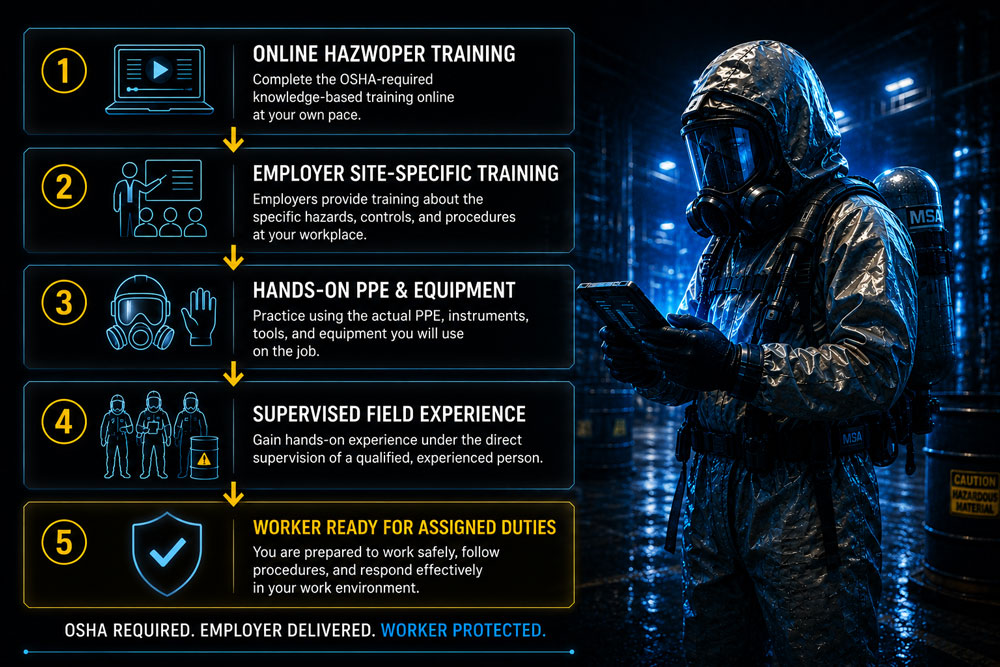
Site-specific Hands-on Training Diagram
Discussions with U.S. OSHA Directorate of Enforcement
The purpose of this webpage is to document conversations we had with the U.S. Occupational Safety and Health Administration (OSHA) Directorate of Enforcement. The content on this page(s) should be treated as informational as we do not speak for OSHA nor any other regulator(s). Also, we do not list the name(s) of OSHA officials we had discussions with unless we have their permission. We encourage you to call U.S. OSHA at 202.693.2100 or visit their website should you have any questions regarding Hazardous Waste Operations and Emergency Response (HAZWOPER) hands-on training. You can always call or email us as well.
Throughout our professional careers, we have been fortunate to engage in communication with the OSHA Directorate of Enforcement Programs in Washington, D.C., These discussions centered on HAZWOPER hands-on training and the practical aspects of this training. Specifically, the two training courses discussed were the 24 hour HAZWOPER and 40 hour HAZWOPER found in 29 CFR 1910.120(e). OSHA has set forth precise requirements for the content and execution of this training, as outlined in OSHA regulation 29 CFR 1910.120 Appendix E (Non-Mandatory Guidelines), which indicates that site-specific hands-on training must complement HAZWOPER courses. Although Appendix E is not a mandatory regulation, OSHA maintains clear expectations regarding its implementation.
What is OSHA’s Core Message on HAZWOPER Hands-on Training?
The core message conveyed to OSHA field enforcement offices is that individuals undergoing HAZWOPER training must receive site-specific hands on instruction using the actual and exact equipment and type of Personal Protective Equipment (PPE) they will use in their respective roles. It has been emphasized that generic classroom or open enrollment hands on training on respirators, for instance, does not align with OSHA’s expectations. In a classroom setting that accommodates students from different employers, the likelihood of the instructor possessing the precise PPE relevant to each worker’s job and each site is slim. Also, site-specific training is required for a contaminated site such as reviewing the health and safety plan with employees, conducting drills for emergency procedures, evacuations, specific hazards, etc. Therefore, it is imperative that individuals receive hands-on training with the actual equipment and PPE they will use, a requirement that cannot be fulfilled through open enrollment class instruction, online training, simulators or videos. Instead, employers must conduct site-specific hands-on training using the actual equipment their employees will encounter.
Generic Hands-on Training vs Site-Specific Hands-on Training
Not all hands-on training is created equal. It is crucial to distinguish between generic hands-on training offered in public seminars and site-specific hands-on training. We have already mentioned this earlier in this article but the importance of understanding the difference between generic and site-specific hands-on training is critical. For example, if your employees attended a public 24 hour HAZWOPER or 40 hour HAZWOPER (29 CFR 1910.120(e)) training seminar and relied solely on this training for hands-on experience (assuming it was conducted), it’s important to note that this does not meet the OSHA standard. The standard requires site-specific training. Generic hands-on training can be done but often times employees have a false sense of compliance thinking this is all that is required. If the only hands-on training you took was generic and not site-specific, you would be considered out of compliance subject to violations and fines. OSHA holds the employer accountable for ensuring site-specific hands-on training is provided, not the training provider.
The goal in requiring a hands-on component is to ensure that each worker has practical exposure to the conditions, materials, and decision-making processes they will face on an actual hazardous waste site. Trainess must show competence in the academic portion of the training as well as the hands-on component. The standard mandates that trainees complete at least three days of field experience under the direct supervision of someone who is both experienced and properly trained—typically a supervisor or site manager who has the knowledge and skills to be a HAZWOPER instructor.
During this period, trainees are expected to demonstrate competency and mastery in critical safety procedures such as proper use of PPE, site control and hazard recognition, decontamination procedures, and safe handling of tools and materials. Unlike classroom instruction, the field experience immerses workers in realistic scenarios—whether it’s practicing donning and doffing chemical-resistant suits, simulating spill containment, or setting up decontamination lines. These exercises reinforce what was learned during the initial instruction phase and bridge the gap between knowledge and action.
Examples of Hands-on Exercises
Although each program should be tailored to site conditions, there are common practical activities that OSHA expects to be included in the hands-on portion. Workers should practice donning, fitting, and maintaining respiratory protection and chemical-resistant clothing to ensure complete understanding of protective equipment use. They should engage in decontamination drills, setting up contamination reduction corridors, sequencing the removal of protective gear, and properly handling contaminated tools and waste.
Other exercises may include safe operation of site-specific machinery, spill containment simulations, and mock emergency responses such as chemical releases or system failures. These scenarios help workers understand how to communicate under pressure, coordinate with emergency personnel, and execute site evacuation routes when necessary. By working through these drills in realistic conditions, trainees build muscle memory and situational awareness that classroom learning alone cannot provide.
Employer Responsibility
What is an Acceptable HAZWOPER Training Method?
In essence, OSHA’s core message aligns with what competent employers have been doing all along, as the HAZWOPER training standard is performance-based. We continue to provide the academic portion of the training online, with the employer taking responsibility for training employees on the actual equipment they will use in their roles. In our numerous interactions with employers, it appears that many are already following this practice.
Notably, HAZWOPER certification is a shared responsibility between the instructor and the employer, a principle that has been consistently upheld. Given the employer’s primary role in safeguarding their employees’ health and safety, their direct knowledge of specific job tasks and site conditions positions them as the natural candidates to administer the site-specific hands-on training.
We take pride in collaborating with some of the most diligent Health and Safety managers in the industry, recognizing that their top priority is the safety of their workforce. We are grateful for the trust many companies and individuals have placed in us for their HAZWOPER training needs. The clarification regarding hands-on training requirements is a welcome development in our ongoing commitment to maintaining high safety standards. OSHACode® provides OSHA compliant 40 hour HAZWOPER, 24 hour HAZWOPER and the HAZWOPER 8 hour refresher training courses.
Why In-House Hands-On Training Works
A common question among employers and safety managers is whether this three-day field component must be conducted by an external training provider or if it can be managed internally. OSHA’s position is clear: employers may conduct the hands-on portion in-house, provided that it is led by a qualified supervisor and that the training content and documentation meet the agency’s standards. When done properly, in-house hands-on and field training can strengthen safety performance, reduce costs, and align training with site-specific hazards more effectively than generic exercises.
There are significant advantages to conducting field training within the organization itself. Perhaps the most important is site-specific relevance. Every hazardous waste operation is different—each with unique materials, exposure pathways, and emergency response protocols. Conducting training on-site allows workers to practice using the same equipment, tools, and PPE that they will rely on in actual operations. It ensures familiarity with your facility’s layout, its decontamination stations, and its response procedures, creating a direct link between training and daily work.
From a logistical standpoint, in-house training offers greater flexibility and cost efficiency. Instead of coordinating travel or waiting for external classes to align with your production schedule, employers can integrate training into regular shifts or downtime. The reduced travel expenses and time savings can be significant, particularly for companies managing large teams or multiple worksites.
In addition, employees tend to be more comfortable and engaged in familiar surroundings. Practicing with their own supervisors and peers often encourages questions, experimentation, and teamwork. This environment fosters a stronger safety culture—one built not on fear of compliance, but on confidence and competence.
Hands-on Training Student to Instructor Ratio
29 CFR 1910.120 Appendix E
The student to instructor ratio should not exceed 30 students per instructor for a 40 hour HAZWOPER training or a 24 hour HAZWOPER training class. Site-specific hands-on activity requiring the use of actual PPE should have the following student to instructor ratios. For Level C or Level D PPE the ratio should not exceed 10 students per instructor. For Level A or Level B PPE the ratio should not exceed 5 students per instructor.
The Difference Between General and Site-Specific HAZWOPER Training
Update July 6, 2026
HAZWOPER training has two essential parts: foundational instruction that teaches core hazardous-waste safety principles, and site-specific hands-on training that prepares employees for the actual conditions of their assigned worksite. Both matter, but they serve different purposes.
1. General HAZWOPER Training: The Foundational Knowledge Portion
General HAZWOPER training provides the core knowledge workers need before performing hazardous waste operations. It may be completed online or in a traditional classroom setting and covers safety principles that apply across many hazardous-waste environments.
Typical topics include toxicology, chemical hazard recognition, OSHA and EPA regulatory concepts, Safety Data Sheets, hazardous-waste operations, decontamination principles, respiratory protection concepts, PPE selection, emergency procedures, and the theory of air monitoring.
This training may use standard examples of protective clothing, respirators, monitoring instruments, and decontamination equipment to explain how the equipment works. However, it cannot fully prepare an employee for the exact hazards, equipment, procedures, and emergency conditions at a particular site.
General training gives workers the knowledge foundation. It does not, by itself, demonstrate that a worker can safely perform assigned duties at a specific hazardous waste site.
2. Site-Specific HAZWOPER Training: The Employer’s Practical Responsibility
Site-specific HAZWOPER training is the employer’s practical training responsibility. It must prepare employees for the hazards, work practices, equipment, and emergency procedures they will encounter at the actual site or in the specific operation where they will work.
Workers should receive instruction and practical exercises using the actual PPE, air-monitoring instruments, tools, communications equipment, decontamination systems, and emergency procedures required for their assigned duties. If the site uses a particular multi-gas meter, respirator configuration, protective suit, or communications system, employees should be trained to use that equipment correctly before they begin work.
Site-specific training should also explain the facility or project’s Site Safety and Health Plan (SSHP), sometimes called a Health and Safety Plan (HASP). Employees need to understand the site-specific information that affects their work, including:
- The hazardous substances and physical hazards present at the site
- Work zones, access controls, and site-control procedures
- Required PPE and respiratory-protection procedures
- Air-monitoring methods, action levels, alarms, and response actions
- Decontamination procedures and equipment locations
- Site-specific emergency alarms, evacuation routes, and assembly areas
- Emergency contacts, medical arrangements, and local response capabilities
- Confined-space, excavation, weather, terrain, traffic, or other operational hazards relevant to the assignment
Hands-on exercises should reflect the real conditions workers may encounter. For example, a site with confined spaces, uneven terrain, heavy equipment, elevated work areas, extreme temperatures, or chemical splash hazards requires practical preparation for those conditions.
General vs. Site-Specific HAZWOPER Training
| Training Element | General HAZWOPER Training | Site-Specific HAZWOPER Training |
|---|---|---|
| Location | Online, classroom, or another general training setting. | At the worksite or tailored directly to the specific site and operation. |
| Equipment | Standard examples used to teach PPE, respirator, monitoring, and decontamination concepts. | The actual PPE, instruments, tools, communications equipment, and procedures employees will use. |
| Hazards | General chemical, physical, biological, and safety hazards common to hazardous-waste work. | The actual substances, exposure routes, physical hazards, work zones, and operational conditions at the assigned site. |
| Emergency Procedures | General emergency-response concepts and hazard recognition. | The site’s SSHP or HASP, alarm systems, evacuation routes, assembly areas, emergency contacts, and medical arrangements. |
| Who Provides It | A qualified training provider or instructor. | The employer, site safety officer, project manager, or another qualified person with knowledge of the site and operation. |
| Role in Compliance | Provides the required knowledge-based foundation for the applicable HAZWOPER training level. | Provides the practical, job-specific instruction needed before employees perform assigned hazardous-waste duties. |
The Bottom Line
General HAZWOPER training teaches workers how to recognize and control hazardous-waste risks. Site-specific training teaches them how to apply that knowledge safely at the actual worksite.
An online or classroom HAZWOPER course can satisfy the knowledge-based portion of the applicable training requirement, but it does not eliminate the employer’s responsibility to provide site-specific instruction, practical exercises, and supervised field experience when required by the applicable HAZWOPER provision. Employees should not be assigned hazardous-waste duties until they understand the hazards, equipment, procedures, and emergency actions that apply to their specific work environment.
FAQs
Does OSHACode sell an 8-hour hands-on HAZWOPER add-on?
No. OSHA requires hands-on training with the actual PPE and equipment a worker will use, plus a minimum of three days (one day for the 24-hour course) of supervised field experience. Both must be site-specific and are the employer’s responsibility, not a training provider’s.
This isn’t a general reading of the standard — it’s a position OSHA confirmed directly, in writing, to our founder. In a February 4, 2009 letter to Clay Bednarz of National Environmental Trainers® (OSHACode’s predecessor company), OSHA’s Office of Health Enforcement clarified that interactive and computer-based HAZWOPER training can be part of a compliant program, but an employer “may not rely solely on the use of an interactive or video training program” to meet the 40-or 24-hour training requirement. OSHA’s standing expectation, restated in that letter, is that a trainee must “don, doff, touch, feel, and otherwise manipulate” the actual PPE and equipment used at their specific site — something a generic classroom or simulator session, on its own, cannot provide.
That’s why OSHACode doesn’t sell a bolt-on “hands-on” module: it would create the same false sense of compliance OSHA flagged in writing over fifteen years ago. See our full breakdown of general vs. site-specific HAZWOPER training for the complete regulatory history and sourcing.
The compliance risk is not theoretical. OSHA inspectors evaluate HAZWOPER training against OSHA CPL 02-02-071 (Technical Enforcement and Assistance Guidelines), and their focus is training effectiveness, not certificate completion — a worker who can’t demonstrate competency with the actual PPE and equipment at the site fails inspection regardless of what certificate they hold. As of the January 2025 penalty adjustment, serious violations carry penalties starting at $16,550 each, and willful or repeat violations can reach $165,514 — and each undocumented worker is typically cited separately, so penalties compound quickly across a crew. See Online-Only vs. Blended HAZWOPER Training and How OSHA Evaluates HAZWOPER Hands-On Training During Inspections for the full inspection and penalty breakdown.
What is HAZWOPER hands-on training?
HAZWOPER hands-on training is practical instruction that allows workers to become familiar with the personal protective equipment (PPE), air monitoring instruments, decontamination procedures, and work practices they will use during hazardous waste operations or emergency response activities. OSHA expects employees to demonstrate competency using actual equipment in a non-hazardous environment.
Is hands-on training required for HAZWOPER?
Yes. OSHA requires employees to receive hands-on training and field experience appropriate to their assigned duties. Workers must have opportunities to practice using PPE, equipment, and procedures before performing hazardous waste operations.
Can online HAZWOPER training replace hands-on training?
No. Online HAZWOPER training can satisfy the instructional or classroom portion of training requirements, but employers must still provide any required hands-on training, field experience, and site-specific instruction.
What skills are typically covered during HAZWOPER hands-on training?
Hands-on training may include respirator use, PPE donning and doffing, air monitoring equipment operation, decontamination procedures, hazard recognition, emergency response actions, spill control techniques, and site-specific safety procedures.
Who is responsible for providing HAZWOPER hands-on training?
The employer is responsible for ensuring employees receive the necessary hands-on and site-specific training required to safely perform their assigned duties under OSHA’s HAZWOPER standard.
Does 40-Hour HAZWOPER require field experience?
Yes. OSHA requires workers completing 40-Hour HAZWOPER training to receive three days of actual field experience under the direct supervision of a trained and experienced supervisor.
Does 24-Hour HAZWOPER require field experience?
Yes. Workers completing 24-Hour HAZWOPER training generally must receive one day of supervised field experience appropriate to their anticipated job duties.
What is the difference between generic hands-on training and site-specific training?
Generic hands-on training focuses on practical skills such as using PPE and safety equipment – this does not satisfy the OSHA requirements. Site-specific training addresses the unique hazards, emergency procedures, work zones, air monitoring requirements, and safety practices associated with a particular jobsite.
Can generic classroom exercises satisfy HAZWOPER hands-on requirements?
No. OSHA expects workers to become familiar with the actual equipment, PPE, and procedures they will use in their work environment. Employers should ensure practical training reflects real-world job conditions whenever possible.
What documentation should employers maintain for hands-on training?
Employers should maintain records showing the employee’s training date, topics covered, instructor qualifications, field experience completion, competency evaluations, and any site-specific training provided.
Do supervisors need hands-on HAZWOPER training?
Yes. Supervisors must receive training equivalent to the workers they supervise and should be competent in the PPE, equipment, procedures, and safety practices used during hazardous waste operations.
How can employers verify HAZWOPER competency?
Employers can verify competency through practical demonstrations, field observations, skills evaluations, written assessments, documented field experience, and ongoing supervision. OSHA places responsibility on employers to ensure workers can safely perform their assigned duties.
Is hands-on training required every year during HAZWOPER refresher training?
Annual refresher training must maintain employee competency. Depending on job duties, employers may incorporate practical exercises, PPE drills, emergency response simulations, and equipment familiarization activities as part of refresher training.
Can employers conduct their own HAZWOPER hands-on training?
Yes. Employers may conduct site-specific and hands-on training provided qualified instructors oversee the training and employees gain the knowledge and skills necessary to perform their work safely.
What OSHA regulation addresses HAZWOPER hands-on training?
HAZWOPER training requirements are found in OSHA 29 CFR 1910.120. The standard requires employees to be trained to safely perform their anticipated job duties and includes provisions for practical field experience and competency-based training.
About the Author
This article was written by Clay A. Bednarz, MS, RPIH, founder of National Environmental Trainers® and OSHACode®. Bednarz pioneered the first commercial online HAZWOPER training programs in 1998 and has supported major hazardous waste operations, environmental remediation projects, and emergency response training initiatives nationwide.