
Summary
Perimeter air sampling monitors airborne contaminants at or beyond the boundary of a hazardous waste site to evaluate whether contaminants are migrating outside the work area. Unlike personal air monitoring, which measures worker exposure in the breathing zone, perimeter monitoring helps protect neighboring workers, the public, adjacent facilities, and the environment by detecting airborne releases before they leave the site. Monitoring may be continuous or periodic depending on site conditions, contaminant characteristics, weather, work activities, and regulatory requirements. Results help determine exclusion-zone boundaries, evaluate engineering controls, document off-site impacts, and demonstrate regulatory compliance during HAZWOPER operations. OSHA emphasizes monitoring as part of site characterization and ongoing hazard evaluation.
Key Takeaways
- Perimeter air monitoring measures contaminants near the site boundary rather than in an individual worker’s breathing zone.
- The objective is to identify contaminant migration beyond the exclusion zone before it affects workers, nearby facilities, or the public.
- Monitoring locations should consider prevailing winds, terrain, work activities, weather conditions, and nearby receptors.
- Direct-reading instruments such as PIDs, FIDs, CGI meters, and multi-gas detectors provide rapid indication of changing site conditions.
- Laboratory sampling may be used to document longer-term airborne contaminant concentrations.
- Monitoring results help establish exclusion zones, support engineering controls, verify decontamination effectiveness, and document regulatory compliance.
- Wind direction should be evaluated continuously because contaminant plumes may shift throughout the workday.
- Monitoring should continue whenever excavation, drum handling, remediation, or emergency response activities have the potential to release hazardous substances.
Personal vs. Perimeter Air Monitoring
| Feature | Personal Monitoring | Perimeter Monitoring |
|---|---|---|
| Purpose | Measure worker exposure | Detect contaminant migration beyond the work area |
| Sampling Location | Breathing zone | Site boundary |
| Protects | Individual worker | Workers, public, neighboring properties, environment |
| Typical Instruments | Sampling pumps, badges, cassettes | PID, FID, CGI, Multi-Gas Meter |
| Primary Decision | Worker PPE and exposure compliance | Site control and public protection |
Common Air Sampling Methods Used at HAZWOPER Sites
| Sampling Method | Typical Contaminants | Laboratory Analysis Required? | Primary Advantage |
|---|---|---|---|
| Filter Cassette | Dusts, metals, asbestos, silica | Yes | Excellent quantitative particulate sampling. |
| Sorbent Tube | Organic vapors | Yes | Highly accurate vapor collection. |
| Passive Badge | Organic vapors | Yes | No pump required. |
| PID | Volatile organic compounds | No | Immediate readings. |
| FID | Hydrocarbons | No | Excellent petroleum detection. |
| Multi-Gas Meter | O₂, LEL, CO, H₂S | No | Monitors multiple atmospheric hazards simultaneously. |
What is Perimeter Air Sampling?
Perimeter air sampling is a critical environmental monitoring strategy at HAZWOPER (Hazardous Waste Operations and Emergency Response) sites. It involves the strategic placement of air sampling equipment around the site’s boundary to detect, measure, and control airborne contaminant migration.
The primary goal is to ensure that hazardous emissions do not exceed regulatory limits, impact workers, the public, or the surrounding environment.
Objectives of Perimeter Air Sampling
✅ Regulatory Compliance
- Ensures compliance with Occupational Safety and Health Administration (OSHA) 29 CFR 1910.120 (HAZWOPER), Environmental Protection Agency (EPA) 40 CFR Part 50 (NAAQS), and National Institute for Occupational Safety and Health (NIOSH) guidelines for air quality.
- Demonstrates due diligence in managing hazardous materials.
✅ Worker & Community Health Protection
- Identifies potential airborne hazards before they affect personnel inside the site or migrate offsite into nearby communities.
✅ Hazardous Substance Migration Control
- Tracks the movement of volatile organic compounds (VOCs), dust, metals, and toxic gases to prevent off-site contamination.
✅ Emergency Preparedness
- Provides real-time alerts for sudden chemical releases, allowing for immediate response actions.
✅ Legal & Liability Protection
- Establishes documented proof of compliance and responsible site management in case of lawsuits or regulatory audits.
When is Perimeter Air Sampling Required?
Perimeter air sampling is mandatory or strongly recommended in scenarios such as:
Hazardous Waste Site Remediation – Monitoring airborne contaminants from excavation and treatment.
Demolition of Contaminated Structures – Detecting asbestos, lead, and other harmful particulates.
Chemical Spill Response & Cleanup – Ensuring toxic vapors and gases do not migrate offsite.
Excavation & Drilling Activities – Preventing exposure to buried hazardous materials.
Controlled Burning or Thermal Treatment – Assessing emissions from combustion processes.
Landfill & Industrial Waste Sites – Detecting landfill gases such as methane, hydrogen sulfide, and VOCs.
Nearby Residential/Community Areas – Protecting local populations from fugitive emissions.
Types of Perimeter Air Sampling
1. Real-Time Monitoring (Direct-Reading) Instruments)
Used for immediate detection and continuous monitoring of hazardous air pollutants (HAPs).
| Instrument | Detects | Typical Use |
|---|---|---|
| PID | Volatile Organic Compounds | VOC perimeter screening |
| FID | Hydrocarbons | Petroleum remediation |
| CGI | Combustible gases | Fire and explosion hazards |
| Multi-Gas Meter | O₂, LEL, CO, H₂S | General site monitoring |


2. Integrated Air Sampling (Laboratory Analysis)
Collects air contaminants over time for precise quantitative analysis.
| Sampling Method | Contaminants Monitored | Use Case |
|---|---|---|
| High-Volume Air Sampler | Particulates (PM10, Lead, Asbestos) | Excavation, demolition, hazardous dust control |
| Sorbent Tubes (NIOSH Methods) | VOCs (Benzene, Toluene) | Chemical spills, solvent emissions |
| Passive Air Samplers | Formaldehyde, Mercury, H₂S | Long-term exposure assessments |
| Impingers (Liquid Media Sampling) | Acidic Vapors, Chlorine, Ammonia | Industrial emission monitoring |
✔ Advantages: High accuracy, long-term exposure analysis.
❌ Limitations: Results take time (lab analysis required), expensive.
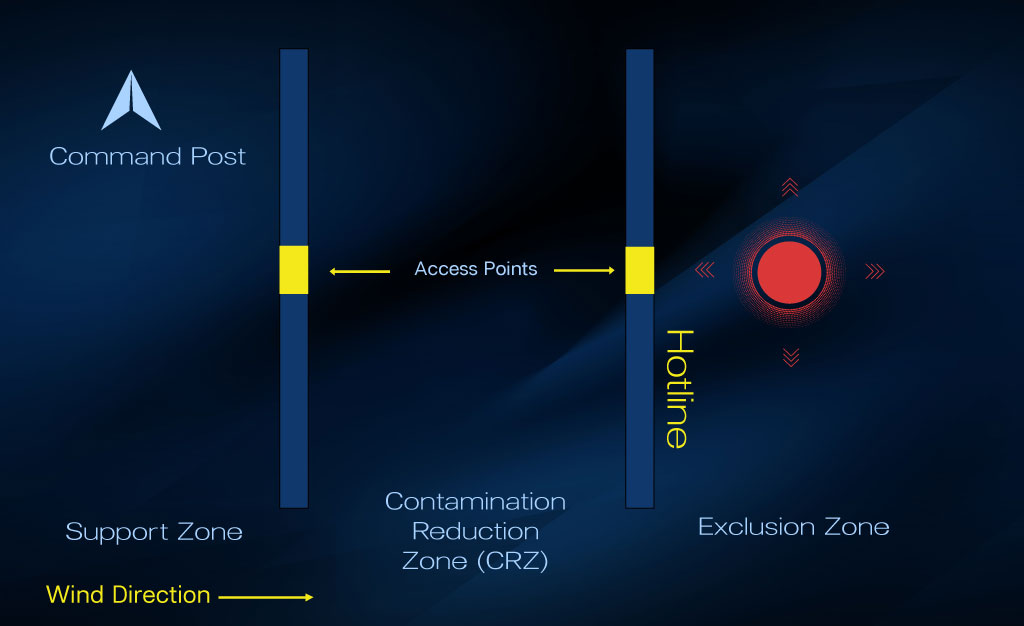
Strategic Placement of Perimeter Air Monitors
Key Considerations for Monitor Placement:
1️⃣ Upwind vs. Downwind Monitoring –
- Upwind Monitors – Capture background air quality levels.
- Downwind Monitors – Identify contamination movement toward populated areas.
2️⃣ Proximity to Receptors –
- Place monitors near residential areas, schools, water sources, and work zones.
- If emissions exceed safe levels, immediate action is required.
3️⃣ Weather Conditions –
- Use meteorological data (wind speed, humidity, temperature) to determine pollutant dispersion.
4️⃣ Site-Specific Risk Zones –
- High-emission zones need denser monitoring coverage.
Perimeter Air Monitoring Layout Example
A typical HAZWOPER site may require:
✅ Four perimeter stations (North, South, East, West).
✅ Additional stations near sensitive areas (residences, water sources).
✅ One or more on-site monitors for worker exposure assessments.
🔄 Dynamic Monitoring: Adjust station locations based on wind shifts and emission changes.
Interpreting Perimeter Air Sampling Data
Once data is collected, it must be compared to regulatory exposure limits:
| Regulatory Standard | Agency | Purpose |
|---|---|---|
| OSHA PELs | Occupational Safety and Health Administration | Legal exposure limits for workers |
| EPA NAAQS | Environmental Protection Agency | Limits for outdoor air quality |
| NIOSH RELs | National Institute for Occupational Safety and Health | Recommended safety limits |
| IDLH | IDLH (Immediately Dangerous to Life and Health) Levels | Prevent Deaths |
Actions Based on Results
| Monitoring Result | Response Action |
|---|---|
| Below Limits | Continue operations, maintain monitoring. |
| Near Action Level | Increase monitoring frequency, apply control measures. |
| Above Limits | Halt work, apply engineering controls, notify authorities. |
Control Measures to Minimize Perimeter Emissions
If air sampling detects elevated contaminant levels, implement corrective actions:
✔ Dust Suppression – Water misting, chemical binders, covering soil piles.
✔ Emission Controls – Vapor suppression foams, negative air pressure systems.
✔ Work Schedule Adjustments – Limit work during high wind conditions.
✔ Barrier Systems – Windbreaks, containment tents, HEPA-filtered exhaust systems.
Regulatory Documentation & Compliance
Data Logging: Maintain accurate logs of air sampling results.
Incident Reports: Document any exceedances and response actions.
Community Notifications: If emissions impact surrounding areas.
Regulatory Submissions: Ensure reports are sent to OSHA, EPA, or state agencies when required.
Record Retention: Air monitoring records must be kept for at least 30 years per OSHA requirements.
Final Thoughts
Perimeter air sampling is a non-negotiable component of HAZWOPER site safety and compliance. It protects workers, communities, and the environment by ensuring airborne contaminants remain within safe limits.
A well-designed perimeter air sampling program includes:
✅ A combination of real-time and integrated sampling.
✅ Strategic monitor placement based on site-specific risks.
✅ Continuous analysis and rapid response to exceedances.
✅ Compliance with all OSHA, EPA, and state regulations.
Monitor the Site Boundary Before Contaminants Leave the Work Area
Perimeter air monitoring is one of the most effective ways to identify airborne contaminant migration before it threatens workers, neighboring properties, or the public. When combined with personal air monitoring, direct-reading instruments, engineering controls, and proper site management, perimeter monitoring helps maintain a safer and more compliant HAZWOPER operation.
OSHACode® HAZWOPER training teaches workers and supervisors how to establish monitoring locations, interpret real-time instrument readings, recognize changing site conditions, evaluate IDLH hazards, and use air-monitoring data to support safe work practices. Employers then reinforce those concepts through site-specific monitoring procedures, calibration practices, and hands-on training using the actual instruments deployed at their facilities.
Learn how to monitor not only the worker—but the entire worksite—to help keep hazardous contaminants where they belong.
FAQs
What is perimeter air sampling?
Perimeter air sampling measures airborne contaminants near the boundary of a hazardous waste site to determine whether contaminants are migrating beyond the work area.
Why is perimeter monitoring important?
Perimeter monitoring helps protect nearby workers, neighboring businesses, the public, and the environment by detecting airborne releases before they leave the site.
Where should perimeter monitors be located?
Monitoring stations should be placed both upwind and downwind of the work area while considering prevailing winds, weather, topography, and nearby receptors.
What instruments are commonly used?
PIDs, FIDs, combustible gas indicators, oxygen meters, multi-gas meters, and other direct-reading instruments are commonly used for real-time perimeter monitoring.
Does perimeter monitoring replace personal air monitoring?
No. Personal monitoring measures worker exposure, while perimeter monitoring evaluates contaminant migration away from the site. Most HAZWOPER projects use both.
How often should perimeter monitoring be performed?
Monitoring frequency depends on site conditions, contaminants, weather, excavation activities, and the potential for airborne releases. Continuous monitoring is often appropriate during higher-risk operations.
Why are weather conditions important?
Wind speed, wind direction, atmospheric stability, temperature, and precipitation all influence contaminant movement and should be evaluated throughout the operation.
What should happen if elevated readings are detected?
Employers should investigate the source, implement engineering or administrative controls, reassess exclusion-zone boundaries, evaluate respiratory protection, and continue monitoring until concentrations return to acceptable levels.
Sources
Emergency Response and Preparedness
OSHA HAZWOPER Hands-on Training Requirement
Medical Surveillance Requirements
U.S. Occupational Safety and Health Administration
https://www.osha.gov/laws-regs/standardinterpretations/1992-08-27-1
U.S. Environmental Protection Agency
https://www.epa.gov/laws-regulations/summary-resource-conservation-and-recovery-act
Related Articles
Building a HAZWOPER Safety Culture
HAZWOPER Hands-on Training Discussions with U.S. OSHA