What Does ALARA Mean?
ALARA stands for “As Low As Reasonably Achievable.” It is the cornerstone principle of radiation safety, emphasizing that radiation exposure should be minimized to the lowest possible levels while still allowing essential tasks to be performed. This principle applies everywhere radiation is present, including medical, industrial, nuclear, and research settings.
The key idea behind ALARA is that any exposure to ionizing radiation carries some level of risk, and reducing that exposure—no matter how small—helps prevent unnecessary health hazards, genetic damage, and long-term effects like cancer.
Why is ALARA Important?
No Safe Dose of Radiation – Even low doses can potentially cause biological damage.
Cumulative Exposure Risks – Radiation damage builds up over time, increasing health risks.
Regulatory Compliance – Agencies such as Occupational Safety and Health Administration (OSHA), Nuclear Regulatory Commission (NRC), Environmental Protection Agency (EPA), and International Atomic Energy Agency (IAEA) require strict adherence to ALARA guidelines.
Public & Worker Protection – Reducing exposure benefits not only workers but also patients, the public, and the environment.
ALARA is not just a recommendation—it is a legal and ethical requirement in radiation-related industries.
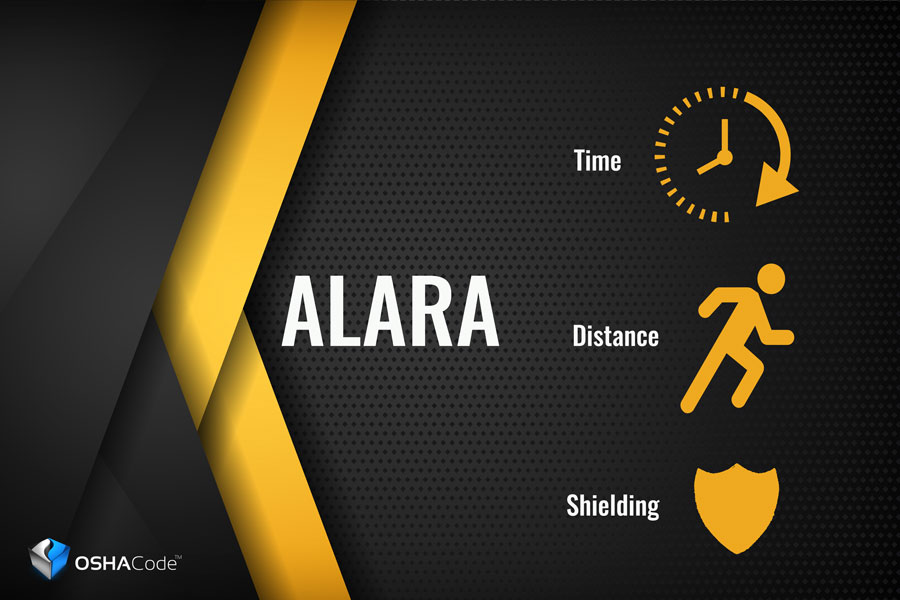
The Three Pillars of ALARA
To effectively minimize radiation exposure, ALARA is built on three fundamental strategies:
1️⃣ Time: Minimize Exposure Duration
- Less time = Less dose
- Radiation exposure follows a linear relationship with time—the longer you are exposed, the higher the dose.
Practical ALARA Time Strategies:
✔ Pre-plan tasks in radiation areas to reduce time spent near the source.
✔ Use automation or robotics to perform tasks remotely.
✔ Rotate workers to avoid excessive exposure to a single individual.
🔹 Example:
- In nuclear power plants, maintenance teams practice procedures outside radiation zones first to minimize time inside hazardous areas.
- In medical imaging, radiologists optimize scan settings to shorten exposure time without compromising diagnostic quality.
2️⃣ Distance: Increase Distance from the Radiation Source
- Inverse Square Law: Doubling the distance from a radiation source reduces exposure to 1/4th; tripling the distance reduces it to 1/9th.
- Distance is one of the most effective ways to minimize radiation exposure.
Practical ALARA Distance Strategies:
✔ Use remote handling tools (tongs, robotic arms) to manipulate radioactive materials.
✔ Maintain safe working distances when possible.
✔ Place workstations further away from radiation sources.
🔹 Example:
- Nuclear medicine workers inject radioactive tracers from behind protective barriers and stand at a distance while scanning occurs.
- Industrial radiographers position themselves in shielded areas far from the radiation source during X-ray inspections.
3️⃣ Shielding: Block or Absorb Radiation with Protective Barriers
- Shielding materials absorb or deflect radiation, reducing the dose received by workers and the public.
- The effectiveness of shielding depends on the type of radiation:
| Radiation Type | Best Shielding Material |
|---|---|
| Alpha (α) Particles | Paper, plastic, clothing |
| Beta (β) Particles | Acrylic, aluminum, plastic |
| Gamma (γ) Rays / X-Rays | Lead, concrete, steel |
| Neutrons | Water, polyethylene, borated concrete |
Practical ALARA Shielding Strategies:
✔ Wear protective gear (lead aprons, thyroid shields) when working near X-ray or gamma-ray sources.
✔ Use lead barriers, walls, and enclosures in radiation work areas.
✔ Optimize shielding thickness to balance protection and mobility.
🔹 Example:
- In hospitals, lead-lined walls and glass prevent radiation leakage in X-ray and CT scan rooms.
- In nuclear reactors, thick concrete and steel shielding protect workers from radiation exposure.
How ALARA is Implemented in Different Industries
ALARA is not one-size-fits-all—it is tailored to specific industries and settings:
Medical & Healthcare (Radiology, Nuclear Medicine, Radiation Therapy)
✔ Limiting unnecessary X-ray scans & optimizing doses.
✔ Using lead aprons, shields, and remote controls.
✔ Reducing fluoroscopy time during surgeries.
✔ Ensuring proper patient positioning to avoid repeat scans.
Nuclear Power & Research Facilities
✔ Minimizing worker time in high-radiation zones during maintenance.
✔ Using robotic arms for handling radioactive fuel.
✔ Implementing concrete barriers around reactors.
Industrial & Construction (Radiography, NDT, Oil & Gas)
✔ Using collimators to direct radiation only where needed.
✔ Keeping workers at a safe distance from radiation sources.
✔ Marking radiation hazard zones and restricting entry.
Space Exploration & Aviation
✔ Designing spacecraft with radiation-resistant materials.
✔ Limiting astronaut spacewalks in high-radiation areas.
✔ Monitoring cosmic radiation exposure in pilots and astronauts.
Regulations & Compliance: Who Enforces ALARA?
Several national and international agencies require ALARA compliance:
| Agency | Jurisdiction |
|---|---|
| NRC (Nuclear Regulatory Commission) | Regulates radiation safety in the U.S. |
| OSHA (Occupational Safety & Health Administration) | Enforces workplace radiation exposure limits. |
| EPA (Environmental Protection Agency) | Monitors radiation in the environment. |
| FDA (Food & Drug Administration) | Regulates radiation-emitting medical devices. |
| IAEA (International Atomic Energy Agency) | Establishes global radiation safety standards. |
📌 Regulatory Limit Example (NRC & OSHA Standards)
- Annual radiation dose limit for workers: 50 mSv (5,000 mrem)
- Annual dose limit for the general public: 1 mSv (100 mrem)
⚠️ Real-world ALARA Targets: Many organizations aim for exposure levels well below these limits, ensuring maximum safety.
Beyond ALARA: Continuous Improvement in Radiation Safety
ALARA is not just a static rule—it is an ongoing process. Companies and institutions must:
✅ Conduct regular radiation safety training.
✅ Perform routine dosimetry monitoring (film badges, TLDs, electronic dosimeters).
✅ Update safety procedures based on new research & technology.
✅ Encourage a culture of safety, where workers feel empowered to follow ALARA.
Conclusion: ALARA is a Mindset, Not Just a Rule
ALARA is the foundation of radiation protection—it ensures safe, responsible, and effective use of radiation while minimizing risk to workers, patients, and the public. By following the Time, Distance, and Shielding principles and staying compliant with regulations, organizations can drastically reduce exposure levels and prevent long-term health risks.
Sources
Emergency Response and Preparedness
OSHA HAZWOPER Hands-on Training Requirement
Medical Surveillance Requirements
U.S. Occupational Safety and Health Administration
https://www.osha.gov/laws-regs/standardinterpretations/1992-08-27-1
U.S. Environmental Protection Agency
https://www.epa.gov/laws-regulations/summary-resource-conservation-and-recovery-act
Related Articles
Building a HAZWOPER Safety Culture
Hands-on Training Discussions with U.S. OSHA