
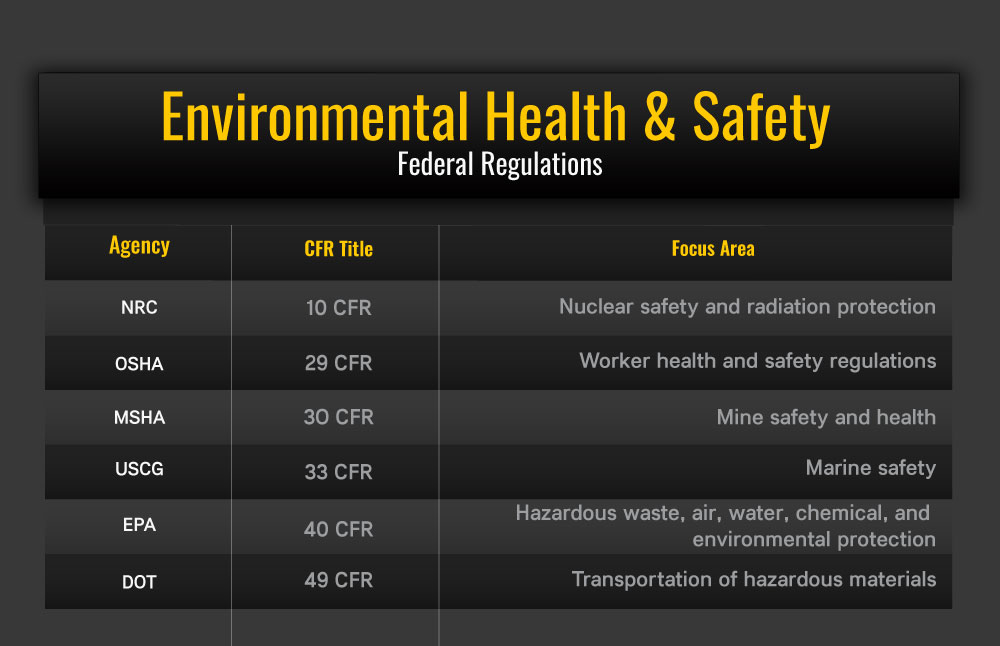
EHS Federal Regulations
Environmental, Health & Safety (EHS) in the United States is governed by several key federal agencies—primarily the Occupational Safety and Health Administration (OSHA), the Environmental Protection Agency (EPA), and the Department of Transportation (DOT). Each agency enforces its own set of federal regulations designed to protect workers, the public, and the environment.
1. OSHA – Occupational Safety and Health Administration
Title 29, Code of Federal Regulations (CFR) Parts 1910 & 1926
OSHA regulations establish nationwide workplace health and safety requirements. These are the core worker-protection regulations in EHS.
Major OSHA Regulations:
-
29 CFR 1910 – General Industry Standards
Covers hazard communication, PPE, confined spaces, respiratory protection, electrical safety, machine guarding, emergency response, etc. -
29 CFR 1926 – Construction Standards
Covers fall protection, scaffolding, excavation, equipment safety, cranes, and more. -
29 CFR 1910.120 – HAZWOPER
Hazardous Waste Operations and Emergency Response—training & safety requirements for hazardous waste sites and emergency response operations. -
29 CFR 1904 – Recordkeeping Requirements
Injury/illness reporting and recordkeeping for employers.
2. EPA – Environmental Protection Agency
Title 40 CFR – Environmental Regulations
EPA regulations protect air, water, land, and human health from environmental pollution and hazardous waste mismanagement.
Major EPA Regulations:
-
40 CFR 260–279 – RCRA (Resource Conservation and Recovery Act)
Governs hazardous waste generation, storage, transportation, and disposal (TSDF requirements). -
40 CFR 300 – CERCLA / Superfund
Cleanup of contaminated sites; the National Contingency Plan (NCP). -
40 CFR 355–370 – EPCRA (Emergency Planning and Community Right-to-Know Act)
Hazardous chemical reporting, Tier II reports, emergency planning. -
40 CFR 50–99 – Clean Air Act
Air quality standards & emissions limits. -
40 CFR 100–149 – Clean Water Act
Spill prevention (SPCC), wastewater, stormwater permitting. -
TSCA (Toxic Substances Control Act)
Chemical inventory, reporting, and risk management.
3. DOT – U.S. Department of Transportation
Title 49 CFR – Transportation of Hazardous Materials
DOT regulates the safe packaging, labeling, marking, placarding, and transportation of hazardous materials across road, air, rail, and sea.
Major DOT Hazmat Regulations:
-
49 CFR 100–185 – Hazardous Materials Regulations (HMR)
Including:-
49 CFR 172.101 – Hazardous Materials Table
-
Shipping papers, labeling, and placarding rules
-
Packaging requirements (UN drums, cylinders, etc.)
-
-
49 CFR 390–399 – Motor Carrier Safety
Driver safety and hazmat routing rules.
4. NIOSH – National Institute for Occupational Safety and Health
(Not a regulatory agency, but highly influential)
NIOSH develops research, recommended exposure limits (RELs), and respirator certifications that OSHA often references.
Key NIOSH areas include:
-
Respirator certification
-
Exposure limit recommendations
-
Industry-specific health hazard evaluations
5. NRC – Nuclear Regulatory Commission
10 CFR – Nuclear Safety Standards
Regulates nuclear materials, radiation exposure, and nuclear facility safety.
6. PHMSA, USCG, and Other Agencies
Several additional agencies regulate specialized EHS areas:
-
PHMSA (Pipeline and Hazardous Materials Safety Administration) – pipeline safety
-
U.S. Coast Guard (USCG) – oil spill response, marine hazmat transport
-
MSHA (Mine Safety and Health Administration) – mine worker health & safety
-
FDA (Food and Drug Administration) – food, drug, device safety
Become HAZWOPER Certified Today!
Ready to begin your own HAZWOPER training? Start your certification today with our courses. We are industry professionals with decades of field experience who know the job firsthand!
Sources
Emergency Response and Preparedness
OSHA HAZWOPER Hands-on Training Requirement
Medical Surveillance Requirements
U.S. Occupational Safety and Health Administration
https://www.osha.gov/laws-regs/standardinterpretations/1992-08-27-1
U.S. Environmental Protection Agency
https://www.epa.gov/laws-regulations/summary-resource-conservation-and-recovery-act
Related Articles
Building a HAZWOPER Safety Culture
Hands-on Training Discussions with U.S. OSHA