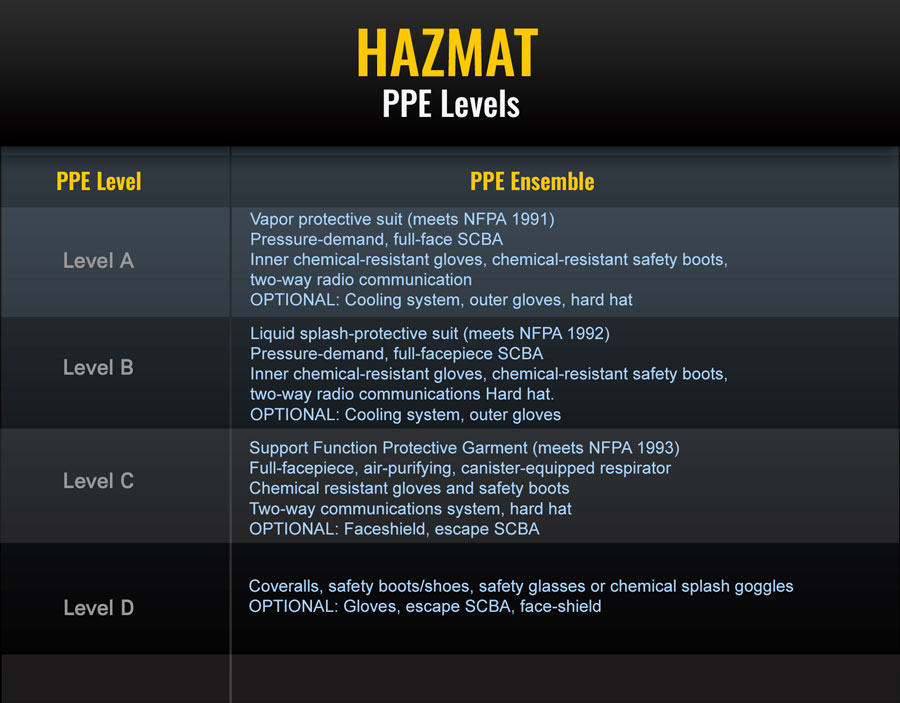
This brief article focuses on HAZMAT PPE Levels and explains the history, early use and limitations for each ensemble. The use of hazardous materials (HAZMAT) suits has a rich and fascinating history that mirrors humanity’s growing understanding of industrial hazards, warfare, and environmental responsibility. In the early 1900s, workers handling acids, asbestos, and other toxic materials wore little more than rubber aprons, canvas coats, or crude respirators made from cloth soaked in chemicals. Protection was primitive and often improvised—designed to guard only against splashes, not invisible airborne toxins. But as chemical industries flourished and warfare introduced new dangers, the need for more advanced protection became urgent.
World War I and II
During World War I, soldiers faced the horrifying reality of chemical warfare, where mustard gas and chlorine gas blanketed battlefields. This prompted rapid innovation in respiratory protection, giving rise to the first functional gas masks and basic encapsulating suits. By World War II, scientists were developing suits capable of shielding wearers from nerve agents like tabun and sarin, marking the birth of the true “chemical suit.” These designs influenced not only military defense but also civilian industrial safety in the decades that followed.
Cold War
In the 1950s and 1960s, as the Cold War heightened fears of nuclear, biological, and chemical (NBC) threats, protective suits became more sophisticated—featuring multi-layered materials, sealed seams, and integrated air systems. Around the same time, major industrial accidents and chemical spills began to draw public attention to worker safety. When environmental disasters like Love Canal and Three Mile Island occurred in the 1970s, the public demanded stronger regulations, leading to the establishment of the Occupational Safety and Health Administration (OSHA) and the Environmental Protection Agency (EPA). Soon after, the Hazardous Waste Operations and Emergency Response (HAZWOPER) standard was born, formalizing the use of personal protective equipment, including HAZMAT suits, at HAZWOPER sites.
NASA Influence
By the 1980s and 1990s, HAZMAT suits had evolved into the four-tier system (Levels A–D) we know today. Materials like butyl rubber, Tychem®, and Viton® offered unparalleled resistance to chemical permeation, and Self-Contained Breathing Apparatus (SCBA) technology gave responders true independence from contaminated air. Interestingly, NASA’s innovations in space suit design—airtight seals, pressurization, and mobility—directly influenced modern Level A HAZMAT suits.
Today, HAZMAT suits represent more than just protective clothing; they embody decades of engineering, experience, and sacrifice. They have been used in the cleanup of the Chernobyl disaster, the Space Shuttle Columbia recovery, and countless hazardous waste sites worldwide. Each suit tells a story of humanity’s determination to confront danger safely—whether facing a toxic spill, a biological outbreak, or a chemical fire. The journey from crude rubber garments to today’s advanced, life-saving ensembles reflects how far we’ve come in the pursuit of safety, science, and survival.
HAZMAT PPE Limitations
Level A
Limitations: Protective clothing must effectively resist permeation by the specific chemicals or mixtures present at the site. All components of the ensemble must be compatible and integrate seamlessly to maintain full protection, ensuring there is no loss of performance or barrier integrity.
Level B
Limitations: Protective clothing must be capable of resisting penetration by the specific chemicals or mixtures encountered. All components of the ensemble should be compatible and properly integrated to maintain full protective performance without any reduction in effectiveness.
Level C
Limitations: Protective clothing items must resist penetration by the chemical or mixtures present. Chemical airborne concentration must be less than IDLH levels. The atmosphere must contain at least 19.5% oxygen.