
HAZWOPER
The HAZWOPER meaning is Hazardous Waste Operations and Emergency Response. It is a key term in the Occupational Safety and Health Administration (OSHA) 29 CFR 1910.120 regulation that governs worker safety during uncontrolled hazardous waste site cleanup, emergency response operations and work activities at hazardous waste treatment, storage and disposal facilities.
In 1990, HAZWOPER training regulations were promulgated by OSHA. The scope of this regulation is designed to protect workers who are potentially exposed to hazardous substances. HAZWOPER regulations are enforced by both OSHA and the U.S. Environmental Protection Agency (EPA), as it involves both labor and environmental considerations. OSHA, found in Title 29 Code of Federal Regulations (CFR) primarily focuses on labor-related safety issues, while the EPA, found in Title 40 CFR, addresses the protection of the environment. The EPA regulation is essentially the same as the U.S. OSHA regulation. Also, OSHA has approved certain states to implement and enforce their own regulations. These are called “OSHA State Plans” and their regulations must be at least as stringent as U.S. OSHA regulations. There are currently 29 OSHA State Plans.
Purpose
The purpose of the HAZWOPER standards is to establish a comprehensive safety framework that protects workers who may be exposed to hazardous substances during waste site cleanup, emergency response operations, and the treatment, storage, or disposal of hazardous material (HAZMAT) debris. Its core objective is to reduce the risk of injury, illness, or death by requiring consistent training, standardized safety practices, and the proper use of protective equipment in high-risk environments.
Training Topics
The OSHA HAZWOPER regulations contain 17 different sections on topics such as hazard recognition and protection, medical monitoring, air monitoring, site control, decontamination, and emergency response. These provide safeguards for individual workers but also supports environmental protection and regulatory compliance.
What Is the Scope of HAZWOPER?
The HAZWOPER standard applies only to specific categories of work involving hazardous waste or hazardous substance releases. It does not apply to all workers, all chemicals, or all cleanup activities. OSHA designed the standard to address environments where hazardous substances pose uncontrolled, unknown, high-risk, or emergency-level threats.
In simple terms, the scope of HAZWOPER covers operations where:
-
Hazardous wastes are present
-
Hazardous substances are being cleaned up or remediated
-
There is a substantial threat of exposure
-
Workers respond to hazardous material emergencies
-
Waste is treated, stored, or disposed under RCRA regulations
If any of these conditions exist, HAZWOPER applies.
The Five Groups Covered Under HAZWOPER
OSHA’s Scope and Application section clearly identifies five groups of employers and employees who are covered by the standard. If an operation falls into any of these categories, HAZWOPER training and procedures are required.
1. Uncontrolled Hazardous Waste Site Cleanup Operations
Citation: 29 CFR 1910.120(a)(1)(i)
This group includes workers who perform cleanup, removal, remediation, or stabilization at uncontrolled hazardous waste sites—locations where contamination is not fully contained, documented, or managed. Examples include:
-
Superfund / National Priorities List (NPL) sites
-
Abandoned chemical facilities
-
Illegal dump sites
-
Train derailment contamination zones
-
Oil spill cleanup areas
-
Brownfields with unknown chemical residues
Key qualifier:
If the contamination is uncontrolled, undocumented, unassessed, or the site does not have a formal waste management program, HAZWOPER applies.
Not included:
Routine cleanup in active, controlled industrial facilities where hazards are already known and regulated.
2. Corrective Actions Under the Resource Conservation and Recovery Act (RCRA)
Citation: 29 CFR 1910.120(a)(1)(ii)
This group applies to employees performing cleanup or corrective actions at sites regulated by the Resource Conservation and Recovery Act (RCRA)—the federal law governing hazardous waste management.
Examples include:
-
Cleanup at permitted RCRA Treatment, Storage, and Disposal Facilities (TSDFs)
-
Actions taken after a spill or leak of hazardous waste
-
EPA-mandated remediation under RCRA corrective action orders
Key qualifier:
If the activity involves correcting a release of RCRA-regulated hazardous waste, HAZWOPER applies.
3. Voluntary Cleanup Operations at Uncontrolled Sites
Citation: 29 CFR 1910.120(a)(1)(iii)
This group covers voluntary cleanup activities performed by:
-
Government agencies
-
Municipalities
-
Private corporations
-
Nonprofits
-
Community response organizations
Even though these operations are voluntary, OSHA still considers the hazards equivalent to any other uncontrolled site.
Key qualifier:
If the site is contaminated and not formally controlled, and cleanup is voluntary, HAZWOPER applies.
4. Hazardous Waste Treatment, Storage, and Disposal Facilities (TSDFs)
Citation: 29 CFR 1910.120(a)(1)(iv), (p)
Workers at RCRA-permitted TSDFs are covered under HAZWOPER because they handle hazardous waste in bulk during:
-
Treatment operations
-
Storage operations
-
Disposal operations
This group also includes personnel who manage incoming waste streams, operate tanks or containers, maintain waste processing equipment, or perform emergency operations at TSDFs.
Key qualifier:
If employees work at a RCRA-regulated TSDF facility, HAZWOPER training under subsection (p) is mandatory.
5. Emergency Response to Hazardous Substance Releases
Citation: 29 CFR 1910.120(a)(1)(v), (q)
The final group includes workers who respond to the release or substantial threat of release of hazardous substances. This covers:
-
Firefighters
-
Hazmat teams
-
Industrial emergency response groups
-
Spill response contractors
-
Environmental emergency responders
-
Public safety departments
-
Pipeline response teams
Key qualifier:
If employees respond to an actual or potential hazardous substance release—whether chemical, biological, or radiological—HAZWOPER emergency response training applies.
HAZWOPER Training Levels
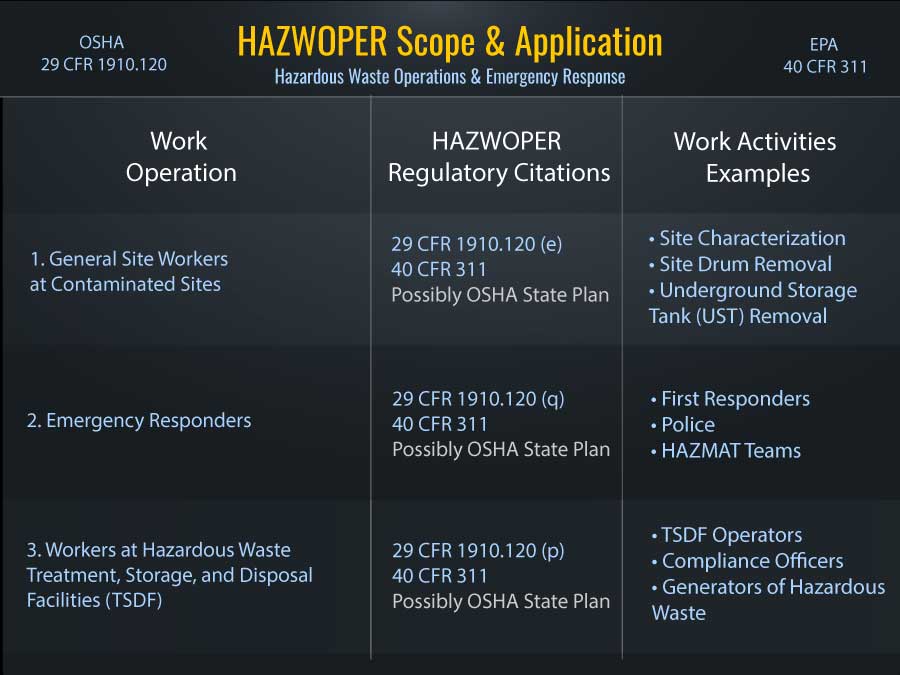
- Clean-up Crew for Uncontrolled Hazardous Waste Sites – 29 CFR 1910.120(e)
- These are workers who clean up contaminated areas (like old chemical plants, landfills, or areas affected by industrial spills). This includes sites having corrective actions involving cleanup operations covered by the Resource Conservation and Recovery Act (RCRA).
- Example: If a factory dumps toxic chemicals into the ground, a HAZWOPER-trained clean-up crew would come to remove and dispose of the waste safely.
- Requirements: 40 hour training, personal protective equipment (PPE), and decontamination procedures.
- Workers Handling Hazardous Waste at Treatment, Storage, and Disposal Facilities (TSDFs) – 29 CFR 1910.120(p)
- These are people who store, treat, or dispose of hazardous waste.
- Example: Employees at a TSDF that processes things like chemical drums, old batteries, or industrial waste.
- Requirements: 24 hour training, emergency response procedures, and safe handling of hazardous materials.
- Emergency Responders Addressing Substantial Threats or Actual Releases of Hazardous Substances – 29 CFR 1910.120(q)
- These are firefighters, HAZMAT teams, or industrial workers who respond to spills, leaks, or explosions involving hazardous substances and/or materials.
- Example: If a train carrying chemicals crashes and spills toxic gas, a trained emergency response teamwould come to contain the spill and protect people.
- Requirements: HAZWOPER training levels depend on role (First Responder Awareness, First Responder Operations, HAZMAT Technician, etc.).
Who Is Not Covered by HAZWOPER?
It’s equally important to understand what HAZWOPER does not cover:
- Routine maintenance in non-hazardous areas
- Normal facility operations not involving hazardous waste
- Laboratory-scale chemical work
- OSHA 1910.1200 (HazCom) activities
- Cleanups of simple spills that employees are trained to handle safely
- Cleanup in fully controlled, non-contaminated industrial settings
Misclassifying workers either over-trains or under-protects them. Correct classification ensures compliance.
Why HAZWOPER’s Scope Matters
Understanding the scope and application of HAZWOPER is essential for:
-
Determining the correct training level for employees
-
Ensuring employers meet OSHA’s legal requirements
-
Building accurate Health and Safety Plans (HASP)
-
Protecting workers from uncharacterized hazardous exposures
-
Preparing for potential OSHA inspections or compliance audits
Misinterpreting the scope can lead to violations, fines, and increased risk during hazardous waste operations or emergencies.
Summary
OSHA’s HAZWOPER standard applies to five distinct groups of operations involving hazardous waste or emergency responses to hazardous substances. If an employee steps into any environment that falls within these categories, HAZWOPER training becomes mandatory—whether they perform cleanup, corrective actions, hazardous waste management, or emergency response. By understanding the scope and application of 29 CFR 1910.120, employers can ensure proper training, maintain compliance, and create safer environments for all workers involved in hazardous operations.
OSHA Sources
Emergency Response and Preparedness
OSHA HAZWOPER Hands-on Training Requirement
Medical Surveillance Requirements
Related Articles
Building a HAZWOPER Safety Culture
