
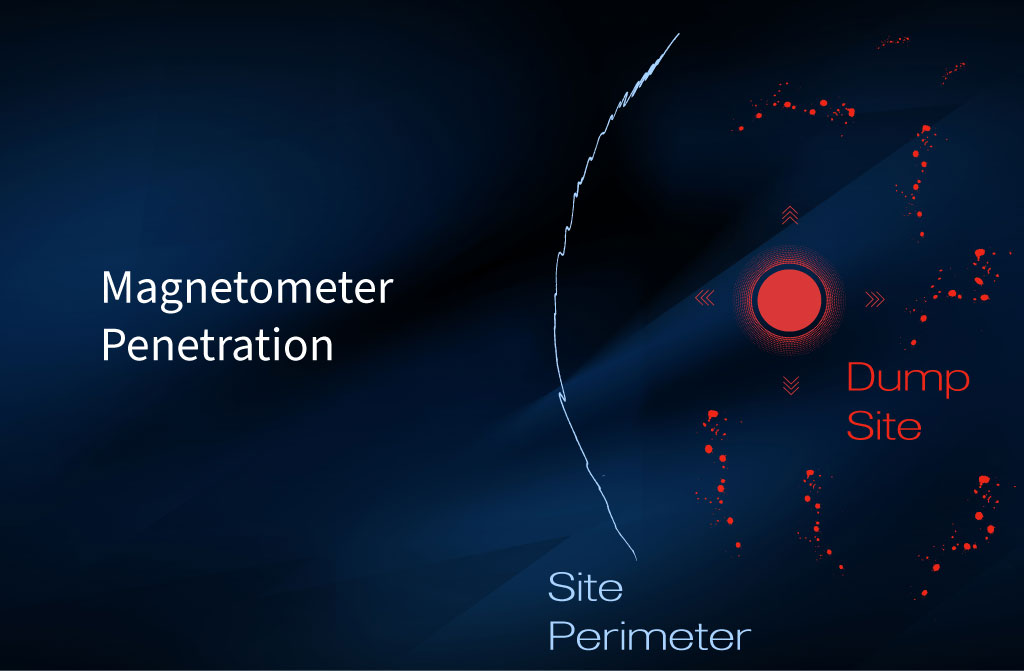
Using Magnetometer Penetration Tests to Discover Buried Drums at HAZWOPER Sites
At HAZWOPER (Hazardous Waste Operations and Emergency Response) sites, buried drums pose significant risks, including chemical leaks, soil and groundwater contamination, and explosive hazards. Magnetometer penetration testing is one of the most effective non-invasive geophysical techniques used to locate buried metallic drums, tanks, and other ferrous (iron-containing) objects.
1. What is a Magnetometer and How Does It Work?
A magnetometer is an instrument that measures variations in the Earth’s magnetic field caused by the presence of ferrous (iron-based) materials.
- Metal drums, barrels, and tanks buried underground create magnetic anomalies.
- A magnetometer detects these anomalies and provides data on location, depth, and size.
- This method is ideal for detecting steel or iron drums but does not work for non-ferrous materials like aluminum or plastic.
2. Why Use Magnetometer Testing at HAZWOPER Sites?
Advantages
✅ Non-Invasive – No need for excavation before identification.
✅ Efficient & Cost-Effective – Large areas can be scanned quickly.
✅ Detects Multiple Drums – Even if deeply buried or clustered.
✅ Works in Difficult Terrain – Can be used over soil, concrete, and even water.
Limitations
❌ Cannot Detect Non-Metallic Drums – Won’t locate plastic, fiber, or aluminum containers.
❌ Depth Limitations – Typically detects objects up to ~10 meters (30 feet), but penetration varies with soil type.
❌ Interference – Nearby power lines, buried pipes, or other ferrous objects may distort readings.
3. Equipment Used in Magnetometer Testing
Types of Magnetometers
| Type | Description | Use Case |
|---|---|---|
| Proton Precession Magnetometer | Measures total field intensity; widely used for general surveys. | Basic drum detection. |
| Fluxgate Magnetometer | Detects changes in magnetic field direction; high sensitivity. | Identifying buried drums with precision. |
| Cesium Vapor Magnetometer | Highly sensitive, ideal for deep or small targets. | Large site surveys with high accuracy. |
| Overhauser Magnetometer | Low-power, high-stability option for field surveys. | Long-duration site monitoring. |
Additional Geophysical Methods for Confirmation
- Ground-Penetrating Radar (GPR) – Useful for detecting plastic or non-metallic drums.
- Electromagnetic Induction (EMI) – Helps differentiate between metal types and depths.
- Resistivity Surveys – Identifies soil disturbances associated with drum burial.
4. Conducting a Magnetometer Survey at a HAZWOPER Site
Step 1: Pre-Survey Preparation
✅ Site Research
- Review historical records, aerial imagery, and site maps to identify possible burial zones.
- Interview personnel or local sources who may know the burial history.
✅ Safety Planning
- HAZWOPER-trained personnel must conduct surveys in compliance with the Occupational Safety and Health Administration (OSHA) 29 CFR 1910.120 standard.
- Check for explosive hazards before entering the site.
- Use Personal Protective Equipment (PPE) and ensure decontamination procedures are in place.
✅ Establish a Grid System
- Mark the site into a grid (e.g., 10m x 10m sections) to ensure thorough scanning.
- Assign unique IDs to each section for precise mapping.
Step 2: Field Survey Using a Magnetometer
-
Calibrate the Magnetometer
- Zero out background magnetic noise.
- Take baseline readings away from known ferrous objects.
-
Systematic Grid Scanning
- Walk with the sensor at a fixed height (~1-2 feet above ground).
- Move in straight lines, ensuring overlap between passes.
- Record real-time magnetic field intensity variations.
-
Identify Magnetic Anomalies
- Spikes in magnetic readings suggest the presence of buried metallic objects.
- Strong, well-defined anomalies indicate larger objects like drums or tanks.
-
Cross-Check with Other Methods
- Use Ground-Penetrating Radar (GPR) or Electromagnetic Induction (EMI) for additional verification.
- If non-ferrous materials are suspected, chemical sniffers or soil gas surveys may help.
Step 3: Data Interpretation & Mapping
✅ Plot Data on a Digital Map (GIS or CAD software)
- Overlay results onto site maps to pinpoint target locations.
- Highlight areas with high magnetic anomalies for excavation or further testing.
✅ Estimate Drum Depth and Condition
- Compare magnetic field strength to known metal objects to approximate depth.
- Uneven or weak signals may indicate corroded or fragmented drums.
✅ Prioritize Excavation Sites
- Rank anomalies from highest to lowest probability of containing hazardous drums.
- Coordinate with site safety teams before initiating excavation.
5. Post-Discovery Procedures
Once buried drums are confirmed, follow strict HAZWOPER handling and remediation protocols:
Controlled Excavation
- Use remote excavation methods (if hazards are suspected).
- Monitor for gas emissions with PID (Photoionization Detectors) and LEL meters.
- Stabilize leaking drums with overpacks or containment systems.
Sample & Characterize Drum Contents
- TCLP Testing (Toxicity Characteristic Leaching Procedure) for hazardous waste classification.
- Volatile Organic Compounds (VOC) Testing for air quality concerns.
- Corrosivity, Reactivity, and Flashpoint Analysis for safety planning.
Disposal & Remediation
- Follow Environmental Protection Agency (EPA) and Resource Conservation and Recovery Act (RCRA) guidelines for hazardous waste disposal.
- Implement soil remediation (if contamination is detected).
- Conduct post-removal surveys to ensure no additional buried waste remains.
6. Case Study: Successful Use of Magnetometer Testing
Location: Former industrial waste disposal site
Challenge: Unmarked disposal of unknown number of drums
Solution:
- Magnetometer survey identified 27 buried anomalies.
- GPR confirmed metallic objects at depths of 3-5 meters.
- Controlled excavation revealed rusted steel drums containing chemical waste.
- Emergency hazmat teams stabilized leaking containers and removed them safely.
Result:
✅ Prevented groundwater contamination.
✅ Avoided worker exposure to unknown hazardous substances.
✅ Successfully remediated the site for future safe use.
7. Conclusion
Using magnetometer penetration testing at HAZWOPER sites provides a fast, reliable, and non-invasive way to detect buried drums. It allows for targeted excavation, minimizing worker exposure and environmental impact. However, combining magnetometer data with other geophysical methods like GPR and EMI enhances detection accuracy, ensuring a comprehensive site assessment.
Sources
Emergency Response and Preparedness
OSHA HAZWOPER Hands-on Training Requirement
Medical Surveillance Requirements
U.S. Occupational Safety and Health Administration
https://www.osha.gov/laws-regs/standardinterpretations/1992-08-27-1
U.S. Environmental Protection Agency
https://www.epa.gov/laws-regulations/summary-resource-conservation-and-recovery-act
Related Articles
Building a HAZWOPER Safety Culture
Hands-on Training Discussions with U.S. OSHA