Overview of OSHA State Plans
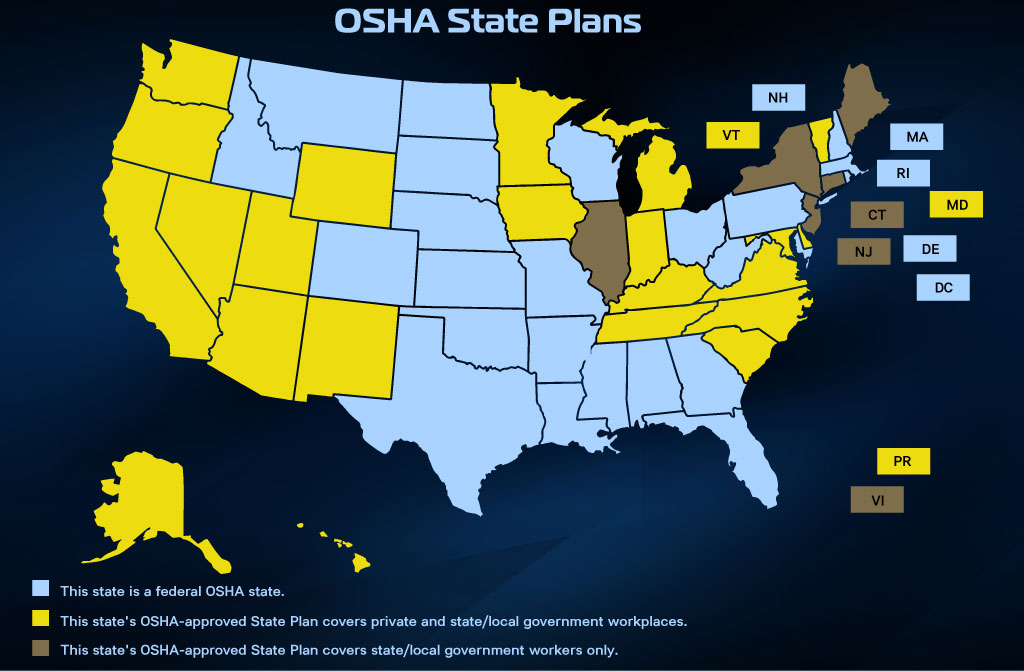
The Occupational Safety and Health Administration (OSHA) allows U.S. states and territories to operate their own occupational safety and health programs instead of being regulated directly by federal OSHA. These are known as OSHA State Plans. Each plan must be approved and monitored by federal OSHA to ensure it is at least as effective as federal workplace safety regulations.
Types of OSHA State Plans
There are two main categories of OSHA-approved state plans:
1. State Plans Covering Both Private and Public Sector Workers
-
These plans cover all private-sector employees as well as state and local government employees (who are not covered under federal OSHA).
-
There are 22 states and U.S. territories with such plans:
State State Plan Agency Alaska Alaska Occupational Safety and Health (AKOSH) Arizona Arizona Division of Occupational Safety and Health (ADOSH) California California Division of Occupational Safety and Health (Cal/OSHA) Hawaii Hawaii Occupational Safety and Health Division (HIOSH) Indiana Indiana Occupational Safety and Health Administration (IOSHA) Iowa Iowa Division of Labor Services Kentucky Kentucky Labor Cabinet, Department of Workplace Standards Maryland Maryland Occupational Safety and Health (MOSH) Michigan Michigan Occupational Safety and Health Administration (MIOSHA) Minnesota Minnesota Occupational Safety and Health Administration (MNOSHA) Nevada Nevada Occupational Safety and Health Administration (Nevada OSHA) New Mexico New Mexico Occupational Health and Safety Bureau (NM OSHA) North Carolina North Carolina Department of Labor (NCDOL) Oregon Oregon Occupational Safety and Health Division (Oregon OSHA) Puerto Rico Puerto Rico Occupational Safety and Health Administration (PR OSHA) South Carolina South Carolina Occupational Safety and Health Administration (SC OSHA) Tennessee Tennessee Occupational Safety and Health Administration (TOSHA) Utah Utah Occupational Safety and Health (UOSH) Vermont Vermont Occupational Safety and Health Administration (VOSHA) Virginia Virginia Occupational Safety and Health (VOSH) Washington Washington Division of Occupational Safety and Health (DOSH) Wyoming Wyoming Occupational Safety and Health Administration (WY OSHA)
2. State Plans Covering Only Public Sector (State and Local Government Employees)
-
These state plans only cover state and local government employees.
-
Private-sector workers in these states remain under federal OSHA jurisdiction.
-
There are six states and U.S. territories with this type of plan:
State/Territory State Plan Agency Connecticut Connecticut Occupational Safety and Health Division Illinois Illinois Occupational Safety and Health Administration Maine Maine Bureau of Labor Standards New Jersey New Jersey Public Employees Occupational Safety and Health (PEOSH) New York New York Public Employee Safety and Health (PESH) Virgin Islands Virgin Islands Division of Occupational Safety and Health
Key Differences Between OSHA State Plans and Federal OSHA States
| Feature | Federal OSHA | State Plan OSHA |
|---|---|---|
| Coverage of Private Employers | Yes | Yes (for 22 states) |
| Coverage of State & Local Government Employees | No | Yes |
| Ability to Set Stricter Standards | No (only federal standards apply) | Yes, state plans can have more stringent safety laws |
| Administration of Safety Inspections | Federal OSHA | State-run agency |
| Enforcement Actions | Federal OSHA issues citations and penalties | State agency issues citations, which may differ from federal OSHA in severity |
How OSHA Approves and Oversees State Plans
For a state to run its own OSHA program, it must follow these steps:
1. Plan Development & Submission
- A state submits a detailed plan to OSHA explaining how it will enforce safety laws.
- The plan must include:
- Workplace safety and health standards (which must be at least as effective as federal OSHA)
- Inspection and enforcement procedures
- Employee complaint handling processes
- Procedures for employer compliance
2. Federal OSHA Approval
- If OSHA finds the plan acceptable, it grants initial approval.
- The state must show progress in implementing its safety program.
3. Full Approval & Ongoing Federal Monitoring
- Once a state meets all OSHA requirements, it receives full approval.
- OSHA continues annual monitoring through audits and reviews to ensure effectiveness.
- If a state fails to maintain standards, OSHA can intervene or revoke approval.
Key Benefits of OSHA State Plans
-
Stronger Workplace Protections
- States can create stricter rules than federal OSHA.
- Example: California (Cal/OSHA) has stricter heat illness and airborne contaminant regulations.
-
Expanded Coverage for Public Employees
- State plans cover state and local government workers, which federal OSHA does not.
-
Localized Enforcement & Faster Response
- State agencies understand local industries and regional hazards better.
- Faster response times to workplace safety issues.
-
Flexibility to Address Unique Risks
- Example: Alaska OSHA has extra protections for cold-weather work hazards.
- Example: Washington OSHA has stronger protections for agricultural workers.
Potential Challenges of State Plans
-
Inconsistent Standards Across States
- Employers operating in multiple states must comply with different rules in each state plan.
-
Budget & Resource Constraints
- Some states lack funding for proper enforcement.
- If a state fails to meet OSHA standards, federal OSHA may step in.
-
Potential Political Influence
- Some states may weaken enforcement due to political or business pressures.
Summary
- OSHA State Plans operate their own safety programs under federal OSHA approval.
- 22 states/territories cover both private and public sector employees.
- 6 states/territories cover only public sector employees.
- State plans must be at least as effective as federal OSHA, but they can set stricter safety standards.
- These programs offer greater flexibility but require constant oversight to ensure effectiveness.