
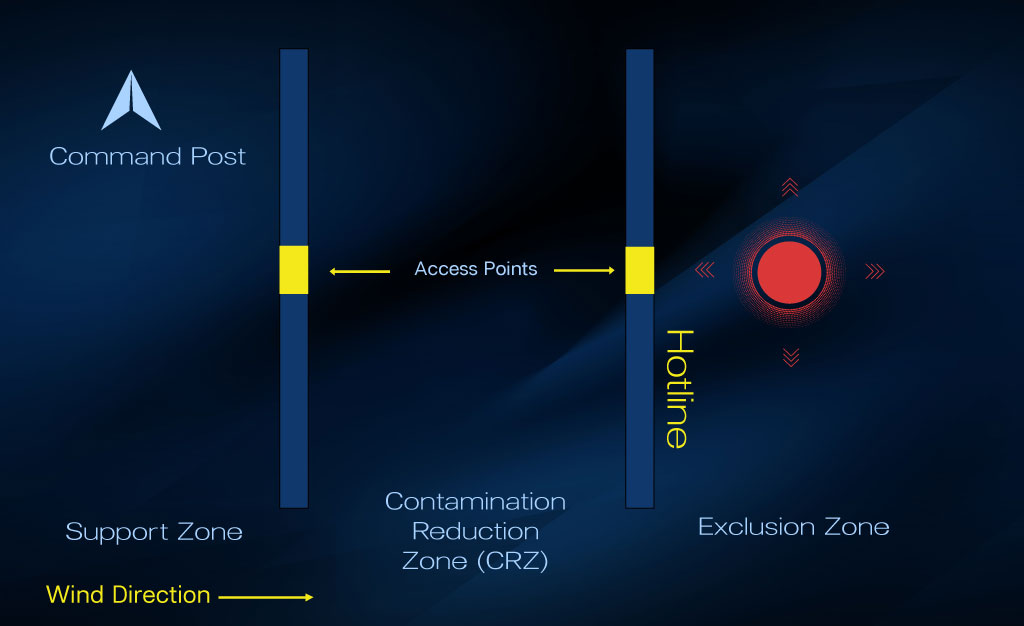
What is Perimeter Air Sampling?
Perimeter air sampling is a critical environmental monitoring strategy at HAZWOPER (Hazardous Waste Operations and Emergency Response) sites. It involves the strategic placement of air sampling equipment around the site’s boundary to detect, measure, and control airborne contaminant migration.
The primary goal is to ensure that hazardous emissions do not exceed regulatory limits, impact workers, the public, or the surrounding environment.
Objectives of Perimeter Air Sampling
✅ Regulatory Compliance
- Ensures compliance with Occupational Safety and Health Administration (OSHA) 29 CFR 1910.120 (HAZWOPER), Environmental Protection Agency (EPA) 40 CFR Part 50 (NAAQS), and National Institute for Occupational Safety and Health (NIOSH) guidelines for air quality.
- Demonstrates due diligence in managing hazardous materials.
✅ Worker & Community Health Protection
- Identifies potential airborne hazards before they affect personnel inside the site or migrate offsite into nearby communities.
✅ Hazardous Substance Migration Control
- Tracks the movement of volatile organic compounds (VOCs), dust, metals, and toxic gases to prevent off-site contamination.
✅ Emergency Preparedness
- Provides real-time alerts for sudden chemical releases, allowing for immediate response actions.
✅ Legal & Liability Protection
- Establishes documented proof of compliance and responsible site management in case of lawsuits or regulatory audits.
When is Perimeter Air Sampling Required?
Perimeter air sampling is mandatory or strongly recommended in scenarios such as:
Hazardous Waste Site Remediation – Monitoring airborne contaminants from excavation and treatment.
Demolition of Contaminated Structures – Detecting asbestos, lead, and other harmful particulates.
Chemical Spill Response & Cleanup – Ensuring toxic vapors and gases do not migrate offsite.
Excavation & Drilling Activities – Preventing exposure to buried hazardous materials.
Controlled Burning or Thermal Treatment – Assessing emissions from combustion processes.
Landfill & Industrial Waste Sites – Detecting landfill gases such as methane, hydrogen sulfide, and VOCs.
Nearby Residential/Community Areas – Protecting local populations from fugitive emissions.
Types of Perimeter Air Sampling
1. Real-Time Monitoring (Direct-Reading) Instruments)
Used for immediate detection and continuous monitoring of hazardous air pollutants (HAPs).
| Instrument | Monitored Contaminants | Application |
|---|---|---|
| Photoionization Detector (PID) | VOCs (Benzene, Toluene, Xylene) | Detects solvent vapors from spills, leaks |
| Flame Ionization Detector (FID) | Hydrocarbons | Monitors emissions from petroleum sites |
| Dust Monitor (TSP, PM10, PM2.5) | Particulate Matter | Tracks airborne lead, asbestos, silica |
| Multi-Gas Detector | CO, H₂S, O₂, LEL | Monitors toxic & flammable gases |
| Infrared (IR) Gas Analyzer | Methane, CO₂, Ammonia | Detects greenhouse & landfill gases |
✔ Advantages: Instant results, continuous data logging.
❌ Limitations: No long-term exposure analysis, less precise chemical identification.
2. Integrated Air Sampling (Laboratory Analysis)
Collects air contaminants over time for precise quantitative analysis.
| Sampling Method | Contaminants Monitored | Use Case |
|---|---|---|
| High-Volume Air Sampler | Particulates (PM10, Lead, Asbestos) | Excavation, demolition, hazardous dust control |
| Sorbent Tubes (NIOSH Methods) | VOCs (Benzene, Toluene) | Chemical spills, solvent emissions |
| Passive Air Samplers | Formaldehyde, Mercury, H₂S | Long-term exposure assessments |
| Impingers (Liquid Media Sampling) | Acidic Vapors, Chlorine, Ammonia | Industrial emission monitoring |
✔ Advantages: High accuracy, long-term exposure analysis.
❌ Limitations: Results take time (lab analysis required), expensive.
Strategic Placement of Perimeter Air Monitors
Key Considerations for Monitor Placement:
1️⃣ Upwind vs. Downwind Monitoring –
- Upwind Monitors – Capture background air quality levels.
- Downwind Monitors – Identify contamination movement toward populated areas.
2️⃣ Proximity to Receptors –
- Place monitors near residential areas, schools, water sources, and work zones.
- If emissions exceed safe levels, immediate action is required.
3️⃣ Weather Conditions –
- Use meteorological data (wind speed, humidity, temperature) to determine pollutant dispersion.
4️⃣ Site-Specific Risk Zones –
- High-emission zones need denser monitoring coverage.
Perimeter Air Monitoring Layout Example
A typical HAZWOPER site may require:
✅ Four perimeter stations (North, South, East, West).
✅ Additional stations near sensitive areas (residences, water sources).
✅ One or more on-site monitors for worker exposure assessments.
🔄 Dynamic Monitoring: Adjust station locations based on wind shifts and emission changes.
Interpreting Perimeter Air Sampling Data
Once data is collected, it must be compared to regulatory exposure limits:
| Regulatory Standard | Agency | Purpose |
|---|---|---|
| OSHA PELs | Occupational Safety and Health Administration | Legal exposure limits for workers |
| EPA NAAQS | Environmental Protection Agency | Limits for outdoor air quality |
| NIOSH RELs | National Institute for Occupational Safety and Health | Recommended safety limits |
| ACGIH TLVs | American Conference of Governmental Industrial Hygienists | Industry exposure guidelines |
Actions Based on Results
| Monitoring Result | Response Action |
|---|---|
| Below Limits | Continue operations, maintain monitoring. |
| Near Action Level | Increase monitoring frequency, apply control measures. |
| Above Limits | Halt work, apply engineering controls, notify authorities. |
Control Measures to Minimize Perimeter Emissions
If air sampling detects elevated contaminant levels, implement corrective actions:
✔ Dust Suppression – Water misting, chemical binders, covering soil piles.
✔ Emission Controls – Vapor suppression foams, negative air pressure systems.
✔ Work Schedule Adjustments – Limit work during high wind conditions.
✔ Barrier Systems – Windbreaks, containment tents, HEPA-filtered exhaust systems.
Regulatory Documentation & Compliance
Data Logging: Maintain accurate logs of air sampling results.
Incident Reports: Document any exceedances and response actions.
Community Notifications: If emissions impact surrounding areas.
Regulatory Submissions: Ensure reports are sent to OSHA, EPA, or state agencies when required.
Record Retention: Air monitoring records must be kept for at least 30 years per OSHA requirements.
Final Thoughts
Perimeter air sampling is a non-negotiable component of HAZWOPER site safety and compliance. It protects workers, communities, and the environment by ensuring airborne contaminants remain within safe limits.
A well-designed perimeter air sampling program includes:
✅ A combination of real-time and integrated sampling.
✅ Strategic monitor placement based on site-specific risks.
✅ Continuous analysis and rapid response to exceedances.
✅ Compliance with all OSHA, EPA, and state regulations.