
Summary
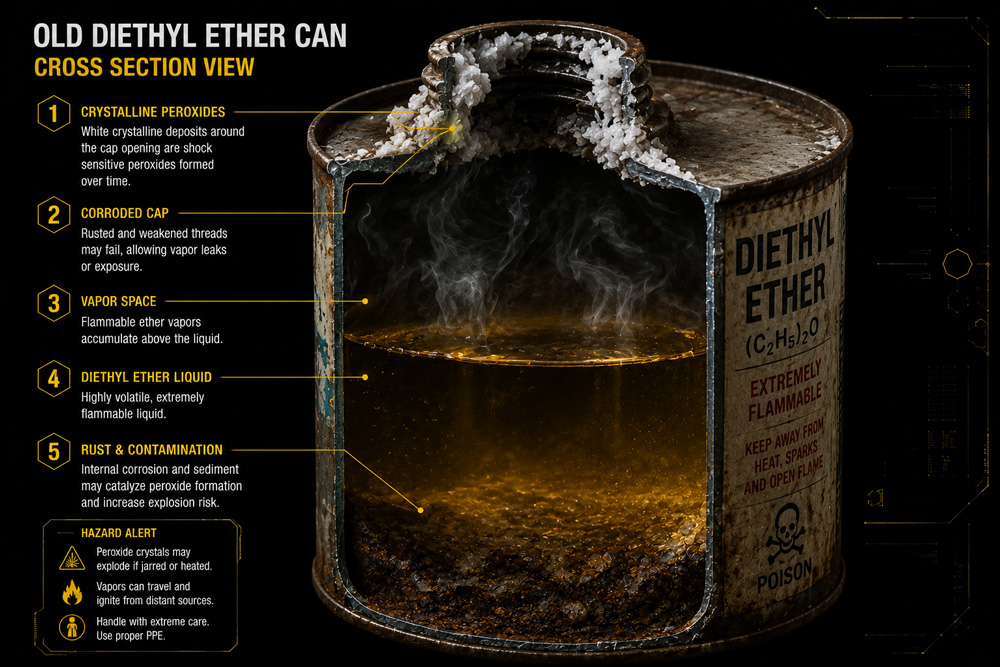
Diethyl ether, also known as ethyl ether, is a highly flammable peroxide-forming chemical. During storage, diethyl ether can react with oxygen to form unstable organic peroxides (crystal peroxides). The hazard can increase when ether is repeatedly exposed to air or when evaporation or distillation concentrates the less-volatile peroxide compounds.
Old, deteriorated, or improperly managed ether containers require special caution. Crystals, films, discoloration, deposits around a closure, or other unexplained residues should be treated as warning signs of a potentially hazardous condition. A container with visible abnormalities or an unknown storage history should not be opened or disturbed merely to determine whether peroxides are present.
Diethyl ether is also an extremely flammable liquid whose vapors can form ignitable mixtures with air. Proper management therefore requires controlling both its flammability hazard and its potential for peroxide formation.
Prevention begins with proper chemical inventory control, dating containers when received and opened, following manufacturer and facility requirements, minimizing unnecessary storage, and ensuring that peroxide-forming chemicals are evaluated or removed before they become an unacceptable hazard.
Critical Safety Warning
Crystals, deposits, or unexplained residue on an ethyl ether container must be treated as a potential explosive-peroxide hazard. Do not open, move, shake, pour, scrape, test, or attempt to dispose of the container through normal chemical-waste procedures. Isolate the area, prevent unnecessary access, eliminate potential ignition sources when this can be done safely, and immediately notify the employer’s environmental health and safety representative, laboratory safety officer, fire department, or qualified hazardous-materials professional.
Diethyl ether can form shock-sensitive organic peroxides as it ages or is repeatedly exposed to air and light. When peroxide residues become concentrated—especially around the cap, threads, or inside a partially evaporated container—they may detonate from friction, impact, heat, or an attempt to open the container. The risk is not theoretical. A suspected peroxide-forming ether container should be handled as a potentially unstable explosive until evaluated and managed by qualified personnel.
What Should I Do?
| Condition | What It May Indicate | Recommended Action |
|---|---|---|
| Properly dated container within facility requirements | Normal inventory condition | Continue to follow the SDS and peroxide-forming chemical program |
| Old or unknown-age container | Peroxide history cannot be established | Do not use until evaluated under the facility's chemical safety procedure |
| Significant solvent evaporation | Possible concentration of less-volatile peroxides | Stop and obtain qualified EHS or chemical-safety evaluation |
| Crystals, deposits, film, or unexplained residue | Potentially hazardous container condition | Do not open, shake, scrape, or disturb the container |
| Material around the cap or threads | Potentially hazardous contamination or residue | Do not attempt to open the closure; isolate and report it |
| Unknown abandoned ether container | Storage and peroxide history cannot be verified | Leave undisturbed and contact qualified EHS or hazardous-materials personnel |
Key Takeaways
- Ethyl ether, also known as diethyl ether, is a highly flammable solvent that can form explosive peroxides during storage.
- Exposure to air and light can promote peroxide formation, especially in containers that are old, repeatedly opened, improperly stored, or partially evaporated.
- Peroxide residues may appear as crystals, films, deposits around the cap, or material at the bottom of a container.
- Visible crystals or residue should be treated as a serious warning sign; do not open, move, pour, shake, scrape, or attempt to dispose of the container through normal procedures.
- Diethyl ether vapors are heavier than air and can travel to an ignition source, creating a flash-fire or explosion hazard.
- Ether containers should be dated when received and when first opened, then managed according to the manufacturer’s expiration guidance and the employer’s peroxide-forming chemical program.
- Storage should minimize exposure to heat, ignition sources, and light while keeping containers tightly closed and segregated from incompatible materials.
- Peroxide testing and disposal decisions should be performed under an established chemical safety procedure by trained, authorized personnel.
- Suspected high-risk containers should be isolated and referred to environmental health and safety personnel or a qualified hazardous-materials contractor.
- Training, inventory control, inspection, and prompt disposal are the most effective ways to prevent crystallized ether from becoming an explosive hazard.

What is Ethyl Ether?
Diethyl ether, commonly called ethyl ether or simply ether, is a highly volatile and extremely flammable organic solvent used in laboratories, research facilities, chemical processing, and other industrial applications.
In addition to its significant flammability hazard, diethyl ether belongs to an important group of chemicals known as peroxide-forming chemicals. These substances can react with oxygen during storage to form organic peroxides.
Because the peroxide compounds are generally less volatile than diethyl ether itself, evaporation or distillation can concentrate them. An aging or partially evaporated container may therefore present hazards that were not present when the material was originally received.
Why Does Diethyl Ether Form Peroxides?
Diethyl ether can undergo autoxidation, a reaction with oxygen that can produce organic peroxide compounds during storage. Exposure to air, repeated opening, storage conditions, and time can contribute to peroxide formation.
The hazard becomes particularly important because diethyl ether is highly volatile while peroxide compounds are considerably less volatile. As ether evaporates—or is intentionally concentrated during processes such as distillation—the peroxide concentration can increase.
For this reason, diethyl ether is commonly classified by laboratory safety programs as a peroxide former presenting a concentration hazard.
Visible crystallization, films, discoloration, deposits around a closure, or other unusual conditions should not be used by an untrained employee to diagnose the chemistry inside a container. Instead, they should be treated as warning signs requiring evaluation under an established peroxide-forming chemical or environmental health and safety program.
Why Peroxide Formation Makes Old Diethyl Ether Dangerous
When ethyl ether peroxides go unnoticed, they turn into ticking time bombs. Here’s why crystallized ethyl ether is one of the most dangerous hazards in chemical storage:
1. Unpredictable Explosions
Unlike many other hazardous chemicals, which require specific conditions to ignite, ethyl ether peroxides can explode with the slightest disturbance. Several recorded accidents have occurred when someone unknowingly handled a peroxide-laden bottle.
2. Difficult to Detect
Crystallized peroxides don’t always form visible deposits. Sometimes, they appear as a thin, barely noticeable layer at the bottom or inside the cap. Without proper testing, there’s no easy way to tell whether an old bottle of ethyl ether is a routine solvent or an explosive device.
3. High Fatality Risk
A peroxide explosion is not just a fire hazard—it is a violent detonation. In multiple cases, researchers and laboratory staff have suffered life-threatening burns, amputations, and even death due to mishandling crystallized ethyl ether. The energy released can shatter glass, ignite nearby flammables, and send lethal shrapnel flying.
4. Dangerous Waste Disposal
Disposing of ethyl ether is extremely hazardous if peroxide formation is suspected. If someone attempts to pour it down a drain or transport it to a disposal site, the slightest friction could set off a devastating explosion.
U.S. EPA Laboratory – National Analytical Radiation Environmental Laboratory (NAREL)
During environmental work at a U.S. EPA laboratory, I encountered an old container of ether with suspicious material around the closure. The condition of the container immediately raised concerns, so I did not attempt to open, move, clean, or otherwise disturb it.
After consulting a senior environmental professional, the potential severity of the peroxide-forming hazard became clear. Local authorities were contacted, and bomb-squad personnel ultimately took control of the container for disposal.
The experience reinforced an important lesson that applies to peroxide-forming chemicals generally: you do not need to identify an abnormal deposit before deciding to stop work. An aging chemical container with an unknown history and suspicious physical condition is sufficient reason to stop handling it and obtain qualified assistance.
Chemical safety depends as much on recognizing when not to proceed as it does on knowing how a chemical normally behaves.
How to Prevent Ethyl Ether Peroxide Disasters
There is no room for complacency when handling ethyl ether. A simple mistake could trigger an explosion powerful enough to level a room. Here’s how to ensure safety:
✅ Store in Small Quantities – Purchase only as much ethyl ether as needed and use it promptly to avoid long-term storage risks.
✅ Check for Inhibitors – Some suppliers add butylated hydroxytoluene (BHT) to ethyl ether to prevent peroxide formation. Always confirm whether your ether contains an inhibitor.
✅ Use Light-Blocking Containers – Store ethyl ether in sealed, amber-colored glass bottles to limit light exposure and slow down oxidation.
✅ Label Clearly – Every bottle should have dates of purchase and opening prominently displayed. Never use ether that has been stored for over six months without testing.
✅ Test for Peroxides Regularly – Use peroxide test strips to check stored ethyl ether, especially if it’s been in storage for more than a few months. If peroxide levels are high, the ether should be neutralized and disposed of professionally.
✅ Dispose of Suspicious Ether Safely – If you suspect a bottle has peroxide buildup:
- DO NOT MOVE OR OPEN IT.
- Clear the area immediately.
- Contact hazardous materials professionals for safe disposal.
The Bottom Line: Don’t Disturb a Suspicious Ether Container
Diethyl ether presents two significant hazards: it is an extremely flammable solvent, and it can form unstable organic peroxides during storage.
The most effective way to control the peroxide hazard is prevention—proper purchasing, dating, storage, inventory control, inspection, testing when appropriate, and timely disposal.
When an old or unknown ether container shows crystals, deposits, discoloration, leakage, deterioration, or other unusual conditions, employees should not attempt to determine the hazard by opening or manipulating the container.
Stop work. Keep the container undisturbed. Restrict access and obtain qualified environmental health and safety or hazardous-materials assistance.
Diethyl-ether Peroxide Hazard Profile
| Property | Diethyl Ether |
|---|---|
| Chemical name | Diethyl ether |
| Also called | Ethyl ether, ether |
| CAS number | 60-29-7 |
| Primary physical hazard | Extremely flammable |
| Additional hazard | Peroxide formation |
| Peroxide category | Concentration hazard |
| Hazard increases during | Evaporation/distillation |
| Warning signs | Deposits, residue, crystals, unknown age |
| Suspected dangerous container | Do not disturb |
Common Peroxide-Forming Solvents
| Chemical | Peroxide Concern |
|---|---|
| Diethyl ether | Peroxides can become hazardous when concentrated |
| Tetrahydrofuran (THF) | Peroxide formation/concentration |
| 1,4-Dioxane | Peroxide formation/concentration |
| Glymes | Peroxide formation/concentration |
| Isopropyl ether | Particularly hazardous peroxide former |
Frequently Asked Questions
What is crystallized ethyl ether?
Crystallized ethyl ether refers to ether that may contain concentrated peroxide residues or deposits formed during storage. These deposits can develop when diethyl ether reacts with oxygen over time, particularly when the solvent is exposed to air and light or allowed to partially evaporate.
Why is crystallized ethyl ether dangerous?
Diethyl ether is highly flammable on its own, but peroxide residues can be unstable and potentially sensitive to heat, friction, shock, or movement. A container with suspected peroxide crystals may present an explosion hazard if it is opened, moved, poured, or handled improperly.
Does all old ethyl ether contain explosive crystals?
No. Age alone does not confirm that a container contains dangerous peroxide deposits. However, older containers, containers stored beyond the manufacturer’s recommended period, and containers with visible residue or crystals should be treated as potentially hazardous until evaluated through an established chemical safety process.
What do ether peroxide crystals look like?
Peroxide contamination may appear as crystals, a white or yellowish deposit, a film inside the bottle, residue around the cap or threads, or material at the bottom of the container. Not all peroxide contamination is visible, so the absence of crystals does not prove that ether is safe to use.
What should employees do if crystals are visible on an ether container?
Employees should stop work, avoid touching or opening the container, keep the area clear, and notify their supervisor, laboratory manager, environmental health and safety department, or other designated safety authority. The container should not be moved or handled as routine chemical waste.
Can ethyl ether be poured down a drain if it is old or contaminated?
No. Ethyl ether should never be poured down a drain. Suspected peroxide-forming ether requires evaluation and disposal through an approved hazardous-waste process. Attempting to pour, transfer, or transport a potentially contaminated container can create a serious fire or explosion hazard.
How does diethyl ether form peroxides?
Diethyl ether can slowly react with oxygen in air to form peroxide compounds. Light, heat, long storage periods, repeated opening, and evaporation can increase the likelihood that peroxide residues will form or become concentrated.
How should ethyl ether be stored?
Ethyl ether should be stored in a tightly closed container, away from heat, sparks, flames, and other ignition sources. Employers should follow the manufacturer’s Safety Data Sheet, date containers when received and opened, protect them from unnecessary light exposure, and maintain an inventory system that prevents excessive storage time.
Should ethyl ether be tested for peroxides?
Employers should follow their written peroxide-forming chemical program, manufacturer guidance, and applicable institutional procedures for testing and disposal. Testing should only be performed by trained and authorized personnel using an approved method. A container with visible crystals, cap deposits, or other signs of possible high peroxide concentration should not be opened merely for routine testing.
What training is important for employees who use ethyl ether?
Employees should receive Hazard Communication training and task-specific instruction on flammability, peroxide formation, proper storage, labeling, inventory control, spill response, emergency procedures, and when to stop work and notify qualified safety personnel.
Is ethyl ether only a laboratory hazard?
No. Although it is commonly associated with laboratories, diethyl ether may also be used in manufacturing, chemical processing, research, maintenance, and other industrial operations. Any workplace that stores or uses ether should manage its flammability and peroxide-forming hazards.
Why are inventory control and disposal dates important?
Inventory control helps prevent ether from remaining in storage long enough for peroxide hazards to develop. Dating containers when received and opened, reviewing them routinely, and disposing of materials before they exceed approved storage periods are essential preventive measures.
Sources
Emergency Response and Preparedness
OSHA HAZWOPER Hands-on Training Requirement
Medical Surveillance Requirements
U.S. Occupational Safety and Health Administration
https://www.osha.gov/laws-regs/standardinterpretations/1992-08-27-1
U.S. Environmental Protection Agency
https://www.epa.gov/laws-regulations/summary-resource-conservation-and-recovery-act
Related Articles
Building a HAZWOPER Safety Culture
HAZWOPER Hands-on Training Discussions with U.S. OSHA
About the Author
This article was written by Clay A. Bednarz, MS, RPIH, founder of National Environmental Trainers® and OSHACode®. Bednarz pioneered the first commercial online HAZWOPER training programs in 1998 and has supported major hazardous waste operations, environmental remediation projects, and emergency response training initiatives nationwide.