
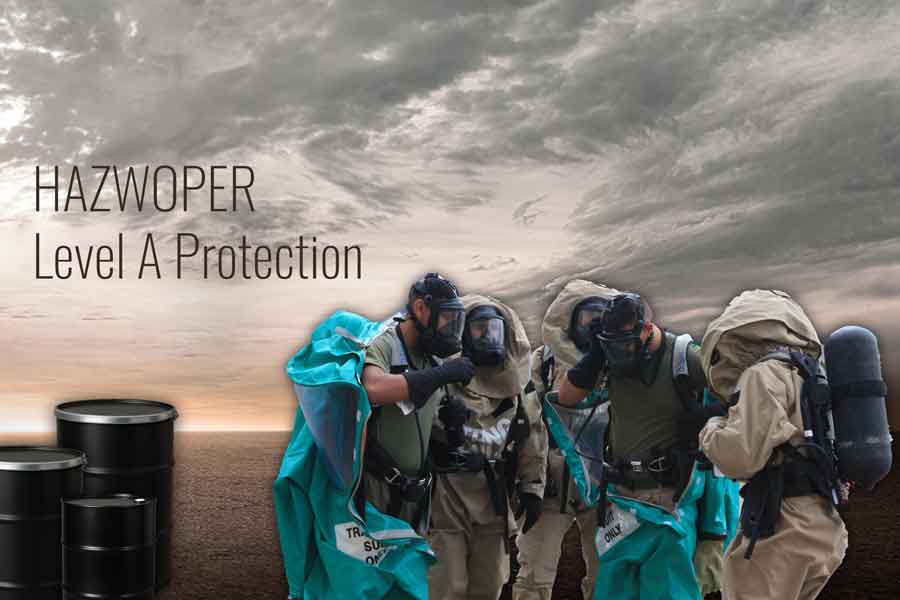
OSHA HAZWOPER Level A PPE: The Ultimate Protection
In hazardous waste operations and emergency response, workers may encounter unknown or highly toxic chemicals, vapors, and particulates. In these cases, only the highest level of personal protective equipment (PPE) is acceptable. Under OSHA’s HAZWOPER standard (29 CFR 1910.120), this is classified as Level A PPE.
Level A ensembles represent the gold standard of protection—designed for life-threatening conditions where exposure to even a small amount of contamination could be fatal.
What Is Level A PPE?
Level A PPE is a fully encapsulating, vapor-tight chemical protective suit worn with a self-contained breathing apparatus (SCBA). Together, they provide maximum respiratory and dermal protection.
Unlike other PPE levels, Level A creates a complete barrier, isolating the worker from the external environment. No skin or respiratory pathways are exposed, and the SCBA is worn inside the suit to prevent contamination of life-support equipment.
Required Components of Level A PPE
Per OSHA and EPA guidelines, a compliant Level A ensemble includes:
- Fully encapsulating chemical-resistant suit
- One-piece, gas-tight construction
- Resistant to permeation by a wide range of chemicals
- Clear visor for vision and face protection
- Self-Contained Breathing Apparatus (SCBA)
- Worn inside the suit
- Provides Grade D breathing air from compressed cylinders
- Typically lasts 30–60 minutes depending on workload
- Glove System
- Inner chemical-resistant gloves
- Outer protective gloves of different material
- Taped and sealed at the suit interface
- Chemical-Resistant Boots
- Often steel-toe and shank reinforced
- Worn under or over suit, sealed at the ankles
- Two-Way Communication System
- Radios or voice amplification for team coordination
- Optional Cooling Devices
- Cooling vests or forced-air systems to reduce heat stress
When Is Level A PPE Required?
Level A is required when:
-
Hazardous substances are unidentified at a spill or emergency scene.
-
Airborne contaminants are present at concentrations above IDLH (Immediately Dangerous to Life or Health) levels.
-
Substances are known or suspected carcinogens, mutagens, or highly toxic agents.
-
Chemicals are present that can be readily absorbed through the skin.
-
Work involves major spills, leaks, or confined areas where vapor concentration is extreme.
Examples:
-
Cyanide gas release
-
Nerve agents or pesticide spills
-
Unknown chemical drums at abandoned sites
-
Industrial accidents involving highly volatile solvents
Challenges and Risks of Level A PPE
Although protective, Level A ensembles present serious operational challenges:
-
Heat Stress – Workers rapidly overheat inside vapor-tight suits.
-
Mobility Restrictions – Bulky suits reduce dexterity, flexibility, and range of motion.
-
Visibility Limitations – Fogging and visor curvature reduce visual clarity.
-
Short Work Duration – Limited by SCBA air supply (often < 45 minutes).
-
Communication Difficulties – Voice transmission is muffled, requiring radios.
-
Complex Donning and Doffing – Requires trained attendants to prevent contamination breaches.
Because of these challenges, Level A is used only when no lesser level provides adequate protection.
Level A in HAZWOPER Training
Under OSHA HAZWOPER training requirements:
-
Workers learn the differences between PPE Levels A–D, with special emphasis on when Level A is required.
-
Training covers donning and doffing procedures, emergency evacuation, and equipment inspection.
-
Site-specific drills are mandated: employers must provide hands-on practice with the exact PPE models (suits, SCBA, communication systems) used in the field.
-
Annual refresher training reinforces proper usage and safety protocols.
OSHACode integrates detailed Level A PPE instruction into its 40-Hour HAZWOPER course supported by interactive modules, realistic diagrams, and knowledge checks.
Why Level A PPE Is Critical
Level A protection represents the last line of defense between workers and catastrophic chemical exposure. By understanding its components, limitations, and application, organizations ensure their teams are prepared for worst-case scenarios.
Investing in proper training and site-specific drills not only ensures compliance but also demonstrates a commitment to the safety and survival of workers in the most hazardous environments.
Conclusion
OSHA HAZWOPER Level A PPE is the most protective gear available for hazardous waste operations and emergency response. It is required when contaminants are unknown, airborne toxins exceed safe limits, or chemicals pose extreme skin absorption hazards.
Through comprehensive training programs, like those offered at OSHACode, workers gain the knowledge and confidence to use Level A PPE effectively—making it a cornerstone of both compliance and workplace safety culture.
Learn more about our HAZWOPER training program to ensure your workforce is prepared for the most dangerous situations.
Sources
Emergency Response and Preparedness
OSHA HAZWOPER Hands-on Training Requirement
Medical Surveillance Requirements
U.S. Occupational Safety and Health Administration
https://www.osha.gov/laws-regs/standardinterpretations/1992-08-27-1
U.S. Environmental Protection Agency
https://www.epa.gov/laws-regulations/summary-resource-conservation-and-recovery-act
Related Articles
Building a HAZWOPER Safety Culture
Hands-on Training Discussions with U.S. OSHA
