
Summary
HAZWOPER does not apply to every job involving hazardous materials or hazardous chemicals. OSHA’s Hazardous Waste Operations and Emergency Response (HAZWOPER) standard applies to specific operations involving hazardous waste cleanup, hazardous waste treatment, storage, and disposal facilities (TSDFs), and emergency response to releases or substantial threats of hazardous substances. Determining whether HAZWOPER applies depends on the employee’s job duties, the type of work being performed, the potential for hazardous substance exposure, and the applicable section of OSHA’s standard. Understanding when HAZWOPER applies helps employers select the appropriate training, implement required safety programs, and maintain compliance with OSHA regulations while protecting workers from hazardous substance exposures.
Key Takeaways
- HAZWOPER applies only to specific operations covered by OSHA’s Hazardous Waste Operations and Emergency Response standard (29 CFR 1910.120), not every workplace that uses hazardous chemicals.
- The standard generally covers hazardous waste cleanup operations, hazardous waste TSDFs, and emergency response to releases or substantial threats of hazardous substances.
- Employers must evaluate employee job duties, potential exposures, and work activities to determine whether HAZWOPER training is required.
- Workers performing routine hazardous chemical tasks may require OSHA Hazard Communication training rather than HAZWOPER training, depending on their responsibilities.
- Employees at uncontrolled hazardous waste sites often require 24-Hour or 40-Hour HAZWOPER training based on their level of exposure and assigned duties.
- Emergency responders must receive training appropriate to their response level, from First Responder Awareness through Incident Commander, when responding to hazardous substance releases.
- Employers remain responsible for providing site-specific training, practical instruction, and supervised field experience where required by the standard.
- HAZWOPER compliance extends beyond training and includes hazard assessments, Health and Safety Plans (HASP), air monitoring, personal protective equipment (PPE) selection, medical surveillance, and emergency planning.
- Understanding when HAZWOPER applies helps organizations avoid unnecessary training while ensuring employees performing covered operations receive the protection required by OSHA.
- When there is uncertainty, employers should carefully review OSHA’s scope and application provisions to determine whether their operations fall within the HAZWOPER standard.
Five Groups Covered Under the HAZWOPER Standard
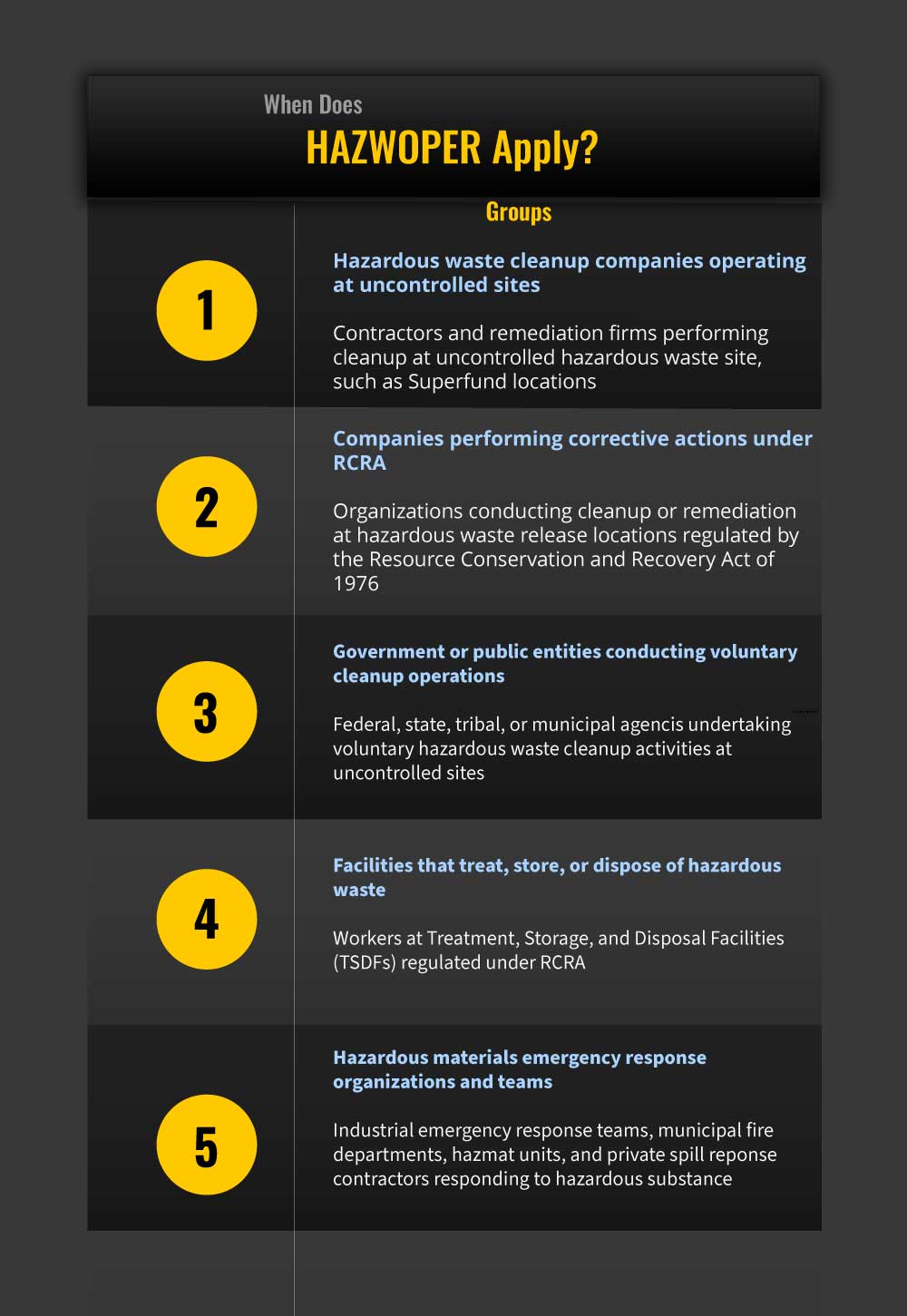
Under the Occupational Safety and Health Administration (OSHA) regulation 29 CFR 1910.120, there are five groups that employers and employees must comply with the HAZWOPER standard. These types of operations are where workers may be exposed to hazardous substances during cleanup, corrective actions, voluntary cleanup operations, emergency response, or hazardous waste management.
Group 1. Hazardous waste cleanup companies operating at uncontrolled sites
This includes contractors and environmental remediation firms that perform cleanup at abandoned facilities, spill zones, Superfund sites, brownfields, or any location classified as an uncontrolled hazardous waste site. Cleanup operations performed inside a controlled manufacturing facility are typically not covered by HAZWOPER unless uncontrolled contamination exists.
Group 2. Companies performing corrective actions under the Resource Conservation and Recovery Act (RCRA)
Organizations that conduct cleanup, remediation, or corrective action at hazardous waste release locations regulated by the Resource Conservation and Recovery Act (RCRA) of 1976 fall under HAZWOPER requirements, especially when responding to leaks, spills, or contamination events.
Group 3. Government or public entities conducting voluntary cleanup operations
Federal, state, tribal, or municipal agencies that voluntarily undertake hazardous waste cleanup activities at uncontrolled sites must follow HAZWOPER procedures to ensure worker protection and regulatory compliance.
Group 4. Facilities that treat, store, or dispose of hazardous waste (TSDFs)
Workers at TSDFs regulated under RCRA are covered by HAZWOPER under 29 CFR 1910.120(p), which requires initial and annual training for employees who handle or may be exposed to hazardous waste.
Group 5. Hazardous materials (HAZMAT) emergency response organizations and teams
This includes industrial emergency response teams, municipal fire departments, HAZMAT response units, and private spill response contractors who respond to the release or potential release of hazardous substances. These operations are governed by 29 CFR 1910.120(q) and require specialized initial training and ongoing competency.
Quick Summary Table
| Covered Operation | When HAZWOPER May Apply | OSHA Reference |
|---|---|---|
| Uncontrolled Hazardous Waste Sites | Cleanup operations where employees may encounter hazardous substances, contaminated soil, drums, tanks, or other uncontrolled waste conditions. | 29 CFR 1910.120(a)(1)(i) |
| RCRA Corrective Action Sites | Remediation work performed to address hazardous waste releases at facilities subject to corrective action requirements. | 29 CFR 1910.120(a)(1)(ii) |
| Government-Recognized Voluntary Cleanups | Voluntary cleanup operations at uncontrolled hazardous waste sites that are recognized by a federal, state, local, or other government body. | 29 CFR 1910.120(a)(1)(iii) |
| Hazardous Waste TSDF Operations | Work at treatment, storage, and disposal facilities where employees handle, process, store, or manage hazardous waste. | 29 CFR 1910.120(p) |
| Emergency Response Operations | Response to releases or substantial threats of releases of hazardous substances, including spills, leaks, fires, explosions, and chemical emergencies. | 29 CFR 1910.120(q) |
Frequently Asked Questions
When does HAZWOPER apply?
HAZWOPER applies when employees perform operations covered by OSHA’s Hazardous Waste Operations and Emergency Response standard (29 CFR 1910.120). These include hazardous waste cleanup operations, work at hazardous waste TSDFs, and emergency response to releases or substantial threats of hazardous substances.
Does HAZWOPER apply to every employee who works with hazardous chemicals?
No. Many employees who work with hazardous chemicals require OSHA Hazard Communication training rather than HAZWOPER training. HAZWOPER applies only when employee duties fall within the scope of OSHA’s Hazardous Waste Operations and Emergency Response standard.
Does HAZWOPER apply to hazardous waste cleanup sites?
Yes. Employees involved in government-required cleanup operations, corrective actions, or recognized voluntary cleanup activities at uncontrolled hazardous waste sites are generally covered by HAZWOPER.
Does HAZWOPER apply to hazardous waste treatment, storage, and disposal facilities (TSDFs)?
Yes. Employees who work at hazardous waste treatment, storage, and disposal facilities regulated under applicable EPA requirements may be covered by the TSDF provisions of OSHA’s HAZWOPER standard.
Does HAZWOPER apply to emergency responders?
Yes. HAZWOPER applies to employees who respond to releases or substantial threats of releases of hazardous substances as part of an organized emergency response. OSHA establishes different training requirements based on each responder’s role and responsibilities.
Does HAZWOPER apply to construction projects?
It can. Construction activities involving hazardous waste cleanup or emergency response may fall under OSHA’s HAZWOPER requirements. Whether the standard applies depends on the nature of the work being performed and the employee’s assigned duties.
Who determines whether HAZWOPER training is required?
The employer is responsible for evaluating workplace operations, employee job duties, potential exposures, and regulatory requirements to determine whether HAZWOPER training applies to specific employees.
What level of HAZWOPER training do employees need?
The required training depends on the employee’s responsibilities and potential exposure. Covered workers may require 24-Hour HAZWOPER, 40-Hour HAZWOPER, TSDF training, or emergency response training based on OSHA’s requirements.
Does online HAZWOPER training satisfy OSHA requirements?
Yes. OSHA permits the knowledge-based portion of HAZWOPER training to be completed online when it meets the requirements of the standard. Employers remain responsible for providing any required site-specific instruction, supervised field experience, and practical training appropriate to the employee’s duties.
What is the difference between HAZWOPER and Hazard Communication?
Hazard Communication applies broadly to employees who work with hazardous chemicals in the workplace, while HAZWOPER applies to specific hazardous waste operations and emergency response activities covered by OSHA’s Hazardous Waste Operations and Emergency Response standard. Employees may require one or both types of training depending on their job responsibilities.
What employer responsibilities accompany HAZWOPER?
In addition to providing appropriate training, employers may be required to develop site-specific HASPs, perform hazard assessments, implement air monitoring, provide PPE, establish decontamination procedures, maintain medical surveillance programs, and prepare emergency response plans.
Why is understanding when HAZWOPER applies important?
Correctly determining whether HAZWOPER applies helps employers provide the appropriate level of worker protection, comply with OSHA regulations, avoid unnecessary training, and ensure employees receive the knowledge and practical instruction needed to safely perform hazardous waste operations and emergency response activities.
Become HAZWOPER Certified Today!
Ready to begin your own HAZWOPER training? Start your certification today with our courses. We are industry professionals with decades of field experience who know the job firsthand!
Sources
Emergency Response and Preparedness
OSHA HAZWOPER Hands-on Training Requirement
Medical Surveillance Requirements
U.S. Occupational Safety and Health Administration
https://www.osha.gov/laws-regs/standardinterpretations/1992-08-27-1
U.S. Environmental Protection Agency
https://www.epa.gov/laws-regulations/summary-resource-conservation-and-recovery-act
Related Articles
Building a HAZWOPER Safety Culture
Hands-on Training Discussions with U.S. OSHA