
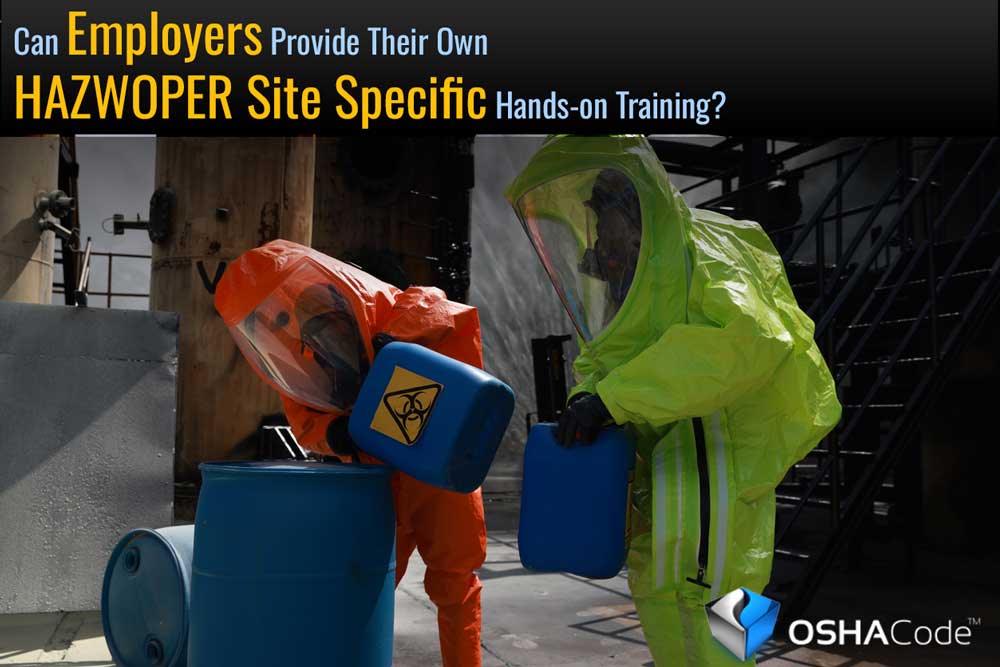
Can Employers Provide Their Own HAZWOPER Hands-On Training?
OSHA Requirements for Site-Specific Field Experience Explained
Yes, employers may provide their own Hazardous Waste Operations and Emergency Response (HAZWOPER) hands-on training — but only when that training is site-specific, supervised by qualified personnel, and directly tied to the hazards of the actual worksite. This distinction is critical. The Occupational Safety and Health Administration (OSHA) does not simply require “hands-on” experience; it requires site-specific hands-on training and field experience that prepares workers for the real conditions they will face at hazardous waste sites.
Failure to understand this requirement is one of the most common and most cited HAZWOPER violations during OSHA inspections.
OSHA’s HAZWOPER Hands-On Requirement Is Site-Specific by Design
Under OSHA’s HAZWOPER standard, 29 CFR 1910.120, employees performing hazardous waste operations must complete both formal instruction and supervised field experience before being permitted to work independently. For general site workers under 1910.120(e), this includes 40 hours or 24 hours of initial training followed by a minimum of three days of supervised, hands-on field experience or one day of supervised training for the 24 hour course.
OSHA intentionally designed this requirement to be site-specific, (29 CFR 1910.120 Appendix E) because no two hazardous waste sites present the same combination of chemical hazards, physical hazards, PPE requirements, environmental conditions, or emergency response challenges. A generic demonstration or classroom simulation does not satisfy OSHA’s expectation. Workers must gain hands-on experience that reflects the actual hazards, materials, and procedures at their assigned site.
What “Site-Specific” Hands-On Training Means to OSHA
Site-specific HAZWOPER hands-on training means that employees physically perform job tasks in an environment that mirrors the conditions of the site where they will work, while under the direct supervision of an experienced and qualified individual. OSHA expects this training to be aligned with the site’s Health and Safety Plan (HASP) and hazard assessment.
This training typically includes hands-on practice with the exact PPE ensembles required at the site, including Levels A, B, C, or D as applicable. Workers must demonstrate the ability to properly don and doff PPE, perform equipment checks, recognize PPE limitations, and respond to equipment failures. Site-specific training also includes using the same air-monitoring instruments, decontamination procedures, work zone controls, and communication protocols used at the site.
OSHA compliance officers routinely ask: “Was the hands-on training specific to this site, or was it generic?” Employers who cannot clearly demonstrate site relevance are often cited.
Who Can Conduct Site-Specific HAZWOPER Hands-On Training?
OSHA does not require employers to outsource hands-on training to third-party providers. However, OSHA does require that hands-on training be supervised by someone with adequate training, experience, and authority. While the HAZWOPER standard does not explicitly use the term “competent person,” the expectation mirrors that definition.
The individual overseeing site-specific hands-on training must have completed the appropriate level of HAZWOPER training themselves (typically the 40-hour HAZWOPER with current 8-hour refreshers) and must have direct experience with hazardous waste site operations. Most importantly, they must understand the specific hazards of the site, the HASP, and the control measures in place.
Simply assigning a supervisor without relevant field experience or site knowledge does not meet OSHA’s intent.
Why Generic Hands-On Training Is Not Enough
One of the most common HAZWOPER compliance failures occurs when employers rely on generic or off-site demonstrations that do not reflect actual site conditions. OSHA does not consider watching demonstrations, shadowing workers without participation, or completing mock exercises unrelated to the site as sufficient.
For example, hands-on training conducted at a clean training facility may not be adequate if workers will be exposed to confined spaces, unstable terrain, chemical vapors, temperature extremes, or complex decontamination setups at the actual site. OSHA expects workers to experience and practice controls for the hazards they will actually encounter, not theoretical ones.
Documentation of Site-Specific Hands-On Training Is Critical
OSHA places significant emphasis on documentation when evaluating HAZWOPER compliance. Employers must be able to demonstrate that site-specific hands-on training occurred and that it was supervised by a qualified individual. Documentation should include the location of training, the tasks performed, the hazards addressed, the name and qualifications of the supervisor, and the dates of supervised field experience.
Records that simply state “completed 3 days hands-on training” without referencing site conditions or tasks are often viewed as inadequate. OSHA expects documentation to clearly show how the training prepared the worker for the specific site.
How Online HAZWOPER Training Fits Into Site-Specific Requirements
Online HAZWOPER courses can be an effective way to deliver the initial instructional portion of training, but they cannot replace site-specific hands-on field experience. OSHA allows employers to combine online instruction with employer-provided, site-specific hands-on training, provided all requirements are met.
This blended approach is commonly used and fully compliant when implemented correctly. Online training covers regulatory knowledge, hazard recognition principles, and theoretical concepts, while employer-provided hands-on training addresses site-specific hazards, equipment, and procedures. OSHA evaluates the program as a whole, not just the delivery method.
Best Practices for OSHA-Compliant Site-Specific Hands-On Training
To meet OSHA expectations, employers should integrate hands-on training directly into site onboarding and pre-entry procedures. Training should follow a structured checklist derived from the HASP and should require workers to demonstrate competence in critical tasks before working independently.
Supervisors should actively observe performance, correct unsafe behaviors, and document completion. Treating hands-on training as a formal, site-specific qualification process — rather than an informal observation period — significantly reduces compliance risk.
Final Answer: Can Employers Provide Their Own HAZWOPER Hands-On Training?
Yes, employers are allowed to provide their own HAZWOPER hands-on training, but only when that training is site-specific, supervised by qualified personnel, aligned with the HASP, and properly documented. Generic or non-site-specific hands-on training does not meet OSHA’s intent and frequently results in citations.
Employers who understand and implement true site-specific HAZWOPER hands-on training not only achieve compliance, but also significantly improve worker safety at hazardous waste sites.
Become HAZWOPER Certified Today!
Looking for OSHA-compliant HAZWOPER training that integrates seamlessly with site-specific hands-on field experience? OSHACode’s online HAZWOPER courses are designed to support employer-provided, site-specific training under 29 CFR 1910.120.
Sources
Emergency Response and Preparedness
OSHA HAZWOPER Hands-on Training Requirement
Medical Surveillance Requirements
U.S. Occupational Safety and Health Administration
https://www.osha.gov/laws-regs/standardinterpretations/1992-08-27-1
U.S. Environmental Protection Agency
https://www.epa.gov/laws-regulations/summary-resource-conservation-and-recovery-act
Related Articles
Building a HAZWOPER Safety Culture
Hands-on Training Discussions with U.S. OSHA