
Summary
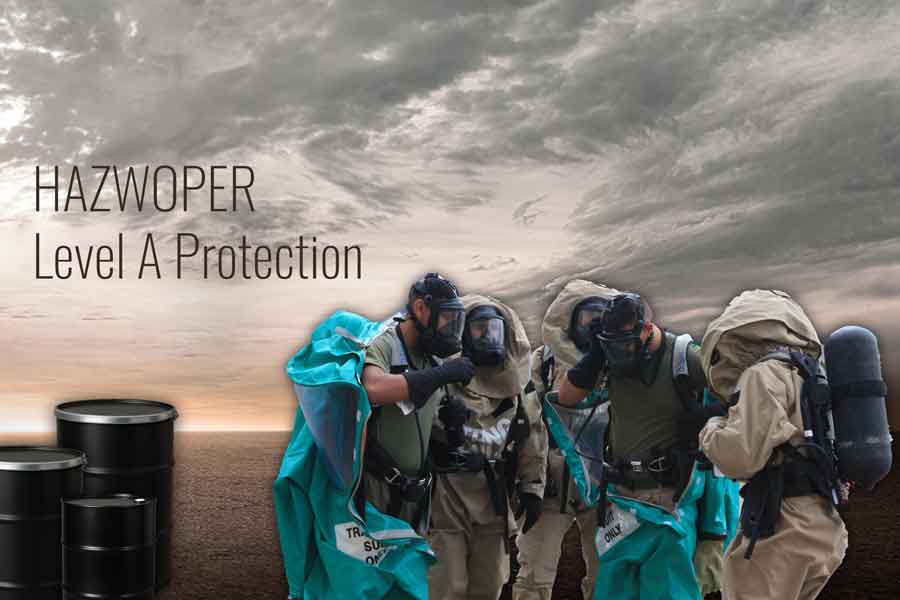
Level A PPE is the highest level of personal protective equipment used in HAZWOPER operations when workers need maximum protection from hazardous substances that may threaten the respiratory system, skin, eyes, and mucous membranes. It is commonly selected when the chemical hazard is unknown, concentrations may be high, skin contact could cause serious harm, or vapors and liquids may penetrate lesser protective ensembles.
A typical Level A ensemble includes a totally encapsulating chemical-protective suit, a positive-pressure self-contained breathing apparatus (SCBA), chemical-resistant inner and outer gloves, chemical-resistant boots, and other accessories needed for the task. The suit is designed to provide a high level of protection against vapor, liquid, splash, and particulate contamination, but it does not make a worker invulnerable. Suit material, seams, closures, gloves, boots, and equipment must be compatible with the specific hazard.
Level A Personal Protective Equipment (PPE) should be selected through a documented hazard assessment and used only by trained workers operating under a site-specific Health and Safety Plan. Workers must understand the limits of the ensemble, respirator use, communications, heat-stress controls, work-time limits, emergency procedures, and decontamination sequence. The Occupational Safety and Health Administration (OSHA) describes Level A protection as appropriate when the highest available level of respiratory, skin, and eye protection is required.
Key Takeaways
- Level A PPE provides the highest available level of respiratory, skin, eye, and mucous-membrane protection for hazardous-materials work.
- It is commonly used when hazards are unknown, concentrations are high, skin exposure may be dangerous, or vapors and liquids could penetrate lesser protective clothing.
- A typical Level A ensemble includes a totally encapsulating chemical-protective suit and positive-pressure SCBA.
- PPE selection must be based on hazard assessment, contaminant information, exposure potential, monitoring data, and chemical compatibility—not on appearance or a generic rule.
- Level A PPE is often selected at the beginning of an unknown-hazard operation and may be downgraded only after site characterization and monitoring support a lower level of protection.
- A Level A suit protects only as well as its material, seams, closures, gloves, boots, visor, and interface points.
- Positive-pressure SCBA is used because air-purifying respirators may not protect workers in unknown, oxygen-deficient, IDLH, or high-concentration atmospheres.
- Level A PPE can create significant heat stress, fatigue, communication difficulty, limited visibility, and reduced mobility.
- Workers need hands-on training with the actual ensemble, including inspection, donning, doffing, communications, emergency procedures, and decontamination.
- A trained attendant and site-specific decontamination procedure are essential because removing Level A PPE can create a secondary-exposure hazard.
- Level A PPE does not replace engineering controls, air monitoring, site control, emergency planning, medical surveillance, or safe work practices.
- Employers must evaluate whether Level A protection remains appropriate as site conditions, contaminants, work tasks, and monitoring results change.
Level A PPE Components and Their Purpose
| Level A PPE Component | Primary Purpose | What Must Be Evaluated | Important Limitation |
|---|---|---|---|
| Totally Encapsulating Chemical-Protective Suit | Provides a high level of protection against chemical vapor, liquid splash, particulates, and skin contact hazards. | Chemical compatibility, permeation resistance, degradation, seams, visor, closures, suit size, mobility, and task duration. | No suit material protects against every chemical or exposure condition indefinitely. |
| Positive-Pressure SCBA | Supplies breathable air independent of the surrounding atmosphere. | Air supply duration, cylinder pressure, facepiece fit, regulator operation, emergency procedures, and respiratory-protection program requirements. | Air duration is limited and may be reduced by heat, exertion, stress, and workload. |
| Chemical-Resistant Inner and Outer Gloves | Protect hands from direct contact, contamination, and potential breakthrough. | Chemical resistance, glove thickness, dexterity, cuff interface, puncture resistance, and compatibility with tools and tasks. | Gloves can tear, degrade, or allow chemical breakthrough without obvious warning. |
| Chemical-Resistant Boots | Protect feet and lower legs from contaminated surfaces, liquids, and debris. | Chemical resistance, slip resistance, puncture protection, boot-to-suit interface, and terrain conditions. | Boots may not protect against every corrosive, sharp, hot, or slippery condition. |
| Hard Hat or Protective Helmet | Provides head protection when overhead, impact, or site conditions require it. | Compatibility with the suit, SCBA, work area, and task-specific head hazards. | A helmet must not interfere with suit integrity, facepiece seal, visibility, or mobility. |
| Two-Way Communications | Helps workers communicate with attendants, supervisors, and emergency personnel. | Audibility, compatibility with PPE, battery life, intrinsically safe requirements, and emergency signals. | Speech can be difficult to understand inside a fully encapsulating suit and SCBA facepiece. |
When Is Level A PPE Typically Selected?
| Site Condition or Hazard | Why Level A May Be Needed | What Must Happen Before Downgrading PPE |
|---|---|---|
| Unknown chemical hazard | Workers may face unknown respiratory and skin hazards before characterization is complete. | Identify the hazard, evaluate exposure routes, confirm chemical compatibility, and use monitoring data to support a lower protection level. |
| Potential for severe skin or eye injury | Corrosive, toxic, or skin-absorbed substances may require maximum skin and mucous-membrane protection. | Confirm the contaminant, concentration, contact potential, and protective performance of the proposed lower-level ensemble. |
| IDLH or potentially oxygen-deficient atmosphere | Air-purifying respirators are not appropriate for unknown, oxygen-deficient, or IDLH atmospheres. | Verify oxygen concentration, airborne contaminants, exposure levels, respirator capability, and emergency-response arrangements. |
| High vapor or liquid-contact potential | Vapors and liquids may contact exposed skin or penetrate lesser protective clothing. | Use site characterization, monitoring, task analysis, and chemical-permeation information to verify a lower level provides adequate protection. |
| Emergency entry or initial reconnaissance | Conditions may be changing rapidly and reliable hazard information may not yet be available. | Establish hazard information, incident objectives, monitoring results, site control, and a documented PPE-selection decision. |
Level A PPE Ensemble

SCBA Diagram

OSHA HAZWOPER Level A PPE: The Ultimate Protection
In hazardous waste operations and emergency response, workers may encounter unknown or highly toxic chemicals, vapors, and particulates. In these cases, only the highest level of PPE is acceptable. Under OSHA’s HAZWOPER standard (29 CFR 1910.120), this is classified as Level A PPE.
Level A ensembles represent the gold standard of protection—designed for life-threatening conditions where exposure to even a small amount of contamination could be fatal.
What Is Level A PPE?
Level A PPE is a fully encapsulating, vapor-tight chemical protective suit worn with an SCBA. Together, they provide maximum respiratory and dermal protection.
Unlike other PPE levels, Level A creates a complete barrier, isolating the worker from the external environment. No skin or respiratory pathways are exposed, and the SCBA is worn inside the suit to prevent contamination of life-support equipment.
Required Components of Level A PPE
Per OSHA and Environmental Protection Agency (EPA) guidelines, a compliant Level A ensemble includes:
- Fully encapsulating chemical-resistant suit
- One-piece, gas-tight construction
- Resistant to permeation by a wide range of chemicals
- Clear visor for vision and face protection
- SCBA
- Worn inside the suit
- Provides Grade D breathing air from compressed cylinders
- Typically lasts 30–60 minutes depending on workload
- Glove System
- Inner chemical-resistant gloves
- Outer protective gloves of different material
- Taped and sealed at the suit interface
- Chemical-Resistant Boots
- Often steel-toe and shank reinforced
- Worn under or over suit, sealed at the ankles
- Two-Way Communication System
- Radios or voice amplification for team coordination
- Optional Cooling Devices
- Cooling vests or forced-air systems to reduce heat stress
When Is Level A PPE Required?
Level A is required when:
-
Hazardous substances are unidentified at a spill or emergency scene.
-
Airborne contaminants are present at concentrations above IDLH (Immediately Dangerous to Life or Health) levels.
-
Substances are known or suspected carcinogens, mutagens, or highly toxic agents.
-
Chemicals are present that can be readily absorbed through the skin.
-
Work involves major spills, leaks, or confined areas where vapor concentration is extreme.
Examples:
-
Cyanide gas release
-
Nerve agents or pesticide spills
-
Unknown chemical drums at abandoned sites
-
Industrial accidents involving highly volatile solvents
Challenges and Risks of Level A PPE
Although protective, Level A ensembles present serious operational challenges:
-
Heat Stress – Workers rapidly overheat inside vapor-tight suits.
-
Mobility Restrictions – Bulky suits reduce dexterity, flexibility, and range of motion.
-
Visibility Limitations – Fogging and visor curvature reduce visual clarity.
-
Short Work Duration – Limited by SCBA air supply (often < 45 minutes).
-
Communication Difficulties – Voice transmission is muffled, requiring radios.
-
Complex Donning and Doffing – Requires trained attendants to prevent contamination breaches.
Because of these challenges, Level A is used only when no lesser level provides adequate protection.
Level A in HAZWOPER Training
Under OSHA HAZWOPER training requirements:
-
Workers learn the differences between PPE Levels A–D, with special emphasis on when Level A is required.
-
Training covers donning and doffing procedures, emergency evacuation, and equipment inspection.
-
Site-specific drills are mandated: employers must provide hands-on practice with the exact PPE models (suits, SCBA, communication systems) used in the field.
-
Annual refresher training reinforces proper usage and safety protocols.
OSHACode® integrates detailed Level A PPE instruction into its 40-Hour HAZWOPER course supported by interactive modules, realistic diagrams, and knowledge checks.
Why Level A PPE Is Critical
Level A protection represents the last line of defense between workers and catastrophic chemical exposure. By understanding its components, limitations, and application, organizations ensure their teams are prepared for worst-case scenarios.
Investing in proper training and site-specific drills not only ensures compliance but also demonstrates a commitment to the safety and survival of workers in the most hazardous environments.
Conclusion
OSHA HAZWOPER Level A PPE is the most protective gear available for hazardous waste operations and emergency response. It is required when contaminants are unknown, airborne toxins exceed safe limits, or chemicals pose extreme skin absorption hazards.
Through comprehensive training programs, like those offered at OSHACode®, workers gain the knowledge and confidence to use Level A PPE effectively—making it a cornerstone of both compliance and workplace safety culture.
Learn more about our HAZWOPER training program (40 Hour HAZWOPER, 24 Hour HAZWOPER, and 8 Hour HAZWOPER Refresher) to ensure your workforce is prepared for the most dangerous situations.
Prepare Your Team for High-Hazard Work
Level A PPE is used when workers may face unknown, highly hazardous, or potentially life-threatening chemical exposures. Effective protection requires more than selecting a fully encapsulating suit and SCBA—it requires hazard assessment, air monitoring, hands-on PPE practice, site control, decontamination planning, medical readiness, and clear emergency procedures.
OSHACode® HAZWOPER training helps workers and supervisors build the knowledge needed to recognize hazardous conditions, understand PPE selection, and support safer decisions in hazardous waste operations.
Explore OSHACode® HAZWOPER Training and strengthen your team’s readiness for high-hazard work.
Sources
Emergency Response and Preparedness
OSHA HAZWOPER Hands-on Training Requirement
Medical Surveillance Requirements
U.S. Occupational Safety and Health Administration
https://www.osha.gov/laws-regs/standardinterpretations/1992-08-27-1
U.S. Environmental Protection Agency
https://www.epa.gov/laws-regulations/summary-resource-conservation-and-recovery-act
Related Articles
Building a HAZWOPER Safety Culture
Hands-on Training Discussions with U.S. OSHA