
Summary
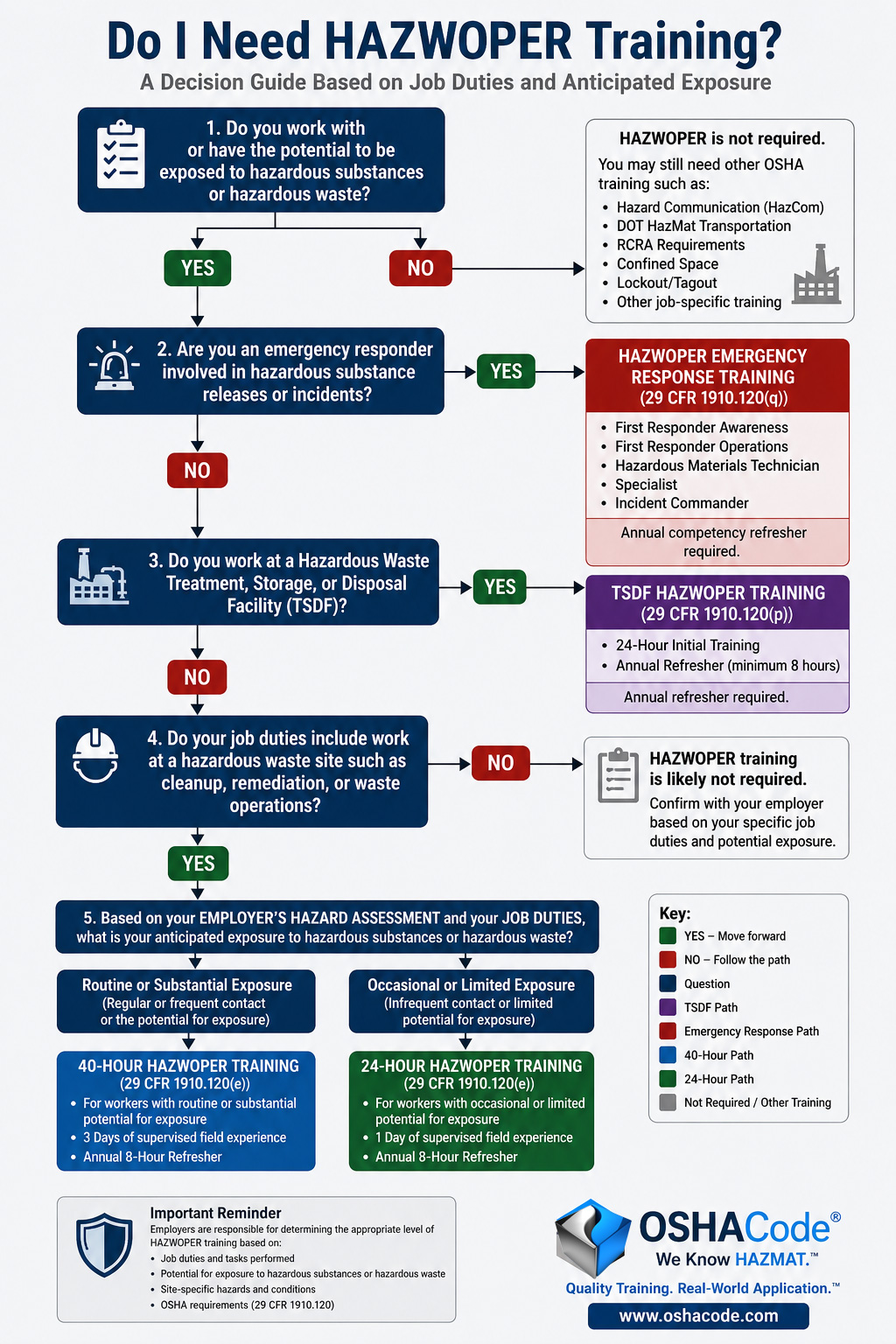
Not every worker is required to complete HAZWOPER training. OSHA requires HAZWOPER training only for employees whose job duties fall within specific hazardous waste operations or emergency response activities covered by 29 CFR 1910.120. Whether you need HAZWOPER depends on the type of work you perform, your potential exposure to hazardous substances, and your employer’s hazard assessment—not simply your job title. Employees working at hazardous waste cleanup sites, hazardous waste treatment, storage, and disposal facilities (TSDFs), or responding to hazardous substance releases are among those who commonly require HAZWOPER training. Understanding which training level applies helps employers remain compliant while ensuring workers receive the knowledge necessary to perform their jobs safely.
Key Takeaways
- HAZWOPER training is job-duty specific, not job-title specific.
- OSHA requires HAZWOPER only for employees performing work covered by 29 CFR 1910.120.
- Workers at hazardous waste cleanup sites typically require either 24-hour or 40-hour HAZWOPER training.
- Employees working at hazardous waste Treatment, Storage, and Disposal Facilities (TSDFs) require TSDF-specific HAZWOPER training.
- Emergency responders handling hazardous substance releases fall under OSHA’s HAZWOPER emergency response requirements.
- Many workers handling chemicals do not require HAZWOPER but may require Hazard Communication (HazCom), DOT HazMat, RCRA, or other OSHA training.
- Employers are responsible for determining the appropriate training based on the workplace hazard assessment.
- When in doubt, consult your employer’s safety manager, project specifications, or applicable OSHA regulations before selecting a course.
Do You Need HAZWOPER?
| Job or Activity | HAZWOPER Required? | Typical Training |
|---|---|---|
| Hazardous waste cleanup site worker | Yes | 24-Hour or 40-Hour HAZWOPER |
| Routine hazardous waste site worker | Yes | 40-Hour HAZWOPER |
| TSDF employee | Yes | TSDF HAZWOPER |
| Emergency responder to hazardous substance releases | Yes | HAZWOPER Emergency Response |
| Truck driver transporting hazardous materials | Usually No | DOT HazMat Training |
| General manufacturing employee | Usually No | HazCom or other applicable OSHA training |
Which HAZWOPER Course Is Right for You?
| Course | Who It's For | Field Requirement |
|---|---|---|
| 40-Hour HAZWOPER | Workers with routine or substantial hazardous waste exposure | Three days of supervised field experience |
| 24-Hour HAZWOPER | Workers with occasional or limited exposure | One day of supervised field experience |
| 8-Hour Refresher | Workers maintaining an existing HAZWOPER qualification | No additional field experience |
Do I Need HAZWOPER Training?
When I started my new job as an Engineer with an environmental consulting firm, one of the first unfamiliar terms I heard was HAZWOPER. Everyone around me seemed to know what it meant except me. I soon discovered that it stands for Hazardous Waste Operations and Emergency Response, a safety regulation created by the Occupational Safety and Health Administration (OSHA) under 29 CFR 1910.120. At first, it sounded complicated and I felt awkward, but I quickly realized that it’s really about one thing—protecting workers like me who may encounter hazardous substances on the job.
My supervisor explained that HAZWOPER training is required for all employees who work around hazardous waste, at contaminated sites, or during emergency response operations. Depending on the type of work and the potential exposure, OSHA requires specific training levels. For example, the 40 Hour HAZWOPER Training is designed for general site workers, the 24 Hour HAZWOPER Course applies to occasional site workers with limited exposure, and the 8 Hour HAZWOPER Refresher must be completed annually to maintain certification. These three job classifications are under 29 CFR 1910.120 (e) for general site workers. I learned the other job classifications come under 29 CFR 1910.120 (q) for emergency response personnel and 29 CFR 1910.120 (p) for operators at hazardous waste treatment, storage and disposal facilities.
My occupation as an Engineer required me to visit contaminated sites to do various tasks. Because my work actvities were short in duration, I was required to take the 24 Hour version.
HAZWOPER Training Topics
As I went through my training, I learned about hazard recognition, personal protective equipment (PPE), air monitoring, decontamination procedures, and emergency response actions. There are 17 sections to the training and I found the content to be of interest. I began to understand that safety isn’t just about compliance—it’s about knowledge. The course covered topics like toxicology, confined space entry, and proper use of PPE, giving me the confidence to respond safely if I encountered a a problem at a contaminated site.
Now that I’m certified, I see how this training applies to my everyday work. When I’m assisting at a contaminated site, I know how to protect myself and my coworkers from exposure. The certification also adds credibility to my role—it shows that I’m trained to meet OSHA’s requirements and prepared for emergencies that could endanger health or the environment.
Looking back, learning what HAZWOPER means was a turning point for me. It’s more than a regulatory requirement—it’s a safety culture. Being properly trained means I’m part of a workforce that values preparedness, protection, and prevention. Every day, I use what I learned to help make my job site safer and more compliant with OSHA standards. And, that’s a good thing.
Jobs That Often Require HAZWOPER
- Environmental Consultants
- Remediation Contractors
- Hazardous Waste Cleanup Workers
- Brownfield Workers
- Superfund Workers
- Emergency Responders
- Fire Departments
- Industrial Emergency Teams
- Hazardous Waste Facility Personnel
- Environmental Engineers
- Decontamination Specialists
Jobs That Usually Do NOT Require HAZWOPER
Examples
- Office workers
- Retail employees
- Most warehouse workers
- General manufacturing employees
- Office laboratory support
- Delivery drivers
- Landscapers
Note: They may still require OSHA training—but not necessarily HAZWOPER.
Still Not Sure?
If you’re asking whether you need HAZWOPER training, you’re asking the right question. The answer depends on your job duties, potential exposure to hazardous substances, and your employer’s hazard assessment—not simply your job title. OSHA requires employers to determine the appropriate level of training for employees covered by the HAZWOPER standard.
Frequently Asked Questions
How do I know if I need HAZWOPER training?
Review your job duties and your employer’s hazard assessment. If you work at a hazardous waste cleanup site, TSDF, or respond to hazardous substance releases, HAZWOPER may apply.
Is HAZWOPER based on my job title?
No. OSHA requirements are based on the work you perform and your potential exposure to hazardous substances, not your job title.
Do construction workers need HAZWOPER?
Sometimes. Construction workers assigned to contaminated sites or hazardous waste cleanup projects may require HAZWOPER training depending on their duties.
Do truck drivers need HAZWOPER?
Most commercial drivers transporting hazardous materials require DOT HazMat training rather than HAZWOPER. Drivers participating in hazardous waste cleanup or emergency response operations may have additional training requirements.
What’s the difference between the 24-hour and 40-hour HAZWOPER courses?
The 40-hour course is intended for workers with routine or substantial exposure to hazardous waste, while the 24-hour course is generally for employees with occasional or limited exposure.
Does online HAZWOPER training meet OSHA requirements?
The knowledge-based portion may be completed online when offered by a qualified provider. Employers must still provide required site-specific instruction and any applicable supervised field experience.
Who decides which HAZWOPER course I need?
Your employer determines the appropriate level of training based on OSHA requirements, the site’s hazard assessment, and your assigned duties.
If I’m unsure, should I take the 40-hour course?
Don’t guess. Speak with your employer or project manager first. Taking more training than necessary is not always required, and taking the wrong course may not satisfy your employer’s needs.
Find the Right Training—Not Just More Training
Choosing the correct HAZWOPER course begins with understanding what your job requires. Whether you need 24-Hour HAZWOPER, 40-Hour HAZWOPER, TSDF training, or an annual refresher depends on your work responsibilities, potential exposure, and your employer’s hazard assessment.
OSHACode® offers comprehensive online HAZWOPER training designed to help workers, supervisors, contractors, and employers understand OSHA requirements while building practical knowledge that can be applied in the field. Our courses clearly explain who needs training, which course is appropriate, and how employers can complete the required site-specific instruction and supervised field experience.
Select the training that matches your responsibilities, satisfies regulatory requirements, and prepares you to work safely in hazardous environments.