
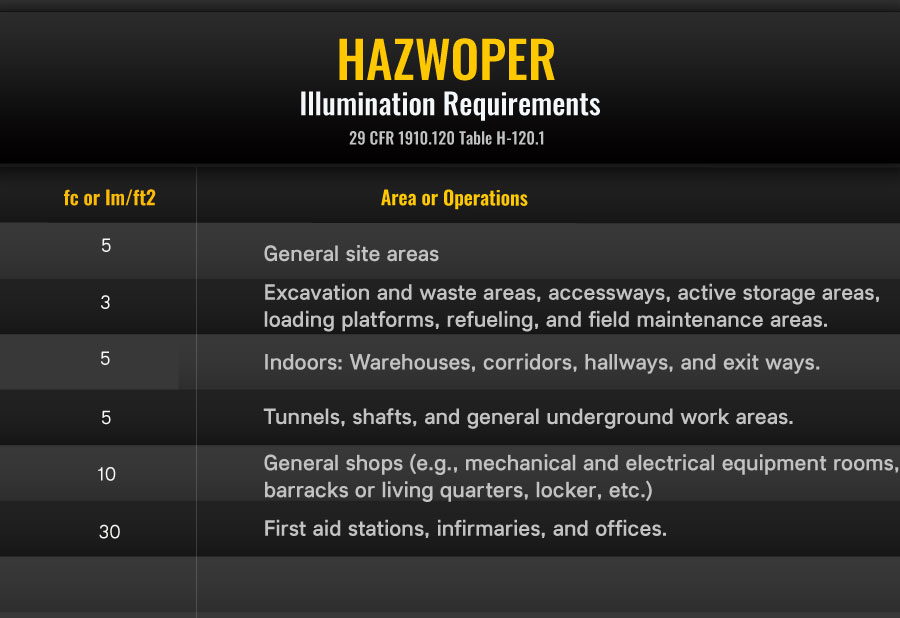
OSHA’s Hazardous Waste Operations and Emergency Response (HAZWOPER) standard (29 CFR 1910.120) includes lighting requirements to ensure worker safety in hazardous environments. These requirements align with the general construction illumination standards found in 29 CFR 1926.56, which specify minimum illumination levels in different work zones.
1. Minimum Illumination Levels
The regulations mandates minimum lighting levels, measured in foot-candles (fc), for different work environments. A foot-candle is a unit that measures light intensity, specifically the amount of light falling on a surface.
| Work Area | Minimum Illumination (Foot-Candles, fc) |
|---|---|
| General construction areas, warehouses, corridors | 5 fc |
| Excavation sites and underground work areas | 5 fc |
| Tunnels, shafts (except those with workers in specific tasks) | 5 fc |
| Active storage areas, loading platforms | 3 fc |
| First aid stations, infirmaries, medical areas | 30 fc |
| Hazardous waste cleanup sites (handling of dangerous substances, decontamination areas) | 10 fc |
2. Lighting Considerations
A. Importance of Adequate Lighting
Proper illumination is critical at HAZWOPER sites to:
- Prevent slips, trips, and falls in hazardous environments.
- Allow workers to identify hazardous substances and warning labels.
- Improve visibility during emergency response situations.
- Ensure accurate readings of instrumentation and controls.
- Support proper execution of tasks such as material handling and decontamination.
B. Portable and Emergency Lighting
In many situations, fixed lighting may not be feasible. In these cases, OSHA requires portable lighting to maintain safe illumination levels. Common types include:
- Explosion-proof lighting for areas with flammable vapors or gases.
- Waterproof lighting for wet or decontamination zones.
- Battery-powered emergency lights for power outages or remote locations.
Additionally, backup power sources (such as generators or battery-operated lighting) should be available to ensure continued illumination in case of electrical failure.
C. Electrical Safety Considerations
Since hazardous waste sites may involve flammable or combustible materials, lighting must comply with OSHA’s electrical standards (29 CFR 1910 Subpart S) and the National Electrical Code (NEC):
- Use intrinsically safe or explosion-proof lighting in areas with flammable gases or vapors.
- Electrical wiring and lighting fixtures should be rated for hazardous locations (Class I, Division 1 or 2 per NEC).
- Temporary lighting must be properly insulated and protected from damage.
3. Special Lighting Needs for Night Operations
If site operations extend into nighttime or low-light conditions, additional artificial lighting is required. OSHA recommends:
- Using high-intensity floodlights for outdoor night work.
- Providing localized task lighting for precision work.
- Ensuring lighting is angled to minimize glare and shadows that could obscure hazards.
4. Compliance and Best Practices
To meet the illumination requirements and ensure worker safety:
- Conduct Light Level Assessments – Use a light meter to verify compliance with the required foot-candle levels.
- Ensure Lighting Does Not Create Shadows or Glare – Poor placement can lead to visibility hazards.
- Provide Portable or Task-Specific Lighting – If general lighting is insufficient, supplement with appropriate portable lights.
- Maintain and Inspect Lighting Equipment Regularly – Ensure bulbs, fixtures, and power sources are in good condition.
- Use Emergency Lighting for Power Outages – OSHA requires backup lighting systems to ensure safe egress and continued operations.
- Train Workers on Proper Lighting Use and Safety – Employees should understand the importance of adequate lighting and how to use supplemental lighting safely.
Sources
U.S. Occupational Safety and Health Administration
Emergency Response and Preparedness
OSHA HAZWOPER Hands-on Training Requirement
Medical Surveillance Requirements
https://www.osha.gov/laws-regs/standardinterpretations/1992-08-27-1
Related Articles
Building a HAZWOPER Safety Culture
Hands-on Training Discussions with U.S. OSHA
PPE Importance in HAZWOPER Operations