
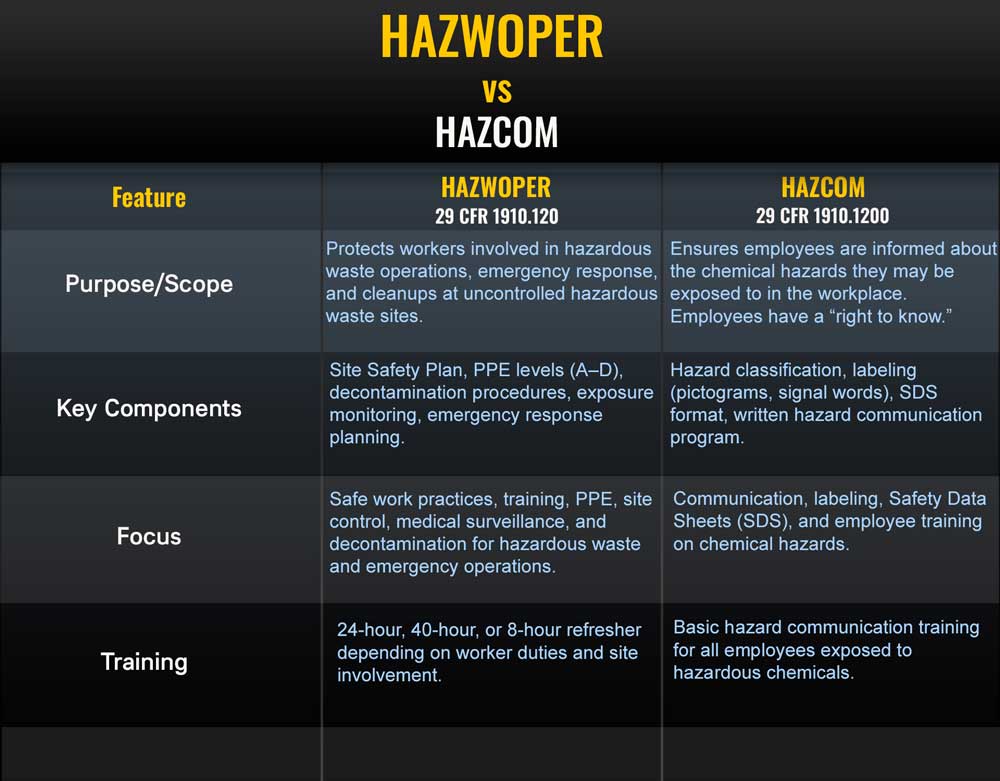
HAZWOPER: Field-Based Hazard Protection
While both HAZWOPER vs HAZCOM fall under OSHA’s regulatory framework, they serve distinct but complementary roles in protecting workers from chemical and hazardous material exposures. The Hazardous Waste Operations and Emergency Response (HAZWOPER) standard (29 CFR 1910.120) was created to protect workers engaged in hazardous waste operations, emergency response, and cleanup activities at uncontrolled hazardous waste sites. It focuses on site-specific hands-on safety practices, such as proper use of personal protective equipment (PPE), decontamination procedures, site control, and medical surveillance. Workers covered under HAZWOPER—such as cleanup crews, hazardous waste site employees, and emergency responders—are required to complete 24-hour or 40-hour initial training, followed by annual 8-hour refresher courses, ensuring they remain competent in identifying hazards and responding safely during high-risk operations.
HAZCOM: “Right-to-Know”
In contrast, the Hazard Communication Standard (HAZCOM, 29 CFR 1910.1200) is often referred to as OSHA’s “Right-to-Know” rule, designed to ensure that all employees understand the hazards associated with the chemicals they work with on a daily basis. Rather than focusing on field operations, HAZCOM emphasizes information, labeling, and communication—requiring employers to maintain Safety Data Sheets (SDS), ensure proper labeling of containers with pictograms and hazard warnings, and provide employee training on chemical hazards and safe handling practices. The goal of HAZCOM is awareness—so that every worker, whether in manufacturing, construction, or a laboratory, can recognize chemical dangers before an accident occurs.
HAZWOPER and HAZCOM: Interconnected
Despite their differences in scope and intensity, HAZWOPER vs HAZCOM are deeply interconnected. In essence, HAZCOM builds the knowledge base, while HAZWOPER builds the practical response skills. HAZCOM provides the knowledge foundation—workers learn how to read an SDS, understand toxicity data, and identify symbols and hazard classes. HAZWOPER then builds on that knowledge through applied safety training, teaching workers what to do when chemical hazards are uncontrolled or emergencies occur. In essence, HAZCOM teaches you what the hazard is, while HAZWOPER teaches you how to confront it safely. Together, they form a complete continuum of chemical safety—one that begins with awareness and ends with action.
Both standards share a common goal: preventing injury, illness, and environmental damage caused by hazardous substances. Yet their difference lies in context—HAZCOM lives in the laboratory, the warehouse, and the factory floor; HAZWOPER lives in the hot zone, the spill site, and the emergency perimeter. When employers integrate both standards effectively, they don’t just comply with OSHA—they create a workforce that is informed, prepared, and capable of responding to any hazard with confidence.
Summary
If your organization handles hazardous substances, ensure your employees are trained and certified through OSHA-compliant courses. At OSHACode.com we offer online HAZWOPER 24-Hour, 40-Hour, and 8-Hour Refresher programs, as well as Hazard Communication training—each designed to meet or exceed OSHA standards and prepare your workforce for real-world safety challenges.
Become HAZWOPER Certified Today!
Ready to begin your own HAZWOPER training? Start your certification today with our courses. We are industry professionals with decades of field experience who know the job firsthand!
Sources
Emergency Response and Preparedness
OSHA HAZWOPER Hands-on Training Requirement
Medical Surveillance Requirements
U.S. Occupational Safety and Health Administration
https://www.osha.gov/laws-regs/standardinterpretations/1992-08-27-1
U.S. Environmental Protection Agency
https://www.epa.gov/laws-regulations/summary-resource-conservation-and-recovery-act
Related Articles
Building a HAZWOPER Safety Culture
Hands-on Training Discussions with U.S. OSHA