APR Respirators for First Responders and HAZWOPER Professionals
Summary
Chemical, Biological, Radiological, and Nuclear (CBRN) respirators are specialized respiratory protective devices designed to protect emergency responders and other personnel from highly hazardous airborne contaminants. Unlike standard industrial air-purifying respirators, CBRN respirators are tested against a broad spectrum of chemical warfare agents, toxic industrial chemicals, biological aerosols, and radioactive particulates. While they provide exceptional respiratory protection in known atmospheres with adequate oxygen, they must never be used in oxygen-deficient or Immediately Dangerous to Life or Health (IDLH) environments, where a pressure-demand Self-Contained Breathing Apparatus (SCBA) is required. CBRN is regulated by 29 CFR 1910.120(q) for emergency responders which is part of the Hazardous Waste Operations and Emergency Response (HAZWOPER) regulations.
Key Takeaways
- CBRN stands for Chemical, Biological, Radiological, and Nuclear.
- CBRN respirators are designed for first responders, HAZMAT teams, law enforcement, military personnel, and emergency management organizations.
- Most CBRN respirators are full-face air-purifying respirators (APR) equipped with specialized CBRN filter canisters.
- CBRN respirators require a known atmosphere with at least 19.5% oxygen.
- They are not appropriate for unknown or IDLH atmospheres.
- SCBAs remain the preferred respiratory protection for emergency entry into hazardous atmospheres.
- Proper fit testing, maintenance, cartridge replacement, and training are essential for effective protection.
What Is a CBRN Respirator?
A CBRN respirator is a specialized respiratory protective device designed to reduce inhalation exposure to hazardous airborne contaminants associated with chemical, biological, radiological, and nuclear incidents. These respirators are commonly used by:
- Hazardous Materials (HAZMAT) Teams
- Fire Departments
- Law Enforcement Tactical Teams
- Emergency Medical Services
- Homeland Security Personnel
- Military Organizations
- Industrial Emergency Response Teams
Unlike conventional industrial respirators, CBRN respirators undergo additional performance testing to demonstrate protection against a broad range of hazardous contaminants.
How Does a CBRN Respirator Work?
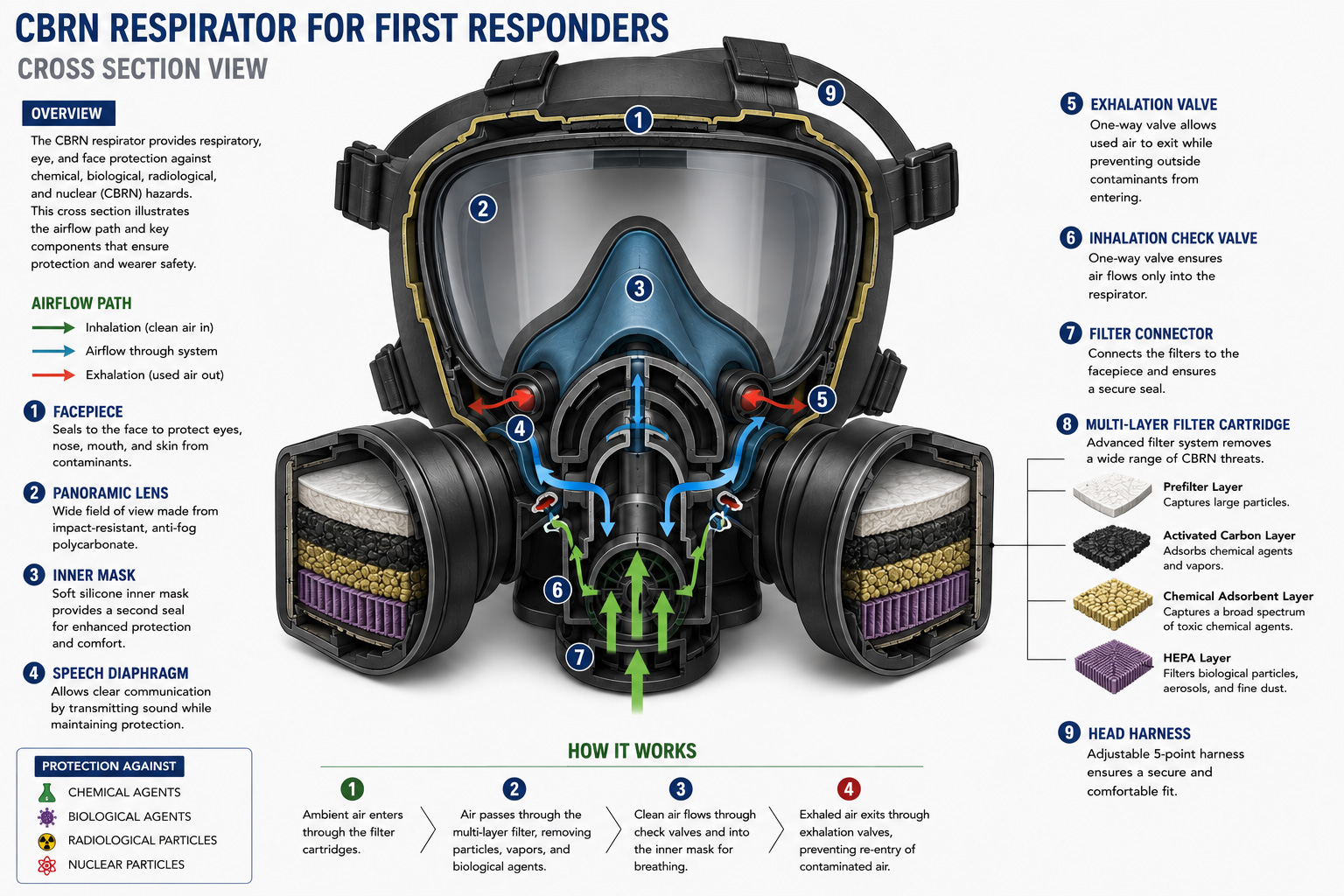
A CBRN respirator removes airborne contaminants through multiple filtration stages before clean air reaches the wearer.
Typical filtration includes:
- Pre-filter for larger particles
- High-efficiency particulate filtration
- Activated carbon adsorption
- Specialized chemical adsorbents
- Additional catalyst layers depending on the canister design
The respirator seals tightly against the wearer’s face, preventing contaminated air from bypassing the filtration system.
CBRN Respirator vs. SCBA
| Feature | CBRN APR | Pressure-Demand SCBA |
|---|---|---|
| Air Source | Filters surrounding air | Compressed breathing air cylinder |
| IDLH Use | No | Yes |
| Unknown Atmosphere | No | Yes |
| Typical Users | Law enforcement, emergency response, security personnel | HAZMAT teams, firefighters, confined-space rescue, hazardous waste operations |
| Breathing Air Supply | Dependent on surrounding atmosphere | Independent of surrounding atmosphere |
Typical CBRN Hazards
| Hazard Category | Examples | Primary Concern |
|---|---|---|
| Chemical | Toxic industrial chemicals, blister agents, nerve agents | Poisoning, burns, respiratory injury |
| Biological | Airborne pathogens, spores, biological aerosols | Infection and disease transmission |
| Radiological | Radioactive particulates | Internal contamination |
| Nuclear | Radioactive fallout and contaminated dust | Inhalation of radioactive particles |
Major Components
A typical CBRN respirator includes:
- Full-facepiece
- Panoramic impact-resistant lens
- Inner face seal
- Speaking diaphragm
- Inhalation valves
- Exhalation valve
- Five-point head harness
- Twin or single CBRN canister connection
- CBRN-approved filter canister
Typical CBRN Filter Construction
Most CBRN canisters include:
- Pre-filter
- HEPA filtration media
- Activated carbon
- Specialized chemical adsorbents
- Moisture barriers
- Particle retention media
Each layer removes different airborne hazards before air reaches the user.
Limitations
Even though CBRN respirators provide exceptional protection, they have important limitations.
They must not be used when:
- Oxygen concentration is below 19.5%
- Atmosphere is unknown
- Conditions are IDLH
- Contaminant concentrations exceed respirator capability
- Respirator does not fit properly
- Canister service life has expired
These situations require atmosphere-supplying respiratory protection.
Respirator Selection Process
The decision process generally follows this sequence:
- Identify the contaminant.
- Evaluate oxygen concentration.
- Determine whether the atmosphere is IDLH.
- Select appropriate respiratory protection.
- Verify cartridge approval.
- Fit test the respirator.
- Conduct user seal check.
- Continuously monitor atmospheric conditions.
Typical CBRN Applications
CBRN respirators are commonly used during:
- Terrorism response
- Chemical release investigations
- Suspicious powder incidents
- Industrial chemical accidents
- Hazardous material transportation accidents
- Biological incident response
- Radiation emergency operations
- Emergency decontamination activities
Training Requirements
Personnel should receive training covering:
- Respirator limitations
- Hazard recognition
- Cartridge selection
- Fit testing
- User seal checks
- Donning and doffing
- Decontamination
- Inspection
- Maintenance
- Emergency procedures
Training should be reinforced through regular exercises and hands-on practice.
Inspection Checklist
Before each use:
- Inspect facepiece
- Inspect lens
- Verify harness condition
- Inspect valves
- Check speaking diaphragm
- Verify canister expiration
- Check seals
- Conduct user seal check
After use:
- Clean respirator
- Inspect components
- Replace damaged parts
- Store in a clean, dry location
Common Mistakes
Avoid these common errors:
- Using a CBRN respirator in an IDLH atmosphere
- Wearing facial hair that interferes with the seal
- Using expired canisters
- Skipping fit testing
- Failing to perform a user seal check
- Assuming all respirator cartridges provide CBRN protection
- Ignoring atmospheric monitoring results
Be Prepared Before the Emergency Begins
Frequently Asked Questions
What does CBRN stand for?
CBRN stands for Chemical, Biological, Radiological, and Nuclear.
Can a CBRN respirator be used during a HAZWOPER emergency?
Yes, if the atmosphere is known, contains adequate oxygen, and is not IDLH. Unknown or IDLH atmospheres require a pressure-demand SCBA.
Are CBRN respirators the same as gas masks?
Many CBRN respirators resemble military gas masks, but civilian CBRN respirators are typically certified for occupational emergency response applications and use approved CBRN canisters.
How often should CBRN canisters be replaced?
Follow the manufacturer’s replacement schedule, expiration dates, and any established change-out program. Replace canisters immediately if damaged, contaminated, or after exposure as recommended.
Do CBRN respirators protect against radioactive materials?
They can reduce inhalation of airborne radioactive particulates when equipped with an approved CBRN canister, but they do not shield users from external radiation.
Can firefighters use CBRN respirators instead of SCBAs?
Not during structural firefighting, oxygen-deficient atmospheres, or IDLH conditions. Firefighters typically rely on pressure-demand SCBAs in these environments.
Do CBRN respirators require fit testing?
Yes. Tight-fitting respirators require medical evaluation, fit testing, training, inspection, maintenance, and user seal checks as part of a respiratory protection program.
What is the difference between a CBRN respirator and a Level A suit?
A CBRN respirator provides respiratory protection. A Level A ensemble provides the highest level of respiratory and skin protection and normally incorporates an SCBA.
Train Smarter with OSHACode
OSHACode provides online 24-Hour HAZWOPER, 40-Hour HAZWOPER, and 8-Hour Refresher training designed to help employers meet OSHA training requirements. Our courses support employer-provided site-specific and hands-on training programs while delivering flexible, self-paced instruction for today’s workforce.
OSHACode® — We Know HAZMAT™
Sources
Emergency Response and Preparedness
OSHA HAZWOPER Hands-on Training Requirement
Medical Surveillance Requirements
U.S. Occupational Safety and Health Administration
https://www.osha.gov/laws-regs/standardinterpretations/1992-08-27-1
U.S. Environmental Protection Agency
https://www.epa.gov/laws-regulations/summary-resource-conservation-and-recovery-act
Related Articles
Building a HAZWOPER Safety Culture
Hands-on Training Discussions with U.S. OSHA
About the Author
This article was written by Clay A. Bednarz, MS, RPIH, founder of National Environmental Trainers® and OSHACode®. Bednarz pioneered the first commercial online HAZWOPER training programs in 1998 and has supported major hazardous waste operations, environmental remediation projects, and emergency response training initiatives nationwide.